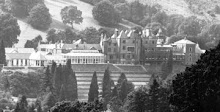
This has just appeared on the BBC Mid-Wales web-site:
"Very interesting project- I recently watched a programme on ABC tv about a farm set up in Molong in Australia for children brought out from the UK to have the chance of a better life in Australia after WW11. The abuses there were kept secret for so long, but for many a chance at healing the memories has begun.
Fri Dec 4 11:26:37 2009 "
Tuesday, December 22, 2009


Monday, December 21, 2009
Ivy Stokes - St Brides
I pick up the phone in Scotland. It's a call from Newport in South Wales and a lilting Welsh voice asks about St Brides.
It's Ivy Stokes, searching for her missing Welsh history, time spent as a child in this TB sanatorium on the Pembrokeshire coast.
Did I know of anyone there? She would love to be able to talk to someone who had shared her experiences.
Ivy was a patient Kensington hospital 1941-45 age 10 years.
I give her David Pearce's phone number . He runs a blog for ex-patients.
I do not normally carry stories about other sanatoriums but Ivy's account is so similar to the Craig-y-nos experience that I thought it worth telling it here although I am sure David will be running it on his blog too.
Ivy Stokes asked her granddaughter if she would help her search on the internet for Kensington Hospital.
“ I would love to meet someone who was there the same time as me,” says Ivy, age 77 from Newport.
“I was there as a 10 years old from 1941 for three and a half years. After I left my mother wouldn’t let me keep in contact with any of the other children. TB was all “ hush hush “ in those days and she was afraid of bringing it back into the house again.”
Now suffering form osteoporosis and arthritis she finds herself thinking about those early days as a child in plaster out on the balcony in Kensington hospital.
“I remember shivering from cold and how we used to pray for it to rain so that we would be wheeled back indoors again.”
She also remembers being strapped to the bed.
“ It was for my own good. It was to make me keep still”.
She remembers being in the Girl Guides, and the day World War 2 ended.
“There was a party. Everyone kept saying” the war has ended the war has ended.”
On returning home at 13 half years of age she went back to school for six months.
“ Nobody talked about TB then. It was all “ hush hush”. But it leaves a mark on you as a patient. I keep myself to myself. I am quiet. I am not a good mixer.
“I got a job in a factory sewing shirts. Then I got married and had two children. Now I have six grandchildren.”
If you were in Kensington in the early 1940s then Ivy would love to hear from you.
Her phone number is: 01633 768651
It's Ivy Stokes, searching for her missing Welsh history, time spent as a child in this TB sanatorium on the Pembrokeshire coast.
Did I know of anyone there? She would love to be able to talk to someone who had shared her experiences.
Ivy was a patient Kensington hospital 1941-45 age 10 years.
I give her David Pearce's phone number . He runs a blog for ex-patients.
I do not normally carry stories about other sanatoriums but Ivy's account is so similar to the Craig-y-nos experience that I thought it worth telling it here although I am sure David will be running it on his blog too.
Ivy Stokes asked her granddaughter if she would help her search on the internet for Kensington Hospital.
“ I would love to meet someone who was there the same time as me,” says Ivy, age 77 from Newport.
“I was there as a 10 years old from 1941 for three and a half years. After I left my mother wouldn’t let me keep in contact with any of the other children. TB was all “ hush hush “ in those days and she was afraid of bringing it back into the house again.”
Now suffering form osteoporosis and arthritis she finds herself thinking about those early days as a child in plaster out on the balcony in Kensington hospital.
“I remember shivering from cold and how we used to pray for it to rain so that we would be wheeled back indoors again.”
She also remembers being strapped to the bed.
“ It was for my own good. It was to make me keep still”.
She remembers being in the Girl Guides, and the day World War 2 ended.
“There was a party. Everyone kept saying” the war has ended the war has ended.”
On returning home at 13 half years of age she went back to school for six months.
“ Nobody talked about TB then. It was all “ hush hush”. But it leaves a mark on you as a patient. I keep myself to myself. I am quiet. I am not a good mixer.
“I got a job in a factory sewing shirts. Then I got married and had two children. Now I have six grandchildren.”
If you were in Kensington in the early 1940s then Ivy would love to hear from you.
Her phone number is: 01633 768651
Tuesday, December 15, 2009
Reunion - in dancing class!

(From left to right) Doug and Joyce Herbert, Roy Harry and Val Filby.
Two boys who were in Craig-y-nos during the war met up again - in a dancing class in Cwmavon!!
Roy Harry says:
"We recently joined a new dancing class in our village. There were no familiar faces, until Doug & Joyce Herbert walked in.
We couldn't place them immediately but then remembered we had met them at the first Craig y Nos reunion.
If we hadn't met at the reunion over two years ago in Craig-y-nos we would not have realised that we were together in ward 1
during the war! "
Roy Harry gives a very moving account of how as a child of three he had a gastric lavage and Doug Herbert tells how he was force-fed cabbage until he was sick.
Both stories are in the book:"The Children of Craig-y-nos" by Ann Shaw and Carole Reeves, price £9.99. available from all good bookshops and online from Amazon.co.uk
Sunday, December 06, 2009
Dr Frank Wells-First Medical Superintendent at Craig-y-nos
Chris Willey, from Gloucestershire, grandson of Dr Frank Wells the first medical superintendent at Craig-y-nos, discovered our web-site and contacted me to see if we have any information on his maternal grandfather.
I could only refer him to our book "The Children of Craig-y-nos" and the research carried out by Carole Reeves.
She discovered that Dr Wells was appointed in 1921 but left in 1926 due to illness to be replaced by two young Scottish women doctors, Dr Lizzie Robertson Clark and her assistant Dr Sarah Walker.
He qualified at St Mary's hospital, London, in 1911.
Chris says:" I never knew him as he died before I was born but my mother used to play at the castle as a child (she was born in 1915 so I assume it would have been in the early twenties) especially in the theatre where the opera singer Adelina Patti sung."
Chris added in another email:
"About twenty five - thirty years ago I took my mother (who died in 2001) down to Craig-y-nos. We were very fortunate that when we were there a person who worked there struck up a conversation with my mother, the end result being that he showed us all round the place. Obviously quite a lot had changed but she recognised a lot. Her biggest thrill was to be shown around the theatre where she used to play as a child.
Frank Wells was a medical missionary in Southern India and shortly after he married he and his wife went out to India. My mother was actually born there (in 1915) and at the age of 5 the family returned to England for my mother's education. I believe Craig-y-nos was his first UK appointment on his return.
This visit to the Castle was, I believe the only time she went back there since her childhood but she used to speak about her time there with very fond memories - she adored her father, her relationship with her mother was of a much more "formal" nature."
"The Children of Craig-y-nos" by Ann Shaw and Carole Reeves, published by The Wellcome Trust Centre for the History of Medicine, UCL, price £9.99p
I could only refer him to our book "The Children of Craig-y-nos" and the research carried out by Carole Reeves.
She discovered that Dr Wells was appointed in 1921 but left in 1926 due to illness to be replaced by two young Scottish women doctors, Dr Lizzie Robertson Clark and her assistant Dr Sarah Walker.
He qualified at St Mary's hospital, London, in 1911.
Chris says:" I never knew him as he died before I was born but my mother used to play at the castle as a child (she was born in 1915 so I assume it would have been in the early twenties) especially in the theatre where the opera singer Adelina Patti sung."
Chris added in another email:
"About twenty five - thirty years ago I took my mother (who died in 2001) down to Craig-y-nos. We were very fortunate that when we were there a person who worked there struck up a conversation with my mother, the end result being that he showed us all round the place. Obviously quite a lot had changed but she recognised a lot. Her biggest thrill was to be shown around the theatre where she used to play as a child.
Frank Wells was a medical missionary in Southern India and shortly after he married he and his wife went out to India. My mother was actually born there (in 1915) and at the age of 5 the family returned to England for my mother's education. I believe Craig-y-nos was his first UK appointment on his return.
This visit to the Castle was, I believe the only time she went back there since her childhood but she used to speak about her time there with very fond memories - she adored her father, her relationship with her mother was of a much more "formal" nature."
"The Children of Craig-y-nos" by Ann Shaw and Carole Reeves, published by The Wellcome Trust Centre for the History of Medicine, UCL, price £9.99p
Sunday, November 29, 2009
Norma ( nee Bryant) Neads - 1945

I have just had an email from Simon Neads whose mother, Norma (nee Bryant) was in Craig-y-nos in 1945 for seven months. She was five years of age.
He says:
"My mother was only allowed one visit a month from my grandparents.
My mother had her 5th Birthday at Craig-y-nos. My mother remembers her preacher visiting from Cwmaman (her village). Her bed was placed on the verander with a sun hat and only underwear to have all the fresh air.
My mother also remembers snow on her bed. The staff used to plait her hair with calica. My mother had her tonsils out in hospital, she remembers the bathroom and the big table in the middle of the ward. My mother recently visited on her 70th birthday, and was taken around and saw the ward.
It was very emotional for her."
"The Children of Craig-y-nos" by Ann Shaw and Carole Reeves is available from Waterstones or online from Amazon.co.uk
Saturday, November 21, 2009
Robert Lindsay, actor- TB as a child
The taboo of silence that used to surround TB crops up in unexpected quarters.
On today’s BBC Radio 4’s Saturday Morning Live programme actor Robert Lindsay says he didn’t know until he was 42 that he had TB as a child.
It was a doctor who looked at his chest x-ray and told him there was a TB scar on his lung.
He asked his father who confirmed it (his mother was already dead.
He said: “It was a disease of the poor, something that was hidden away. My parents never talked about it.”
Yet as a 7 year old he remembers that he spent three months in a sanatorium.
As an actor he “ dumped his background” along with his Derbyshire accent.
But loosing a chunk of his childhood did have consequences. It made him isolated; he likes being on his own.
Well, all those of us who went through the “sanatorium experience” know exactly how he feels.
Book "The Children of Craig-y-nos" by Ann Shaw and Carole Reeves
Dr John Crofton- leading TB specialist
Dr John Crofton, the Edinburgh doctor who perfected the triple-drug regime for TB has just died aged 97 in Edinburgh.
He was given a copy of “The Children of Craig-y-nos” a few months ago by my former colleague Chris Holme , Health correspondent on “The Herald” who knew him personally and had written about his work for many years.
Chris is now Communications manager for the NHS in Scotland.
He hand delivered the book to Dr Crofton one afternoon and he says there was a “scrabble between Dr Crofton and his wife as to who would be the first to read it.”
He was given a copy of “The Children of Craig-y-nos” a few months ago by my former colleague Chris Holme , Health correspondent on “The Herald” who knew him personally and had written about his work for many years.
Chris is now Communications manager for the NHS in Scotland.
He hand delivered the book to Dr Crofton one afternoon and he says there was a “scrabble between Dr Crofton and his wife as to who would be the first to read it.”
Wednesday, November 18, 2009
Raymond O'Connor- his story-( final )

Bertha O'Connor with her two children Eileen and Raymond, 1942.
Missing piece of the puzzle
Bertha was to die a few years later in Craig-y-nos where both Raymond and his sister were patients. He remembers living in a "big glass building" but only when he received a copy of "The Children of Craig-y-nos" did he realise that it was the same place his mother had ended her life in.
Following her death he was sent to relatives in Liverpool.

Raymond celebrating his 71st birthday

sister Eileen
Raymond continues the final part of his story: Act of kindness
Many months passed before my sister Eileen joined me and I remember it was Christmas time. The war was still on and the food I was given was next to nothing as I was always hungry, mostly bread. The only person who showed any kindness was the next-door neighbour Mrs. Quinn who ran a grocers shop, she gave each child an apple, orange and a stocking with chocolates.
Thrown scraps of food
I must not forget the workmen who worked at Camellaird shipyard who on their way home. They used to give me their leftover sandwiches, which I shared with my sister and stepsisters. This was the pattern of life to follow for my sister Eileen and myself for our main source of food was going through the bins.
Moving house
The next thing that happened was my father was demobbed as he came home and told us we were moving into a new house, 71 St.Paul's Road next door to William's paper shop and opposite Cissy Walker's. Shortly after this, Christina my half sister was born. She was not to know then but she had a
great deal of misfortune ahead of her. She was neither a Walker nor an O'Connor and totally deprived of love all her life yet she admired and worshipped me as her big brother.
This I found out at Clatterbridge hospital, Cheshire shortly before she died of cancer at the age of 50.
Beatings doubled
My father started work at the shipyard, the only thing that altered for Eileen and myself was we got 2 beatings instead of one because after Kitty Walker had told him what we had or not done we got another hiding off him.
It was round about this time that I had a strange experience, during the night I was disturbed by a lady who stood at the end of my bed beckoning to me and when she left the room I ran down the stairs, woke my fathe and told him of the incident. As you can imagine this was not a wise thing to do, he dismissed me and told me to go to bed and not to be so stupid. I slept on the staircase for the rest of the night, as I was frightened.
Traumatised and stammering
The food situation never improved as we never ever had breakfast, went to school hungry and had only bread
when we got back. Things improved when we were given supplemented food and free milk at school. I was so traumatised, that I began to stammer and was sent to a school in Well Lane for special therapy after school
hours and was still under observation of Doctor Foster a specialist in TB, his surgery was in Hamilton Square,
Birkenhead. I had to go every 6 months for a check up and I wondered why my sister never went.
Sent to convalescence
It was during one of these visits that the doctor found it necessary to send me to convalescence in Southport for three months. When I was about 11 years old the schoolteacher called Mrs. Allroyd at Ionic School took pity on me and gave me a pair of leather boots, which were studded on the heel, and toe and I shall never forget this act of kindness.
Flea infested home
What does puzzle me is why nobody ever took any action against the conditions and the cruelty that prevailed in this house that we lived in. The beds, bedding and the walls of the house were infested with fleas, we were bitten from top to bottom and we were covered with scars from the belt, shoe and bamboo cane beatings. Kitty Walker used the steel brush to beat Eileen over her head whilst she brushed her hair.
Childhood games
It was not all gloom and doom. Like all children you always find time to play and enjoy yourself, as adversity is not a thing you think about. The bombed houses became a playground a place for hiding and full of adventure as I had a vivid imagination. The local pub was a focal point for all the characters that lived in the district. At the weekend it was a hive of activity and as children we used to watch the grownups singing and dancing in the parlour. There was a passageway between the parlour and the snug where all the old ladies gathered to gossip and men played darts and stood by the bar drinking. We used to do pretend boxing outside the pub as the drunks came out and threw pennies at us in the middle of the road as there were no cars about in them days. In the weekdays it was quiet except for the snug where the old ladies had their heads together gossiping.
Earned pocket money running to bookies
There was Cissy Walker head of the pack with Mrs.Shields, Mrs.Laverne, Mrs.Hughes and a few others who were my source of income as I was running messages for them by placing bets at the illegal bookies and collecting any winnings. When they did win their bets, they gave me some extra money.
Suits to pawnshop on Monday …back on Friday
They also sent me to the pawnshop, one was on St.Paul's Road and the other was on Old Chester Road near Green Lane. I took bundles of bedding and their husbands suits and shoes on a Monday and fetched them back out on Friday morning so their husbands could use them at the weekend. I don't think the men were aware of this.
The prize panda that came to life
It was near Christmas time they had raffles and the prizes were hampers of food. One of the times the prize was a great big Panda and guess who won it, 'KITTY WALKER’ She was not going to to give it to any of the children and they discussed re-raffling it to make money for themselves. So on the following Saturday while they were at the pub I opened the panda and took all the filling out, asked my sister Eileen to get in and stitched it up. You can imagine the shock on Kitty
Walker and my dad's face when they returned home drunk to see the panda running around, I knew what to expect so I ran away when I heard them say 'what has he done this time’.
Running away from home
All the time I lived with this family, I tried running away at every opportunity, as I wanted to go back to my family in Wales. I took a plan of action when I found out that two boys who broke into a corner shop were sent to work on a farm in Wales as punishment. They told me tales of how they looked after animals on the farm, so at every opportunity I used to break into shops, play truant in the hope of being arrested and sent to Wales.
Confessed to crimes that I didn’t do in hope of being sent away
Finally, on one of my excursions I stole my fathers cycle and cycled through Chester to Wales. I got as far as Conway Castle before the police who wished to know where I was going arrested me. I was taken back to Well Lane police station where I was interrogated by the CID, I told them everything I had done and when they asked me to look at the book which contained all the crimes, committed in that area, I admitted to most of them hoping they would send me away even though I had not
done them.
Sent to approved school
The consequence of this action was that I ended up in court and sentenced to approved
school. Before they sent me away the social worker visited me in my cell and said that I had a choice as they could intervene on my behalf if I wished. They gave a choice, did I want to go away or go home to which I
replied 'I want to go away' as this was my plan all the time, to get away from the house of horrors.
I was sent to St.Thomas Moores in Southport.
First job as coffin maker
I was released at the age of 15 and returned to 71 St.Paul's Road, Rockferry but things had not changed. I was given my first job by the social worker as a coffin maker and when I received my wages at the end of the week, I was told by my father to hand over the wages to Kitty Walker.
The meal situation was no different as Kitty Walker was playing the black market with the ration coupons as she had always done and when I finished work and sat down in the chair I was told, why don't you go out, you are always under my feet and when I did go out it was always, 'where have you been, don’t you know what time to come in'.
Leave home
Finally we had a bust up as I said, 'how can I go out if you take all my wages?”
Kitty Walker said, 'you have to pay for all your food and all the family allowance I lost while you were at the approved school'. I told her I was leaving and never coming back. She told me to tell my father when he came home which I did and he said, 'you've made your bed, now lie in it, as it is a big world out there and you will
be sorry'.
The happiest day of my life is when I left 71 St.Paul's Road never to return.”
Raymond is married with three children and two grandchildren.
He lives with his wife in Gainsborough with their eldest son and is kept busy doing maintenance, decoration and repair work for all his family.
"The Children of Craig-y-nos" by Ann Shaw and Carole Reeves available from Waterstones or online from Amazon.co.uk
Tuesday, November 17, 2009
Raymond O'Connor- his story-( contin)

Raymond with his father Chris O'Connor and mother Bertha taken in 1939.
After leaving Craig-y-nos, where his mother died, his ordeal was about to begin for he was sent to relatives in Liverpool.
Raymond's story is so heart-rendering that I am running it in full. It's like a Welsh version of "Angela's Ashes".
This is the second part:
"The next memory I have is that someone went to a great expense to kit me out in brand new clothes, grey jacket and trousers, collar and tie, a peak cap, socks that came up to my knees with a pattern on the top, brand new shoes and mackintosh. I can remember travelling to the railway station in a horse and cart and the gentleman with a top hat handed me over to the porter along with a letter of instructions of my destination. I can remember changing stations at Crewe and being put on another train to Chester.
On my journey from Crewe to Chester I recollect a lady telling me to take off my mackintosh as it was very warm in the coach. I remember having to wait in Chester in the porter's room where they gave me a big mug of tea and biscuits. After some time I was put on a train to Rockferry, Birkenhead.
I was met by a man and a woman there who took me to a house in St.Paul's Road, Rockferry.

Craig-y-nos Castle
If anybody thought of 'Craig-y-nos' as a bad place to live in, what was about to take place is like a horror movie.
I was introduced to my new family as they put it, the lady who picked me up at the railway station, told me that she was my new mother and the place where I was to live was a one room flat and the 2 girls that were there were my sisters. Catherine who was the eldest and Beryl. I was told to put my bags down and come to meet the new family .
We walked up the street for 300 yards all the houses we passed were derelict and bombed, to a row of houses that were three storeys high with a cellar.
Opposite there was a pub called The Railway Hotel. We went into the first house that we came to, down the steps into a cellar.
Inside, was a crinkly old man in the corner and his wife sat opposite and about 5 children of different ages.
The mother and father of my new mother were introduced to me as Cissy and Hughie Walker. The horror was about to begin as I was told to take off all my new clothes and to put on the rags that they gave me.
The shoes had holes in the soles with piece of cardboard to keep out the water. ' These new clothes will be kept for Sunday only' were the harsh words of Kitty Walker, needless to say, I never saw them ever again.
My reaction was one of horror as I ran out of the house down the street straight across the main road where I was brought to a final halt by being covered with black mud and water as I had reached the muddy shores of Rockferry muddy beach.
I was retrieved by two of Kitty Walker's brothers Sammy and Gerald who dragged me back to the big house, stood me in the backyard and hosed me down with cold water.
What an introduction to my new family on the first day!
(to be continued)
Thursday, November 12, 2009
Raymond O'Connor- Lincolnshire

Raymond's 71st birthday party
This is Raymond O'Connor personal account of how TB affected his life.
He decided to write his story after a relative sent him a copy of "The Children of Craig-y-nos" as a 71st birthday present.
Not only did it trigger off many childhood memories but it provided the answers to questions he had been asking all his life.
Today he is married with three children and lives in Gainsborough.
He says:" I am kept quite busy doing the maintenance, decoration and repair for all my children.
My story is about Tuberculosis and how it took control and shaped the destiny of my family.
It all started with the death of my grandmother Margaret Ann Davies formerly Williams. Her father was a coachman who had the public house called the 'Bull's Head' in Brecon.
It was at the time of the farmers market where she met Dan Isaac Davies whom she later married. This was normal practice at the time, for all the local farmers to visit Brecon to sell their wares. Margaret eventually settled down in Forestfach on a farm called Glanyrafon, a farm with a mill attached. Dan Davies also worked down the pit following his family tradition as his dad
William Davies better known as Wil Sar ran the farm at Pontalasau, Morriston called Maeseglwys.
He also worked down the pit, made coffins and buried the dead as he was a joiner and also had time to practice country medicine. He originally came from Llanderbie where the family is well
known.

Craig-y-nos- view of the Glass Conservatory and balconies
My grandparents had four children called Ifor, John William, my mother Bertha Kathlyn Mary and Margaret. The fourth child Margaret Davies, born February 29th 1920 and died March 12th 1920 due to complications in birth and tuberculosis.
Grandmother Margaret died Dec 14th 1920 at Cyrola Sanatorium, Neath. Two years later, Dan Isaac died Sept 6th 1922 due to an accident down the pit where he was crushed between two trams, leaving three children as orphans so they were taken under the wings of the formidable Aunty Annie. She lived on a small holding called 'Tredigarfach' on the road that leads to Felindre, until British Steel built the steelworks in its place. She raised all the children that were orphaned from the Davies family as there were others besides my mother and her two brothers.
Fate decided to strike once more as young Ifor was killed in a motorbike accident in Llangyfellach at the age of fifteen. My mother and her brother William continued to live on the farm until my mother had to go into service to supplement the income of the farm. It was during this time that she met my father Chris O'Connor who was home on leave from the army. He was in the Kings own regiment at Brecon.
It was during their courtship that my mother asked aunty Annie permission to marry even though she was 21. The answer was 'No' the reason being that Chris O'Connor was an Irish Catholic. However, this did not deter her as she married him anyway but the Davies family ostracised her. She lived with my father's mother at 31 St.Georges Terrace now known as Hannover Street where i was born on 1st October 1938. My father was still in the army at the time. Two years later my sister Eileen was born. It would appear my mother was asked to leave as there were too many people at the house. My sister was actually born in Page Street in Nov 20, 1940.
At this time my father was away in the war in Africa so she was like a single parent struggling to raise 2 young children on her own. It must have been an awful time for her as she was forced to accept lodgings at her sister-in-laws in Richards Place behind the police station in Swansea. I have fond memories when I lived there as all the children slept in one bed, 3 at the top and 3 at the bottom.
I remember being snug as a bug with the welsh multi-coloured blanket on us. I know I was a handful for my mother as I remember running around the streets whilst the air raid was on, talkingto the ladies on the search lights while everyone else were taking cover in the shelters.
Now as I reflect at the age of 71, it is strange how something's are very vivid in my memory whilst other things are obscure.

It was when I received the book 'The Children of Craigynos' from my second cousin Hilary Thomas as a gift on my 71st birthday, some of the things in the book had answered the dreams I've been having for years and still have these dreams now.

The Glass Conservatory - babies ward
Most strange dream is about the house with many glass windows in and being tied down to the bed and travelling down a corridor on a trolley with lights passing overhead. Another one of my dreams was about horses and the blacksmith working, shoeing horses and quenching the iron shoe in a water barrel at the side of the door. The next one was, rolling down the hill which was full of nettles and wild flowers. Being locked in the cupboard under the stairs.
Now as I try to remember Craigynos it is a complete blank. Maybe I shut out the memories because of the death of my mother as she died a day before my 5th birthday.
I try to ascertain as to when my mother, sister and myself arrived at Craigynos and I can only do this by the last photograph that was taken in Swansea in July 1942 so, this leaves 13 months from the photograph to the time of her death in Sept. 30th 1943.
I do know that I was released before my sister and looked after by my aunt Molly. She was the one who gave me the photographs in 1990 at the re-union of the family arranged by me but that's another story.
Monday, November 02, 2009
Budgies and memories- Frances Purcell 1953-54

Ann with Bubbles
Memory is a curious thing ...
Take the case of my budgies, Bubble and Squeak ( named by Dr Huppert!). The other day I spoke to Frances Heenan ( nee Purcell). We were both children in Ward 2 together yet neither of us remembers the other.
Except the budgies.
I tell her the budgies were mine. She is surprised. She says after I left it was her responsibility to look after them though she assures me that there was only one not two.
Anyway one day she didn't tie the string properly on the cage door .
And Bubbles flew away.
Frances apologises, half a century later, for the mishap.
" I am so sorry."
I am lost for words. I never ever expected to meet someone, even if only over the phone, who not only remembered my budgies but had actually been put in charge of them.
Saturday, October 24, 2009
Gwyneth Davies- Frances Purcell
Frances Purcell emailed:
" I am so pleased to hear that Gwyneth recovered and
went on to become a doctor. She was such a
lovely gentle girl.
I did not achieve any thing so grand.
Some years after I recovered my mother passed
away and I looked after my father and brother and sister for years.
I did not marry until I was 38 years old when ."
Traditional role of unmarried daughter
Frances, your story is that of so many young women in Wales where it was expected that the daughter would give up her life to look after elderly relatives.
When the family trawled around relatives to care for my 80 year old grandmother living on an isolated Welsh hill farm my name came up (" Ann is not married...she can do it").
I resisted the pressure though on at least two other occasions when an emergency call came to return to help out on the family farm I did succumb, giving up my job and flat in London to return to Wales.
Only last week I heard of a friend's aunt, now in her late 70's, who said her life stopped at 34 years of age when she left her secretarial job in London to return to the family farm to care for her ageing parents.
" I am so pleased to hear that Gwyneth recovered and
went on to become a doctor. She was such a
lovely gentle girl.
I did not achieve any thing so grand.
Some years after I recovered my mother passed
away and I looked after my father and brother and sister for years.
I did not marry until I was 38 years old when ."
Traditional role of unmarried daughter
Frances, your story is that of so many young women in Wales where it was expected that the daughter would give up her life to look after elderly relatives.
When the family trawled around relatives to care for my 80 year old grandmother living on an isolated Welsh hill farm my name came up (" Ann is not married...she can do it").
I resisted the pressure though on at least two other occasions when an emergency call came to return to help out on the family farm I did succumb, giving up my job and flat in London to return to Wales.
Only last week I heard of a friend's aunt, now in her late 70's, who said her life stopped at 34 years of age when she left her secretarial job in London to return to the family farm to care for her ageing parents.
Sunday, October 18, 2009
Frances Heenan (nee Purcell)- Ward 2, 1953-54
Frances Purcell e-mailed me after googling Craig-y-nos.
She is the only one, to my knowledge, to have come forward who spent most of her time inside Ward 2. ( This is curious because most of the children, around 15-18, were in fact inside the ward with only 6-8 girls on the balcony. )
Frances wrote:
"I was a patient in Ward 2 at Craig-y-Nos Hospital from 1953-54.
The girls called me Percy because my maiden name was Frances Purcell.
I would love to hear from anyone remembers me or would like to write to me?
If so, you are very welcome to write to me at my email address: francis.heenan@ntlworld.co.uk
I very much look forward to hearing from any of you.
I was mostly in the ward but was on the balcony for some months. It was winter and so very cold, a hot water bottle froze in one of the girls' beds.
The doctors

Dr Mullhall

Dr Williams
I wonder if Dr Mullhall is still with us? ( Yes he is still alive and living near Brecon - Ann)
Both he and Dr.Williams were loved by all the girls. After their rounds we would all say who we liked the best, a bit naughty for girls so young.
Memories

Gwyneth Davies suffered from asthma and Dr Huppert put her out on the balcony during a foggy spell in the hope that it would cure her. She had a severe attack one night . Even as a young girl Gwyneth wanted to be a doctor and she became one .
"I remember the Christian names of some of the girls on the ward; there was Brenda with short dark hair, Ann Norris who was there before I arrived, Gwyneth a lovely girl with long brown hair, who had severe asthma, Marilyn who was told her mother had died, someone pulled the curtains around her and left her to cry. There was a girl with lovely red hair from Swansea, I can't remember her name. Her parents gave her a big doll. "
"The Children of Craig-y-nos" by Ann Shaw and Carole Reeves is published by the Wellcome Trust Centre for the History
of Medicine, UCL , price £9.99 and is available from Waterstones and most major bookshops or from Amazon online.
She is the only one, to my knowledge, to have come forward who spent most of her time inside Ward 2. ( This is curious because most of the children, around 15-18, were in fact inside the ward with only 6-8 girls on the balcony. )
Frances wrote:
"I was a patient in Ward 2 at Craig-y-Nos Hospital from 1953-54.
The girls called me Percy because my maiden name was Frances Purcell.
I would love to hear from anyone remembers me or would like to write to me?
If so, you are very welcome to write to me at my email address: francis.heenan@ntlworld.co.uk
I very much look forward to hearing from any of you.
I was mostly in the ward but was on the balcony for some months. It was winter and so very cold, a hot water bottle froze in one of the girls' beds.
The doctors
Dr Mullhall

Dr Williams
I wonder if Dr Mullhall is still with us? ( Yes he is still alive and living near Brecon - Ann)
Both he and Dr.Williams were loved by all the girls. After their rounds we would all say who we liked the best, a bit naughty for girls so young.
Memories

Gwyneth Davies suffered from asthma and Dr Huppert put her out on the balcony during a foggy spell in the hope that it would cure her. She had a severe attack one night . Even as a young girl Gwyneth wanted to be a doctor and she became one .
"I remember the Christian names of some of the girls on the ward; there was Brenda with short dark hair, Ann Norris who was there before I arrived, Gwyneth a lovely girl with long brown hair, who had severe asthma, Marilyn who was told her mother had died, someone pulled the curtains around her and left her to cry. There was a girl with lovely red hair from Swansea, I can't remember her name. Her parents gave her a big doll. "
"The Children of Craig-y-nos" by Ann Shaw and Carole Reeves is published by the Wellcome Trust Centre for the History
of Medicine, UCL , price £9.99 and is available from Waterstones and most major bookshops or from Amazon online.
Tuesday, October 13, 2009
"The Children of Craig-y-nos" - book
It is good to hear "The Children of Craig-y-nos" is selling in Wales.
Carole Hughes sent me the following email:
"i had my copy of the book the children of craig y nos in may at craig y nos
but my daughter and son in law went to swansea and in waterstones there they had a lot of copies of the book
but amanda and phillip then went walking in neath abbey they walk miles and philip spoke to a sister williams from craig y nos
she knew nothing of the book but sent a young man into swansea to waterstones where she had her copy
many people who were either patients or nursing staff never knew but we live so near sister williams we never seen her before or since that day."
Carole Hughes sent me the following email:
"i had my copy of the book the children of craig y nos in may at craig y nos
but my daughter and son in law went to swansea and in waterstones there they had a lot of copies of the book
but amanda and phillip then went walking in neath abbey they walk miles and philip spoke to a sister williams from craig y nos
she knew nothing of the book but sent a young man into swansea to waterstones where she had her copy
many people who were either patients or nursing staff never knew but we live so near sister williams we never seen her before or since that day."
Sunday, October 11, 2009
Raymond O'Connor- Lincolnshire

Glass conservatory for the babies and small children
And still the "children of Craig-y-nos" are coming forward in search of their missing past.
Only the other day I received this very moving email from Raymond O'Connor in Lincolnshire:
" I was one of those children at Craig-y-nos along with my sister Eileen and my mother Bertha Kathlyn Mary O'Connor nee Davies who died on 30th September 1943 at Craigynos.
Her death certificate was signed by G. Richards M.B. (cause of death tuberculosis).
As I was just 5 year old when my mother died and my sister Eileen was 3, do you have any records as to when my sister and myself were released after my mother's death?
I do have 2 photographs; the first one is with my parents at the age of approximately 18 mon.ths, and the second one is my mother, my sister and myself just before she went into Craig-y-nos.
My father was away in the war.
Incidentally, I just received a copy of your book from my aunt in Swansea as a birthday
present. I will be 71 on the 1st of October and my sister Eileen will be 69 on 20th Nov.
The full story about our childhood and our adult life and the way everything affected us is
a very, very sad story."
Raymond added:
" To this day I still have dreams of the glass conservatory.
I now live in Lincolnshire."
I have to tell Raymond that all records were destroyed - that's why we tried to piece together 40 years of missing Welsh history in our book The Children of Craig-y-nos available online from Amazon or your local Waterstones.
Wednesday, October 07, 2009
Waterstone's Abergavenny
Just heard that a friend finally managed to get a copy of "The Children of Craig-y-nos" from Waterstone's Abergavenny though he placed an order several weeks ago.
I tell people it is quicker to get it online from Amazon
I tell people it is quicker to get it online from Amazon
Sunday, October 04, 2009
Valerie Brent and Susan Davies- surprise!

Valerie Brent ( left) with Susan Davies ( nee Evans) at her 70th birthday party
Susan, a former child patient in Craig-y-nos in the early 1950s had a double surprise the other day.
For her family gave her a surprise 70th birthday party and retired nurse Valerie Brent, the star guest presented Susan with a copy of "The Children of Craig-y-nos".
Valerie says:" Susan was unable to make the book launch but she did come to the reunion the year before. She hadn't been able to get hold of a copy of the book so I got her one and gave it to he. She was absolutely delighted."
Comment
Frances Purcell said...
I could not make the Exhibition.
I was a patient in Ward 2 at Craig-y-Nos Hospital from 1953 – 1954
The girls called me Percy because my Maiden name was Frances Purcell.
I would love to hear from anyone remembers me or would like to write to me? If so. you are very welcome to write to me at my email address: francis.heenan@ntlworld.co.uk
I very much look forward to hearing from any of you.
Kind regards, Frances
Tuesday, September 29, 2009
Jonathain Aitken and TB
I was surprised to hear former MP Jonathan Aitken talking on Radio 4 this morning ( "The House I Grew Up in") about his time as a three year old in hospital with TB.
The son of a wealthy, powerful Dublin family he caught TB from his Irish nanny and spent four years encased in plaster in the Cuppae hospital run by nuns.
He said his four years lying motionless on an iron frame taught him to be stoical, and time spent in this TB hospital proved useful training for his seven months in prison in adult life after being caught lying to the court.
He says he was happy there. He had become institutionalised and accepted that was the way life was. He remembers being wheeled outdoor for fresh air and how Sister Mary Finbar would order them to breathe deeply for the "fresh air treatment".
"It was all very theatrical. It was as if she was conducting an orchestra."
Life in the Dublin hospital though seems far less austere then in Craig-y-nos as our stories reveal in"The Children of Craig-y-nos". ( available from Amazon and a number of good bookshops.
Those of us in Craig-y-nos, including myself, lived out on the balconies all year round including in the snow - not wheeled out for a brief period each day.
The son of a wealthy, powerful Dublin family he caught TB from his Irish nanny and spent four years encased in plaster in the Cuppae hospital run by nuns.
He said his four years lying motionless on an iron frame taught him to be stoical, and time spent in this TB hospital proved useful training for his seven months in prison in adult life after being caught lying to the court.
He says he was happy there. He had become institutionalised and accepted that was the way life was. He remembers being wheeled outdoor for fresh air and how Sister Mary Finbar would order them to breathe deeply for the "fresh air treatment".
"It was all very theatrical. It was as if she was conducting an orchestra."
Life in the Dublin hospital though seems far less austere then in Craig-y-nos as our stories reveal in"The Children of Craig-y-nos". ( available from Amazon and a number of good bookshops.
Those of us in Craig-y-nos, including myself, lived out on the balconies all year round including in the snow - not wheeled out for a brief period each day.
Saturday, September 26, 2009
Benefits of the "Children of Craig-y-nos" project
Just heard of another instance where an ex child patient said how much he had benefited from being able to talk about his early traumatic days as a child in Craig-y-nos as a result of this project.
"For years something that had been hidden is now out in the open. And that must be a good thing," said Terry Hunt.
"For years something that had been hidden is now out in the open. And that must be a good thing," said Terry Hunt.
Tuesday, September 22, 2009
Balcony boys - reunited
Roy Harry and Gerwyn Davies were both "balcony boys" in the 1940s and they have just discovered they live less than a quarter of a mile from each other in Cwmavon.
"We have never met since those days in Craig-y-nos but we plan to do so now," says Roy.
They have been in telephone contact after discovering through photographs on the blog that they were there together.
"We have never met since those days in Craig-y-nos but we plan to do so now," says Roy.
They have been in telephone contact after discovering through photographs on the blog that they were there together.
Subscribe to:
Posts (Atom)