Wednesday, January 16, 2008

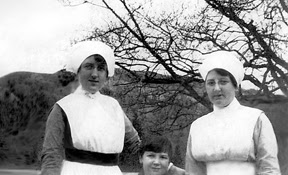
Joan Wotton (nee Thomas) 1950-52


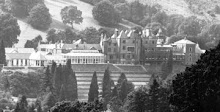
Joan on the balcony of Ward 2


Trawling through my 1,000 plus photos the other day I came across one marked “unknown” in the collection of Mari Friend ( nee Jenkins.)
Could this be Joan Wotton ( nee Thomas)?
I emailed her daughter, Beth.
Back came the following reply.

"Dear Ann,
                 Mum is here and she cannot remember having this photo taken.She thinks it may have been taken at the same time as the group photo of her with the girls.
"Didn't realise I was so good looking" Mum has just said. And she cannot remember Mari Jenkins obviously she was at Craig-Y- Nos at the same time as Mum.It was lovely to see this photo for the first time, thanks' Ann best wishes Joan and Beth."

Kathleen Powell - 1920s


The lack of any records from the time that Craig-y-nos was a childrens TB sanatorium remains a source of much regret.

Today I received the following email from Janet Tayler in Worcester:
 
"I'm so disappointed to find out there are no records of patients at Craig y nos.  My great aunt, Kathleen Powell, from Cwmgwrach, died there during the 1920s.  My grandfather was only young at the time and he hasn't spoken much about his sister.  I can't even find a record of her death.  If I find anything else out from the only other surviving sister sister, or if there are any photos, I will contact you.  ( My grandfather is nearly 90 and his sister is 88)  Kathleen caught TB from visiting a friend who had it.
 
I've spent many happy hours walking round "Madam Patti's" - the country park, and I've taken my own children there.
 
Good luck with the book."
 

Craig-y-nos stories

I have noticed a discrepancy between accounts given in the official oral recordings for this project and stories written by ex-patients.

Invariably the official oral recordings often paint an upbeat happy picture of their time in Craig-y-nos, whereas those who have written their own accounts are more likely to reveal intimate details of painful memories.

( I first noticed this when people I had chattered to informally gave me one story then once the tape-recorder was switched on I got a much more bland version of events.)

Now pyschologist Michael Eysenck, Professor of Pyschology at the Royal Holloway and Bedford New College University of London offers an explanation in his book : "Happiness”.

He calls it the “social desirablity bias” which simply means we often distort the truth in order to present a more socially desirable image of ourselves than is actually warranted.

One study shows that people who completed a questionnaire on happiness in the context of a personal interview reported to feeling “very happy” in 36 per cent of cases whereas those who completed the same questionnaire alone said they were only 23 per cent “very happy”.

Tuesday, January 15, 2008

Valerie Brent, ex-nurse Craig-y-nos, 1940's


Valerie Brent

Our reporter and roving ambassador for this project Valerie Brent from Mumbles, ex nurse and author of “ Life isn’t all kiwi and oranges”
went up to Brecon to see the current exhibition “ Children of Craig-y-nos”.

She says it has attracted a good deal of interest in the area and the Visitors Book has got at least ten pages of names.

Afterwards she popped across the road to the pub “to warm up” and within minutes both Valerie and her friend were deep in conversation with the only other customer there and the landlord. (“We had a grand evening...very jolly”).

It didn't take Valerie long to find out that both men had TB as children and had been treated at home .

Why was this? what was the criteria used to select some children for the sanatorium and others either to be treated in the local hospital or at home? We can only hazard a guess that it was to do with the stage of the disease.

Valerie reminded me again of some of her stories of her time as a 15 year old nursing in Craig-y-nos in the mid 1940’s.


”I got paid £3.10 shillings a month plus board and keep and had one day a week off.”
Valerie was glad of the job and grateful to Matron Knox- Thomas for taking her on. (“My parents had died. I was an orphan”).

She lived in the nurses home and worked three shifts
Her hours were from 7.30 -4.30 1.30- 8.30
8.30-8am.

She recalls on one occasion being reprimanded by
Sister Williams, who for reasons unknown, was called “Boogie” for washing negative and positive toothbrushes in the same bowl.
“I had no idea what she meant. So she explained to me that some children were positive with TB and others were negative.”
How this was established was of course through the use of the notorious gastric lavages.


Gastric lavages started at around 2 years of age. Sister Powell did them. She was “very firm” and the nurse would have to hold the child tight.


Valerie worked in the Glass Conservatory - the babies ward.
As a 15 year old she would often be in charge alone on the night shift with at least 20, maybe more. children in her care.

It was , she admits, a “skeletal staff”. She could if a crisis arise call on the night sister.

One night though Sister Outram did called on her to help.
She asked her to go to Ward 4 and warned her not to be afraid.

“She told me to put on wellingtons, a long gown, mask and gloves then took me into this side ward.

There was this young girl . She was beautiful, like a Madonna. I had to help lay her out.
The tears were running down my face. The girl was only a year older than myself.”


Photo: Sister Outram with Dr Huppert

Monday, January 14, 2008

Rose Hunt- 1941-43


Rose, born in 1935, was an evacuee who caught TB from the family she lived with, and was admitted to Craig-y-nos as a 6 year old.


I knew that I was quite ill and I was told much later that it was tuberculosis but my mother always told me that I had a bad chest.

Loving family
I know I was there when my sister was born in 1942 and I can remember two Christmases in there.
I came from a very close loving family and I had a sister who was very close to me – she was only 13 months younger and I had a brother which had been born in May 1939 and my mother was a very caring person so I found it very hard to settle down.


Arrival in Craig-y-nos
I wasn't so ill that I couldn't walk into the ward because I remember walking up the stairs and going in but they insisted that you had bed rest. I received no treatment when I got there.
I was kept in bed. The sisters were quite firm. They were very strict. Not conducive really to being happy as a young child.
We never went out but we did go on to a veranda.

Life later on the verandah
I went out on to the veranda for quite a long period of time. I don't know how many months because my parents are dead and I can't ask them but I know it was a long time because it was from the spring right through until it got so bitterly cold that we had ice on the tarpaulin. We were very cold. I'm sure it was through the night as well. Frightened I was because you had the woods in front of you and you heard the foxes, which you didn't know what they were. You knew they weren't dogs because it was too high and a blasted owl. There was an owl in a huge fir which was quite near to the hospital itself and that was really frightening.

Difficulty in sleeping
I found it hard to go to sleep and in the wards it was even worse because you could hear the groans and the moans and the coughing and the spitting and the ones that were out on the veranda were those that weren't so bad. You were really starting to improve I think.

"She died in her sleep"
I was aware of people dying there. That's why even to this day I don't sleep very well because I was afraid to go to sleep because the nurses used to say:" oh she died in her sleep. "
I used to think well I don't want to die and I was afraid to sleep.

Ward furnishings
I don't remember anything on the walls at all. It was a metal bed, thin mattress and the beds were so close together that there was only a small locker between us so really and truly when you were upset at night you could stretch your hand out and you could touch the next person. There was no heating.

How many patients in the ward?
I've given this a bit of thought. My uncle was in the navy and he was allowed to come in with a hand of bananas and each banana was cut in half and there was just enough to go round so there must have been close on 20 in the ward.

Porridge
I don't know how to this day I can eat porridge because I can remember being on the veranda and everybody passing me their porridge because it was thick with lumps and there was me pushing it down the waste pipe and then one day it rained so heavy the porridge all bubbled back up. You had to own up who did it and you really did suffer.

Staff
I must admit there were a couple of ladies who came in from outside – they weren't nurses they were cleaners – and they were absolutely marvellous. They used to bring in comics and sneak in sweets. I suppose the nurses had a job to do and some were bitches. Some of them took great delight in tucking you in so tight in bed that you couldn't move. You wouldn't dare move. Then there were some that were absolutely lovely.

Education
There was no schooling.
This was 1941 and there was nothing but I was fortunate. I could read fluently before I went and while I was there because of the restriction on visiting I used to read whatever I could get my hands on and there was some books left in Craig-y-Nos belonging to Madeline Patti or whatever and I can remember quite distinctly saying to my mother if ever I get out of here I'm going to this place and I had been reading a book on Rome. I didn't understand half the words and other people couldn't tell me what the words meant but I still read it and Greece and India and Egypt and China. I would read whatever I could. I wasn't able to start those travels until I was 50 and I did it.

Friendships
If you made a friend they either got older and they moved to a different ward or they died.

Rat in ward
There was a rat in the room and to this day I can't cope with rats or mice. The rat jumped from the table in the room on to the bed on the other side. I can remember screaming and screaming. Nobody believed me.

Visiting
Visitors were allowed once a month for a very short time. Very difficult for my mother to get there because during this time my mother was pregnant with my sister Gloria and one visit in particular my mother missed the bus and she was crying at the bus stop and a post office van pulled up and he put my mother in the back with the mail bags and dropped my mother at Craig-y-Nos. I can remember my mother turning up at my birthday, 3rd May and my sister was born on the 7th. My mother was very, very big and at 6 years old you didn't understand what it was all about. My mother explained she had been allowed to come at a different time because of the birth.

Trifles for my birthday
The bakers in the High Street was very, very good and when my mother told him that it was my birthday. There must have been a lot of children on the ward because my mother had to have the trifles put on two layers. He made the trifles in waxed cartons and this was 1941 and stuck cardboard in between them but when my mother actually arrived they were running everywhere. You drunk it practically.

Books and puzzles
Ralph the books in Swansea by the station in the High Street were absolutely marvellous. They used to give my mother the comics that had been damaged so my mother would turn up laden.
There was puzzles. I can remember that. We played snakes and ladders I think but I'm not sure but I know we had some board games there. If you were very good you were allowed to sit at a table. That meant getting out of bed so that was a privilege.

Going home
I must have come out in winter because I had only been home a few weeks and I know I had pneumonia.

Christmas
I can remember the fact that we had better food at Christmas. The staff did something. It wasn't a pantomime – it was something similar but I don't know what. I can remember being wrapped up and going down to the theatre with blankets but that's all I can remember.


Life after Craig-y-nos
I didn't go to school for a long time because I had pneumonia and there's a clinic in Swansea which is called Grove Place – that was the TB clinic – and I'll never forget the doctor, he had bright ginger hair, Dr. Lewis. He was a lovely man and he was so kind because he kept saying you don't have to worry about school but I did. Of course I could read but I'm still hopeless at maths. I missed a lot of primary school. I know I was home for a long time.

An evacuee who caught TB from her host family
Up until last year I used to do talks in schools and women's groups about being an evacuee – it was appalling and I think that's where I got my TB from. I wasn't evacuated far but the family didn't want us and my sister and I had to sleep in a cabin trunk, one each side and we literally didn't get food. The man had a continuous cough. That's all I can remember. They said it was because he had been a miner but the general idea of my mother was later that he had TB and that's where I picked it up.
Talks to schools
I go to schools because its part of the curriculum andI tell them that not everybody had wonderful evacuation. I ran away with my sister who was very young and I knew we got there on a train so I got to the railway line which was across to the field but I walked in the wrong direction. Instead of towards Swansea I walked towards Caernarfon.

Long term effect of Craig-y-nos on my life
It definitely had an effect on me, with the sleep. The one good thing out of it, it made me a much stronger person. I'm not afraid to travel on my own. I'm not afraid to face things.

I blocked out my experience at Craig-y-Nos.

Rose Hunt was interviewed by Cynthia Mullan of The Sleeping Giant Foundation.


Rose Hunt

Sunday, January 13, 2008

What's the "true story" about Craig-y-nos?

The other day my nephew was asked in a school exam to consider the following historical question in relation to child evacuees during the last war.

He was given a photograph of happy smiling children walking down a street on their way to their new homes. Alongside that he was also given an eye witness account, written in 1960 by a teacher who recalled the occasion as one of sadness with much weeping and mothers pursuing their departing children up the street.

Now the question he was asked was: which is the most useful ?

(Of course it begs the next question: useful for what? )
Nevertheless it got me thinking about the collection of over 1,000 digital photographas I possess which tell one story and the written accounts of ex-child patients which record in many cases a different version.

So, here's the question:
Which is the “true” story?
Because it is such a complex tale spanning nearly forty years of social and medical change I suspect there is no one "true story", but rather one of multiple perspectives.

Saturday, January 12, 2008

Douglas Herbert 1945- 48


Douglas Herbert, an accountant working in Swansea, tells his story of his time in Craig-y-nos.


I was born 21st February 1941 and I came to Craig-y-Nos in 1945. I was about 4 years old.

Until very recently the only information I had was that I had fluid on the lung as a child. For one reason or another, the doctor we have now, on discussing various topics with him, he said that's what they used to call TB.

I know I had had my 7th birthday when I went home so it must have been two and a half to three years. I think the last six months was just getting out of bed and getting better slowly. I could walk about and exercise.
I didn't get out of bed for a heck of a long time.

Tied to the bed
I was restrained on many occasions. I wasn't a quiet, innocent young lad, boys will be boys. They had this contraption which had the shape of a piece of material across the chest and four straps. One strap was tied to the lower right, one to the upper right, and the same on the left. No matter how hard you tried you couldn't get those knots, they were too far away.

Forced to eat cold cabbage until vomited

The one thing I hated was the cabbage - green cabbage which was virtually puréed and you ate it whether it was hot or cold. I didn't like it. In the end they used to bring me a bowl to be sick in at the same time as the meal. It would come straight back up into the bowl. The nurse then took it to show the sister as proof that I had eaten it.

The food was basic. We had ice cream and jelly, I remember that. It was basic food I think. I don't recall having too much fruit but then again, the war years. I do remember wondering what the heck that boy had in his hand over there. What was he going to do with it and he had a banana. I hadn't seen one before.

Arriving in Craig-y-nos
I cried my eyes out for the first couple of days. My parents had come with me in the ambulance. Actually I think it was only my mother, my father was working.
I had a brother and sister, I was the middle one.
When I came out, we had moved.
We had visiting once a month.

Treatment
I didn't have a lot of treatment. The tube down the throat, I don't know what it was called. ( gastric lavage). From what I understand they used to take a sample with that and test it on animals. I got fairly used to it. It takes me 10 minutes to swallow an aspirin now.

Prior to going to Craig-y-Nos I had pneumonia. They injected me with something or other and according to my wife I have two dimples in the posterior where that went.

Visitors wore mufflers because of the cold
I can recall several occasions in the hospital. The windows were very large and open and we got used to being cold. I can't recall curtains. We would be in our pyjamas sitting on the bed and visitors would come with mufflers, gloves, hats coats and everything else. I'm so much acclimatised now I don't like heat.

1947 snow on balcony
I would say there would be 10 to 15 of us in the ward. Beds were around the ward and there was a balcony to my left. I was right by one of the windows and I recall being wheeled out on at least 2 occasions to sleep on the balcony. On one occasion, must have been in19 47, the snow was piled high when I woke up and I couldn't see the front of the bed.

Derby Day
If you can find out what the Derby Day was in 1947, that was a couple of months before I came home. I can specify that because I was the only one with a radio speaker and I had 47 visitors that day all listening to the Derby.

Andrew my best pal
Pencil, paper, crayon I recall. I had a jigsaw which I never did because on the day my parents came to take me home they brought me a small jigsaw to do and I never did it. I gave it to my friend Andrew in the next bed. He was a great pal. He couldn't move. His back was encased in plaster of paris because he had the spinal version. He never made it.

Medicine
There was a lot of iron medicine and we were fed regular doses of syrup of figs because the iron medicine would constipate you. We were given a bedpan every morning. They woke you up at 6 o'clock and you didn't get breakfast until you used it. If you were constipated that was really something else.


Punished by Dr Huppert "little Hitler"
Once I was allowed out of bed for half an hour ( the start of the grading process) and this would increase until such times as I went home. The doctor, I can't remember her name, she was Austrian, short and dare I say it, little Hitler gone mad. The boys made paper aeroplanes and we were throwing them around in "rest hour" and one landed on the floor. I got up to get it. As I did that" little Hitler" came in and said:" in bed for a month!" and I thought evil thoughts of her.


Entertainment
I can't recall a great deal about Christmas. We had shows in the theatre, which was beautiful. Silent film shows, Laurel and Hardy. There was a pantomime I recall once sort of amateurs thing but Christmas was upsetting in a way because you weren't at home.

Lessons
There were lessons – spasmodic. From an early age, I loved maths and while I was there I was quite good. I'd gone past the tens and units bit before and English was not my best subject but I got along with it. There were some lessons but not a lot. I did catch up because I was very interested in maths.
We had crayoning books and reading books. I think I struggled through Robinson Crusoe when I was there.

Outside food
We used to get things like fresh farm eggs. I remember them bringing in an apple or two and on one occasion I can remember an orange.

Visitors
My parents travelled to see me on a bus and I went home on the bus. It took forever. I think it must have taken three to three and a half hours. Pay being what it was then, it was a lot of money. They stayed for two hours. I saw my grandfather twice while I was in hospital and he had died before I got out of hospital.


The matron I recall though not by name was always for the children. That was a person you could depend on. She used to give the staff hell.


Gingerheaded nurse
There was one nurse I recall she was either redhead or ginger, that stuck in my mind. She was fabulous. On a particular night there was a fire. It was an accident we were told. A bus and something to do with petrol. She was the only one left in the whole ward because everyone was take because there were serious consequences. She must have stayed on till midnightish. Nothing was too much trouble and she would even sing you a lullaby.


Craig-y-nos" a grand place"
I felt and I think a couple of the others felt that it was a grand place where someone important used to live. It had this beautiful theatre.

Most of the time I was quite happy but I didn't want to be there but you made the best of it. From the day I left that place, no a month after when Andrew died, I really love living. I have met some miserable people in my life.

The pub quiz
When I was 18 or thereabouts I went with my father to a quiz show and they were asking questions and one was who won the Derby of 1947 and no-one could answer. They asked if anyone in the audience knew the answer and I put my hand up. My Love won the Derby in 1947. My mother had sixpence each way on it. I remembered it from my time in Craig-y-nos.

The seance
We had a group of friends and they all came round to our flat and we decided to have a Ouija Board. I wasn't interested so I really sat across the living room maybe three and a half metres from what they were doing so I couldn't push anything. I had never discussed with my wife what had gone on in hospital and it started does anybody know Andrew. I said he had been a child with me but I wouldn't discuss it with them. I wrote down on a bit paper and asked what was the last thing I gave Andrew. They spelt out jigsaw. Nobody at that table knew. I asked what was on his back and they spelt out plaster.

Douglas Herbert was interviewed by Cynthia Mullan of the Sleeping Giant Foundation.

Friday, January 11, 2008

Sanatorium deckchairs - 1948


Barbara Pye


Barbara (first left, seated)


Fresh air was an important part of the sanatorium regime and deck chairs were provided so that patients could sit and enjoy the clean mountain air.

These photos come from Barbara Pye’s ( nee Dommett) collection (1948) and show patients from the Annexe.


Do you recognize any faces? if so let me know:
annshaw@mac.com

Thursday, January 10, 2008

Sylvia Moore (née Peckham) 1953-57


Sylvia was admitted to Craig-y-nos as an 11 year old. She remained there for five years, and then she returned to nurse for a further two years.

"I lived with my father and I think it was due, actually, to poor upbringing. Luckily for me, I had appendicitis and was admitted to hospital to have the operation where they discovered I had TB. In those days it was really poor diet, poor upbringing.

So you spent more or less the whole of your teenage years there?
Yes, I did.

Are your memories happy or sad?
Fantastic. It was a wonderful, wonderful place.

Glenys and one or two other people (ie. Beryl Richards and Ann Williams) have said that you had a good attitude. Glenys told me about the tennis and how you wanted to watch Wimbledon and wouldn’t take no for an answer.

I wasn’t allowed to sit up. I wasn’t allowed to get off my back and of course Wimbledon was starting and I adored Wimbledon. We’d had this television set donated to us, and I asked if I could watch it. Glenys turned round and said, ‘If you sit up I shall put the screens around you for the rest of the day.’ And I can remember those words so vividly and I was feeling so sorry for myself. I thought, ‘Oh well, that’s it.’ But within about twenty minutes or so in she comes with two porters dragging this most enormous dressing table with a mirror on it and positioned it so that I could see the television and watch Wimbledon. Now, that’s true dedication, isn’t it? People wouldn’t think of doing that sort of thing.

Glenys instigated a lot of things.
She was the most fantastic nurse, she really was.
Everyone has said that about her.
She deserves an OBE really.

Did you not have a mum?
No, I did not. My mother and father divorced when I was just over a year old so I was brought up with my father and between his sisters as well. Six months here, six months there …

Did you have any brothers and sisters?
No, I was an only child.
It was monthly visiting and only my father came to visit, and then he couldn’t always afford to come up so I didn’t see him every month.
Where did they live?
Llanelli, which took three and a half hours on the bus. So it was a full day journeying.

What about the food?
The food was absolutely fantastic. I can’t remember the chef’s name but he was an enormous person. But he did brilliant, brilliant food – good wholesome food.

What about entertainments?
Unfortunately, I wasn’t able to go to those because I was on my back for three years so I didn’t get to go to any of those.


Did you have TB in the lung?
Yes, in both of them. I wasn’t expected to come out. I was really poorly. I was put in a room next to Dr Hubbard.

Did they give you streptomycin?
Yes, thank goodness they did and I was able to take it because that’s what pulled me through.

Glenys did say that you were very poorly. She did say that you were very, very sick.
That’s right. I was well under six stone. I had nothing on me at all and I always remember Dr Hubbard when I first went in there. First of all, I was covered in iodine from when they swabbed me all over to have the appendix operation. She came to examine me and she pulled the clothes back and said, ‘What is this?’ As if I hadn’t bathed, you know. Then I told her what it was and she said, ‘Oh, I see, such a lot of mess for a little cut.’ I always remember her saying that to me. Then she gave me an examination and said to me, ‘Do you like milk?’ And I said, ‘Yes, yes.’ I was almost too frightened to talk to her really. She said, ‘Good, you drink for me lots of milk – four or five pints a day – and we’ll get on well together.’ And out she walked. She used to come in and see me two or three times a day. She was lovely. A very formidable lady, mind. She’d put the fear of God into anybody, I would think, but she had the patients’ interests at heart. That was her first and foremost thought.


There are mixed responses to Dr Hubbard. Some people have said she was awful and others say that they owe her their health.

I have great, great admiration for that lady. Yes, she used to come into the ward and if she saw anybody sitting up that shouldn’t be, she’d shout at them, and they’d get down straight away. We could hear her coming because, unfortunately, she’d had polio herself, you see. We could hear her coming up the corridor so quite often she never caught any of us. She was a wonderful, wonderful lady, she really was.

Peter Wagstaff said that it was due to her that he got out of bed. He was in bed for four years and she got him up within six months of her arrival at Craig-y-nos.

That’s right and the same applied to a couple of others that were there as well, according to Peter. She said, ‘What are they doing in bed? Get them up and get them up now.’

You were in for five years. That really took your whole teenage life away. And you were on your back for three years?

Three years, yes.
What ward were you on?

I was on Ward 2. I was up in this room with Dr Hubbard for eighteen months on my own.
Then little Joan Nicesro – she was deaf and dumb …
Well, she came in with me and she taught me the deaf and dumb alphabet and we communicated, but she was only there for about four months that I can recall. Then she was put into another ward and then Theresa came in to me – Theresa Thomas, as she is now – Theresa O’Leary she was then.

She was another one who wasn’t expected to go out.
Theresa and I became great friends. I was there on my own for about eighteen months and then I think six or nine months with company before I went down onto Ward 2.on the balcony.

What about education? What about the schooling there?
No, I didn’t receive any education because I was so ill that they wouldn’t let the teacher near me, put it that way. Not because I was infectious because, luckily, through streptomycin, they stopped the TB germ working, but I wasn’t allowed to move, to write or to do anything.

As far as education is concerned, I’m self-taught.

What about your decision to go back there as a nurse.
That was pre-empted by Dr Williams. There were three of us. There was Theresa (O’Leary), Diane Hughes and myself. We were all about to be discharged. Well, I nagged to go home really because I had done my grading.
This took the best part of fifteen months, it was that slow. Then he (Dr Williams) said, ‘Yes, you’re alright, you can go home.’ But I had to be very careful. Then he just got us together and he said, ‘Don’t you think it would be a wonderful idea if you came back to nurse here?’ We all sort of looked at each other and thought, ‘Well, great,’ because that’s an offer of a job, isn’t it?
We thought, ‘How wonderful is that. Why not?’ So in January the following year the three of us went back there. I was discharged in the November and I went back in the January but of course it was a ploy, wasn’t it, to keep an eye on us.
I was there for about two and a half years and Diane and Theresa, I think, about the same length of time.
It was a ploy on his (Dr Williams’) behalf and very cleverly done. We learned afterwards from Sister Powell that she was to keep an eye on us and make sure that we didn’t overdo things to start with, and not to be out late at night and all that. It was very, very cleverly done and it kept a good eye on us for about the first year. Then after that we were allowed to do what we wanted to do, more or less.
Did you live in the nurses’ home?
Yes, we did.
Having been there as a patient for five years, you didn’t mind going back?

Not in the least. It was our home, it really was home. The nurses were absolutely fantastic. We had a great deal of fun with them. They really did used to entertain us. For example, we had the domestics chasing Glenys with a wet sponge into the ward so that we could see what was happening. They were wonderful like that.

Did it feel strange being on the other side?
No, because when I went back there, I went back into the children’s ward, and I was only there for about nine months before they transferred all the children (in 1958). Then it became a ward for ex-miners with silicosis, and the other wards became geriatric. So it ceased to be a hospital for tuberculosis.

Did you stay there or did you go with the kids to Talgarth?
No, I stayed at the hospital.

Tell me your typical day as a nurse. What sort of things would go on?
We usually had a seven o’clock in the morning start. We’d go onto the ward and we had thirty beds (to make). Those beds had to be made within half an hour.
Two nurses per bed. They were totally stripped, mattresses turned, backs of the beds wiped, put back with crisp sheets, etc., and the patients put back into the beds. Breakfast was then served and then on would come Sister Powell and she’d do the inspection. In those days the corners of the counterpanes, if they were not at ninety degree angles, she’d pull the counterpane up and tell you to make the bed again. It had to be absolutely spot on.
My daughter runs a bed and breakfast and she does hospital corners as well.

What else would happen?
Then it would be bed-bathing the patients. That would take most of the morning. Then the domestics would clean the ward; then it would be lunch for the patients or getting them out of bed and putting them into the chairs or taking them outside for a walk. The days went very, very quickly there. In the evenings when matron came on her six o’clock round, she’d come in with a beautiful red setter dog that she had, named Patty. She’d come on the wards and the dog would follow her around, but before she came on, all the nurses had to roll down their sleeves and put their white cuffs on, and stand by the beds while she came round. Honestly, talk about Hattie Jacques. She was just like her.
Did she bring the dog onto the ward?

She did, and Dr Hubbard used to bring the cat onto the ward.
She had a cat called Thomas. That cat followed her everywhere.
The cat used to come onto the ward and around with her. The patients used to love it, absolutely love it. She absolutely adored that cat. Glenys, you see, has a phobia about cats, so when the cat used to come onto the ward, Glenys would climb up onto a table. She had a dreadful phobia for them.

She didn’t mention that.
No, she wouldn’t. She wouldn’t mention the cat because she hated the thing (laughs). It was wonderful. They used to bring the animals on and the TB patients used to absolutely love it.

Theresa O’Leary is now living in the vicarage where Betty Lewis used to live. She bought it. It’s the vicarage on Penwyllt Road in Pen-y-cae, just below the hospital. She’s Theresa Thomas now.

Sister Betty Lewis is the niece of the first sister at Craig-y-nos, Sister Margaret Phillips, who lived in Penwyllt. Margaret Phillips was there in the early 1920s and set up the hospital with the first matron. Margaret Phillips married somebody called Lewis and all the very early photographs of the hospital that we have came from her son, Phil Lewis. I only found out that Betty Lewis was related to her when I interviewed her.
She remembered being very fond of Dr Hubbard and she used to take her out to tea in her car and shopping in Brecon. Apparently, she took the place of Sister Winnie Morgan. Was that right?


I wouldn’t know because I was a patient of Dr Hubbard when Sister Lewis was running Ward 2, and I didn’t know of her until I came down into that ward. I do remember an occasion – I don’t know if Sister Lewis told you this – where none of us were behaving in the ward.
Well, she came into the ward with a bandage around her head, and she had smeared it with some sort of jam or something or other. She came into the ward and she said, ‘Look what you have done. You’ve made Sister bang her head. Now, will you all please be quiet.’ We all thought, ‘Oh, did we really do that?’ She wasn’t very good at controlling us, put it that way. She was too soft for her own good! Whereas others would just come in and bang the door with the side of their fist and say, ‘Will you all rest now!’ Or else … Sister Lewis was lovely but soft.
She is quite sweet, actually, and amazing for ninety-nine. What made you leave?
Well, I met my husband, Donald, in April 1960.

He’d just started there and he was walking near the nurses’ home and I had the window slightly up. Do you remember the lemon Jiff squirters?
I’d filled one of those with water and squirted him with it as he went past, for devilment. He found out who it was and he returned the compliment, on the ward, needless to say. I ran into the sluice room and stood with my back to the door and my legs sort of apart. Of course the door of the sluice room didn’t go right down to the ground, and underneath came this lemon squirter, and of course I was absolutely soaked. That’s how it started. We got married about ten months later.
He was an engineer, wasn’t he?
Yes, he was.
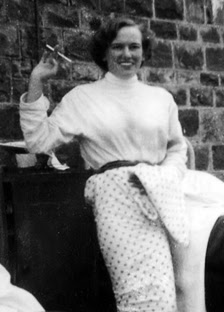
Everybody has said that you were full of fun and were a bit naughty!
I was, yes. Apparently, I used to roll bottles across the ward in the middle of the night.

Beryl Richards (Rowlands) told me about that. She said that it happened the first night she was there and she was absolutely petrified, and stayed under the bed covers all night. She later knew that it was you. Of course, it was the fear of ghosts, wasn’t it?

That’s right, yes, and of course it was a wooden floor and the sound of these bottles rolling across. I got another girl into trouble, apparently, when I thought Glenys was in the lift. I said to her, ‘Glenys is coming down in the lift. Jump out and frighten her.’ She and Christine (Bennett) both did it and of course it was Dr Hubbard, wasn’t it. Lots of things went on and a lot of them are hard to remember until someone jogs your memory about them.

What with being there as a patient and nursing there, it was about seven years in total, wasn’t it?
That’s right. I was there really from eleven to nineteen years of age altogether. There are quite a few girls who would say that they were the happiest days of their childhood.

I think Christine Bennett does.
Yes, she’s the one who got into trouble with Dr Hubbard.

Why do you think some children found it very unhappy and some children didn’t?
I think perhaps it may depend upon the age that they were at the time, but I think, like entering a hospital today, it’s all very frightening anyway. It’s no different really. I honestly think that they perhaps exaggerated the position because they were so young. It’s so difficult to say why really. I’ve heard of one example where somebody said that Dr Hubbard had pulled a plaster off her neck and pulled her skin along with it. Now, Dr Hubbard would never ever have done that. Yes, she might have taken the plaster off and caught the hairs on the nape of the neck but she wouldn’t have done anything of that nature at all and not cared about it. Another one said that she got locked in a room by Dr Hubbard all on her own. Never, because there were no locks on any doors in any of those rooms. She would never have done anything like that. There’s one girl, Ann Williams, I don’t know if you’ve spoken to her.

Yes, I have.
What has she said?
She was quite happy there.
There you go. The happiest days of her childhood, she said.

She was also in bed for about three years.
Yes, but she was up on blocks and virtually upside-down.

Did you have the dreaded gastric lavage?
Oh yes, indeed, where you had to swallow the tube. Luckily for me, I was very good at swallowing. A lot of people are not. They washed the contents of your stomach out, and they did that for three days in a row. Luckily for me, with streptomycin, at my very first test the bug had stopped.

You were lucky.
I was very, very lucky.
Did you have streptomycin when you first went in?
Yes, I had two injections a day because they couldn’t give it to me in one. They had to split the dose, which meant that I had an injection in the morning and an injection in the evening. I had that for one year and then I went onto one injection for the next two years. So your backside became like a pincushion.

Glenys told me that she became terribly sensitive to streptomycin after giving it so frequently. She ended up not being able to anywhere near it.
She couldn’t. It affected her eyes.
She said it was dreadful and she was moved to the X-ray department.

She did occasionally still do it but she suffered afterwards. She was brilliant at giving injections, Glenys was. We had some that weren’t so good but it had to be like that because the experienced ones often developed the allergy (to streptomycin).
I never gave streptomycin. By the time I went back nursing and once the children had been transferred, it wasn’t a TB hospital. And of course I was just a student and wouldn’t have been allowed to give it anyway.

How long were you there before they all got moved to Talgarth?
About nine months. The children didn’t go to Talgarth. They went to Llandough and Rhydlarfa Hospitals which is towards the Rhondda Valley. That’s where the children went.

Did you know that Adelina Patti had some beautiful peacocks?
Oh, Jacko?
That’s right, a peacock and a peahen.
They were just there in the grounds. They were well looked after and it was lovely to see them when you did your grading and went for your quarter of an hour walk as far as the first oak tree. After that you’d go as far as the second oak tree and that sort of thing.

After you left, did you have to keep going for check-ups for a long time?
No, not once I went back there nursing. I didn’t have any more check ups. But unfortunately for me, because I didn’t have an operation … well, actually, it was Dr Patrick Mulhall … he did his very first bronchoscopy on me.
I saw him the other day at the reunion (in April 2007) and he said, ‘Oh my word, you survived.’ Because they didn’t have the proper equipment to do it, I was tipped up on this table and strapped to it whilst they took the photographs (they used rigid bronchoscopes in those days, not the flexible fibre optic scopes used now). I should have had an operation to have part of my lung removed, and I didn’t. Consequently, when I was twenty-four, I became seriously ill and I got aspergillosis (a severe lung infection caused by a fungus of the Aspergillus species). It obviously got into my cavity that I still had there and it caused an immense amount of bleeding and I was haemorrhaging rather badly and I went into the Brompton Hospital, London, because they couldn’t find out what it was. There was a Professor Scadding there.

He found out what it was, luckily, and I had an operation in the Brompton.
Virtually all of the left lung was removed there.

So you had a rough time.
Yes, unfortunately. If I’d had the operation it wouldn’t have happened, but where I got the aspergillosis from was just a puzzle. They had no idea.

You’ve been okay ever since, have you?
Absolutely fine.
You never had any recurrence of TB?
No, nothing at all. As a matter of fact, when I had the operation, the very first thing they said to me was, ‘What you need to do is to go and get yourself pregnant.’

So that’s what you did?
That’s exactly what I did.
How many children did you have?
I had two, a boy and a girl.

TB does compromise fertility and some ex-patients didn’t have children.
Did Glenys ever tell you about the BBC programme that was made there?
It was done in the late 50s. It was a night time programme where they wanted really to just have Patti’s voice in the background singing, ‘There’s no place like home,’ and a nurse going around the wards with a candle. It was Glenys that was chosen for the job. Did she tell you that?

There were all sorts of things that she didn’t tell me and I feel that she was reticent about these sorts of stories as if she didn’t want to be in the limelight or to say too much about herself.

She was chosen for the programme. You didn’t really see her. She just walked around the ward and patients were just lying down in the beds and she’d go up to them and just have a look. The BBC did that programme and it was late 50s.


Have you been told about the gardeners giving the patients boat rides on the lake?
Whilst the nurses are always in the forefront, the gardeners did a tremendous amount. They were so friendly and they did an awful lot for us as well. Indeed they did, and the porters. They were all absolutely great there.
The head gardener was Edgar, wasn’t he?
Yes.
There’s a photograph in the exhibition of a load of girls sitting in a boat.
That’s right. Edgar was the head gardener and Alfie Rapado. They all did their bit."


Sylvia Moore (née Peckham)in telephone interview with
Dr.Carole Reeves, Outreach Historian with The Wellcome Trust Centre for the History of Medicine, University College London .

Wednesday, January 09, 2008

Can TB be liberating?

You may think this an odd question to ask but: can disease be liberating?


A radio discussion the other day on Albert Camus, the French intellectual giant and writer led one speaker to remark that for Camus, a bright working class lad who developed TB in his late teens it was in effect a “liberating experience” without that he would have stayed within the “petite bourgeoisie” culture of his day confined to the life of a schoolteacher.

Now that route was denied him he had to find alternative means of earning a livelihood. So he came to Paris and became writer and journalist.

I wonder if there are any around who regard their own experience in the same way?


In my own case having a relapse at 19 years of age did in fact become a “liberating experience” though I did not think so at the time. Until then I was heading for a teacher training college in Bristol .


Instead two hospitals later - Sully, near Penarth and Pinewood Rehabilitation Centre near Wokingham, both establishments of which I cannot speak highly enough- saw me back into the educational system with my expectations raised well beyond being a primary school teacher. So, in curious way, that relapse opened the window for me into a world I would never have experienced and a life in journalism that was far more exciting than a primary school teacher in rural Wales.

Tuesday, January 08, 2008

Brecon exhibition

Thanks to the staff at Brecon library the exhibition is going to be extended until the end of January which will allow more people to visit and schools too.

The local newspaper, the Brecon and Radnor Express, will carry an item on the extension. We are very grateful to Brecon Library for allowing this exhibition to have such a long run.

Childhood experiences: sense of injustice

“You never forget what happens to you in childhood. It remains with you for the rest of your life.”

No, this was not a comment made by a former child patient but said by the distinguished journalist and broadcaster John Humphrey's speaking on the radio about his early childhood in a poor working class area of Cardiff and how he got beaten by his headmaster for being late one morning for school after he had struggled to deliver newspapers in a snowstorm.

Yet a similar sense of injustice comes through in many of the children's stories we are hearing. They felt they were unjustly punished for seemingly minor offences- beds pulled out into centre of the ward or corridor or even put out overnight on the veranda for talking after the lights were turned out . ( See yesterday's blog of Winnie Gammon's experiences).

In my own case I remember being penalised for allegedly throwing away a dental brace.

But I was very proud of my brace and saw it as an opportunity to have my teeth sorted out. However, I could not eat it with it in and it had to be taken out before meals. Then one lunch time it disappeared from my locker.

The punishment ordered by Dr Huppert was that all “privileges” had to be stopped: no walks, no cinema.

While other girls went off in groups I was forced to stay alone on the balcony.
Yet the brace mysteriously reappeared about a month after I left Craig-y-nos. One girl claims to have found it in the rhododendrohm bushes.

Yes, I could sympathise with John Humphreys sense of injustice in getting caned for being late after battling through a blizzard.

No ghost in the machine- mystery solved


The mysterious photo used in the blog last week has been identified.
Joan Wotton ( nee Thomas) visited her daughter, Beth’s, home and after looking at the blog said she recognised it as
Langdon, the porter and the young woman is Gaynor . It seems Gaynor had a crush on him.

And yes it did come from Joan’s collection which has been emailed to me.


Langdon, the porter, with Gaynor

The book “Children of Craig-y-nos”

I am starting to get emails for people wanting to know where they can buy the book!..have to reply and say that we are still doing the research though - Lottery funding permitting - we do hope to publish it this year.

Monday, January 07, 2008

Winnie Gardiner (née Gammon), age 81,- Craig-y-nos 1927


Winnie at the recent Patients Reunion

Winnie Gardiner was admitted to Craig-y-nos in 1927 as a nine month old baby and remained there for five years.

She did not have TB. though at the time they thought she had a condition known as "TB of the stomach".
Only at 60 years of age was her condition finally diagnosed - celiac disease, an allergy to gluten.


"All the time I was in Craig-y-nos they thought I had TB of the stomach. Of course, I ended up being fragile, no body at all, walking around in callipers.
I came home in callipers. I had such skinny legs.
I suppose I was restricted because we weren’t allowed to play out for hours on end or run around. We could go down on the grass for a while and someone would be there with us, seeing that we didn’t run off or go out the gates, but I think it was lack of exercise really.

Visiting
Mother could only afford to visit every six months. It was up to the social people whether they’d allow her a second visit but she had one every year definitely (Winnie’s mother was receiving parish relief). Once or twice she said she asked for a second one – the beginning of the year and the end of the year at Christmas. Not that I knew her anyway, you know. At five-years-old you wouldn’t remember after six months if you haven’t seen someone.

Where did your family live?
Limeslade, in a wooden bungalow. They used to call it holiday village. We lived there all our lives. Well, until I was ten.
Your mother came from London?

A cockney, yes. She wasn’t accepted very well, not in the family that she married into. She used to talk funny.

Sister Phillips with a child (early 1920's)

Memories of Craig-y-nos in the 1920’s.
It was very hard-going. You got dumped into the bath every night – about three of you in a huge bath. We’d all sit in it and they’d wash all our hairs first then get us out. Three of us at a time and then into bed. It was all rush, rush, rush. I don’t know how many nurses they had on there but you only saw one or two in our ward with the younger children. Of course, they weren’t all walking.

Do you remember which ward you were on?
The conservatory.

You grew up there really, didn’t you?
Yes, until I was five.

Did you think about your parents?
No, it never entered my head. I never knew I had four brothers. I never knew that until I came home, and they just sat looking at me with their mouths open. Whether my mother had told my older brothers that I existed, I don’t know, but they just stared at me and I just sat with my back to them because they were four boys. But, lucky for me, I had a younger brother and we grew up together very close, like twins. Where he went I went, and where I went he went.

Do you remember any of the nurses and the doctors?
Nobody. They all seemed very old to me. I suppose some of them must have only been in their twenties really but they all looked old to me, and they wore heavy clothing. Navy blue or black frocks – navy blue I think it was.

Punishment
Were you put outside if you’d done something wrong?
Oh yes. Well, if you were naughty and giggling and laughing when everybody was supposed to be going to sleep, they’d say, ‘Right, any more of this nonsense and out on the veranda you go.’ I was one that was always out on the veranda. Yes, we’d stay there all night with a bit of tarpaulin over the top of the cot.

Did they bring you in during the day?
Oh yes, we’d come in in the morning and they’d take us to get dressed. I can’t remember what clothes I wore or anything like that but we did change into a frock or a skirt or something. They’d wash us and give us breakfast.

Do you remember any of the food?
Oh yes, it was horrible. The smell of it was. The smell was all over the place. I know now what it smelled like – lamb stew, lamb stew, lamb stew!
All the time, yes, and it was a grey colour on your plate – in a dish. And very smelly! But that’s what we learned to live on. We did eat it. I suppose I must have remembered it when my mother used to make stew at home when I got back home to the bungalow. I remembered that it was that sort of smell.

Celiac disease
Did you always have stomach problems from a child?
For most of my life if I changed my diet in any way – had something richer or something I wasn’t used to – I would always have a bad stomach, diarrhoea or sickness. I couldn’t take rich things. At home I didn’t have any trouble. My mother was told that I could survive on white meat, banana, bread and butter. As long as I had the banana and white meat I’d be alright – and fish. We did have a lot of fish, mind.

I never told anyone that I’d had TB because I wanted to go into the RAF, which I did, and I didn’t tell them. I did tell the doctors when I was pregnant that I was born with TB and I’d spent some time in Craig-y-nos. They were interested and said, ‘Where did you have it?’ ‘In the stomach.’ ‘Oh, you don’t have TB in your stomach. Never heard of anybody having a TB stomach.’ It was just passed over but they always sent me with the children to the TB clinic after they were born. I’d have to go up there to the clinic (for TB and miners’ chest diseases). I didn’t always go there though. Once I found out what they were looking for I thought it was ridiculous that my children would have it, but I did go with my last child because he was a bit fragile. He was always fragile.

How many children did you have?
Four. Two girls and then two boys.
Have you got lots of grandchildren?
Oh, I’ve got dozens. They’re coming out of the woodwork? (laughs).

Going into the RAF
You had to wait till you were eighteen to join.
Myself and a friend who lived in Carmarthern at the time, we both signed up the same day in the YMCA down here. That was April (1944), and they said, ‘You can’t come till you’re eighteen.’ We were both eighteen in the July, so we had to wait until then. We signed on (in April). They said they’d send us papers, which they did. I think it was the 18th or 19th July that we had our pips and we were on our way to Manchester.
I was in the RAF from 1944 until 1947.
And I enjoyed every minute of it. Yes, and I could have changed my whole life at that point and I never did. We both kicked ourselves for that when we came out. They wanted people to go to Germany and round the country, but you must have been in the Forces for over three years, and we had. We had the choice, either go to Germany and become sergeants or come home, and we hummed and hahed and hummed and hahed, and in the end we both came home.

Do you regret that?
Oh yes. I did a couple of years later. I wished I’d gone.

Marriage
I came out of the RAF in December 14th (1947) and I got married on December 18th. It was my childhood boyfriend. He’d come back from Singapore, so we got married.
Is he still alive?
Oh yes, he divorced me. He’s remarried.


Good memories of Craig-y-nos
Well, we enjoyed being together as children. I can’t remember being miserable or crying all the time. I cried sometimes especially when I was out in the garden. I think, being so young and not knowing any other home, I just thought it was home. It was just where I lived. I don’t know what I thought really. I never knew about school or buses or trains or my mother or the village we lived in, Limeslade. I’d never seen any of it so I had no thought of the outside world, which was a sad thing for the older girls of my age group.

They did have a mother, they did know their home, they did know they had a father. When they came in at about six or seven or eight, they’d all had their own bedrooms – that was the sad thing, really, because they used to cry a lot when their mother was coming or going.

Some people have said that it actually gave them problems in later life. They felt that it gave them psychological problems in later life, being there. Did you feel that?
No, I didn’t feel any of that because they say what you don’t have you don’t miss. The biggest shock to me was just sitting outside of the bungalow at home and wondering who those boys (my brothers) were.

Going home again
Did you find it difficult to settle back into your home because you’d never know it as a home, had you?

No, but because I was used to having children around me – all of us (in Craig-y-nos) were children together – I accepted four boys. It didn’t mean anything that they were my brothers because I didn’t know what brothers and sisters were. I’d never had one, but of course I’d always had children around me so I was not nosy or worried about it.

Life inside the Glass Conservatory
What did you do to pass the time in Craig-y-nos? You obviously didn’t have any schooling.
None whatsoever. I can’t remember drawing or writing on paper or anything like that. I don’t remember having a doll or a teddy bear, except the big one on the wall.
It was huge, the size of a man. As tall as a man.

Where did that come from?
The local mayor, all dressed up in a mayor’s clothes with a big gold chain round his neck, delivered it to us a day or two before Christmas. It landed on my lap. Well, it was standing up on the floor, and I thought it was mine. I broke my heart for that. I can remember crying for that, thinking it was mine because he gave it to me! I really thought it was mine.

But it was just for the ward.
They put it up on the wall with a ladder and it was high enough for the nurses to go underneath. We couldn’t even touch it or reach it. Nobody played with it. I think I must have been about two or three when it happened because I watched it for two years or more, and I thought it looked dirty. It wasn’t so bright and yellow as it was when it came there.

What did you do to pass the time?
I don’t think we did much. We were very restricted in noise – no shouting, no running up and down the ward or anything like that. We sort of lay immobile unless we were outside, and then we could only stay outside for half an hour or an hour, and then come back in again. Sometimes nurses would come and sit by children who were crying or hurting or whatever, and then we’d have two or three nurses in the room because somebody new had come in or somebody else was crying but we just had to sit quietly then while the nurses calmed them down. In all probability I cried from the time I was nine months old until I was two and got used to being where I was. I don’t remember that far back. It was a way of life for us, that’s all.

“Like an orphanage”
Later on, when I came home, I found out what an orphanage was like because I had friends in school who belonged to the orphanage, and I thought, ‘Well, they’re very much like we were in hospital.’ They came at a certain time, they went at a certain time, they had food at a certain time, they went to bed at a certain time, which is not what happens in a home.


Visitors
Did other children have visitors more often that you?
Oh yes.
Did you ever wonder why you didn’t have any?
No. Most of them were in for a good couple of months and their mothers got to know us (who didn’t have visitors) and they’d walk up to our beds or cots and give us a sweet or a piece of chocolate or something. The parents would go up and down to the children they knew who didn’t have visitors.

How did it affect your mother? Did she ever talk about it?
She said that she would cry every time she got there and when she was coming away because she knew she couldn’t come back again for six months or a year. There was no way she could get up there again. Between six months and a year I don’t remember missing her because it just seemed to me a place where I lived, and I don’t think my mother explained to me that I had brothers at home and where we lived and all that.

I wouldn’t have remembered because I was under five then. I think, even coming out of there when I did, was something that might have been happening to children like me. Being sent home because there was no more they could do for you. They thought I had TB I suppose. They treated me I suppose for TB but there was nothing more they could do for me anyway. I believe there was a sort of close down of money matters. I thought about it later on when I was older and I know things were very sparse. We didn’t have as many treats or nice things. After I was getting older and talking to my mother, she said it was probably close to closing down (Craig-y-nos) but of course it didn’t until the 50s.

Going outside in the grounds
We stayed in until they opened the doors and told us we could go out for half an hour or an hour or whatever the weather allowed us to do. We loved being out there.
Oh, we loved it. We went mad, I think! It was an awful lot of noise, I know.
We had the run of the whole ward but we weren’t allowed to run up and down it. We had to walk. We got used to being indoors, and then we could play on the veranda if it wasn’t warm enough to go down on the grass. We could stay out on the veranda, not that you could do much on a wooden veranda but we sat or played out there, whatever games we played. I don’t remember even seeing a book. I don’t really remember seeing a book or a Bible or a choir or songs or singing or a Sunday School. I suppose there was a church or chapel up there.


Movement within the castle
Did you ever go to anything in the Adelina Patti Theatre? Did they have any shows or concerts?

I didn’t know anything about the other part of the hospital at all. We never got past the big hall. I don’t remember even going upstairs to the other floors, ever. When you get into the hall and see the stairs, I just thought people lived up there, or children. I probably did get taken up there but I can’t remember. I can’t even remember where the bathrooms were. They must have been on the ground floor with us, somewhere.

Darkness
I remember that it was never dark there. It was always daylight. At least, I thought it was always daylight. The only time I can remember it being dark was when I was pushed out onto the veranda and then I could see the stars. We were all in bed by seven o’clock, I imagine, so it was always light. It was lit by gaslight, not electric light.


Winnie Gardiner (née Gammon) was in conversation with Dr Carole Reeves, Outreach Historian with The Wellcome Trust Centre for the History of Medicine University College London.

Sunday, January 06, 2008

Podcast: "A day in the life of Ward 2" (1951)


e="movie" value="http://www.youtube.com/v/g8Jxx9su9Z8&rel=1">

This is my first podcast so I hope it runs.
It is a based around a parcel I received from my mother. As you know all parcels were opened and searched.
(Warning: it is slow to download )

To view other video clips related to "The Children of Craig-y-nos" go to the internet channel:
www.Youtube.com/childrenofcraigynos


Here is a transcript for those who have difficulty downloading audio ( or don't have the patience!).


Mabel, the cleaner, says there is a parcel for me in the office.
“How can I let Sister Morgan know that I have found out,?” I ask Carver.

“Tell her you are expecting a parcel from your mother cause she promised you a new jumper and you are cold and you are waiting for it to arrive.”

I wasn't so sure. My clothes had been a subject of some dispute between Dr Huppert and my mother. A few months ago I had been told to write home and tell mother to bring me in some clothes because I was now going to be allowed up.

So a parcel arrived and for the first time in nearly two years I had proper clothes to wear.

I remember the excitement when Sister Morgan handed me the parcel , already opened, as that was the custom to search everything and the feeling of slight disappointment that mother had sent me grey clothes, a grey skirt, grey twinset and grey socks. I had hoped, indeed expected, a bit of colour.

It was not to be. However, I was delighted to have proper clothes again and put them on feeling very proud.


No doubt I looked a bit peculiar,like some kind of orphan in institutional clothing which in a way is what I was, not that it bothered me though I could see that I was dressed differently from the other girls.

However, it bothered Dr Huppert for on the next visiting my mother was ordered to go and see her.

A rare event. She wondered what had happened.
Later she came back and told me.
“She says I must get you some clothes suitable for a little girl to wear, not grey, you must have some clothes with colour in them.”

Shortly after that a red sweater arrived.

So now I am the proud owner of a red sweater.
After the fracas over my clothes I thought it unlikely Sister Morgan would believe mother had sent me another jumper.
One was enough.

Sometimes though she would send me sweets or even as a special treat a box of chocolates. This is what Mavis had reported seeing in Sister Morgan office.

Now we had long had our suspicions that Sister Morgan kept our parcels for days before handing them over.

She would say she had to search them for improper food though why this search should sometimes take a week was beyond us.


Once Vera the ward boss challenged her on this and demanded to know if a parcel her mother had sent her for her birthday had arrived.

It had and the result of this is that Sister Morgan held on to it for another day.

She suspected some cleaners could be bribed to tell the girls about the parcels. This was not the case with Mavis, who had told me without expecting anything in return.


So I decided that it would be better to keep quiet and wait with growing excitment for the parcel, knowing it was there in Sister Morgan’s office.


Two days later Sister Morgan handed me my parcel. It was indeed a box of chocolates, a magazine on budgies and a new vest.
Everything had been opened, including the
box of chocolates ( only three missing) and the letter from mother.

Saturday, January 05, 2008

Joan Wotton (nee Thomas) 1950-52


Wordsworth refers to certain memories as “spots of time”.

So it is that Joan and I pour over shared reminiscences, scavenging for bits of information that will illuminate dark corners of our childhood history in Craig-y-nos Castle.

Joan ( left) with Elaine

I remember Joan as a very pretty teenager. She used to love to sing and would entertain the girls with her repertoire.

She has mixed memories of the staff:

“Auntie Maggie” -” was everyone's favourite”. I do not tell her that Auntie Maggie became blind and died about ten years ago.

Nurse Glenys Davies “she didn't like me I don't know why. I had nothing. We were as poor as church mice” .

Dr Huppert - who shouted at her for wearing a lilac bedjacket - she objected to the colour and Miss White remonstrated with her telling her “not to be cross with me.”

Sister Morgan - she used to switch the radio on every Sunday morning for the religious service, the only time we got to listen to it.

The dentist ( aka Santa Claus) who fondled her breasts and pressed himself against her so that she refused to go to see him again even though she had toothache.

She loved writing letters and one day she wrote to the Editor of the teenage magazine Girl asking if they would like to do a feature on the girls in Craig-y-nos.

“And I got a most dreadful row from the matron and sister for daring to suggest it.”

Some letters going out were opened.
Now this was news to me though I knew that parcels and sometimes letters in parcels were opened coming in.

She recalls two girls Rita and Marjorie running away. They just walked out with the weekend-visitors ( adults were allowed visitors every weekend unlike the children who were only allowed visitors one weekend every month). They got as far as Ystradgynlais before being caught and brought back.


Once during a bad fall of snow the bus couldn't get as far as Craig-y-nos and visitors walked the last few miles. She remembers her father sitting on the balcony with frozen hands and her young brother having to stand out in the courtyard waiting.


Some time after leaving Craig-y-nos Joan had a relapse and she was sent to Cimla hospital for the removal of a lung.
“It was a lovely, lovely place, so different from Craig-y-nos. To me that was a workhouse.”

Friday, January 04, 2008

Joan Wotton (nee Thomas) 1950-52


Joan ( centre) with Gwyneth (left) and Elaine

“Do you remember how we used to comb the nits out of our hair and collect them on newspapers and “click” them with our fingernails to kill them?”

We laugh. It’s over 50 years since we did this on the balcony of Ward 2 yet it only seems like yesterday that nit hunting was a recreational activity for us.

Joan Thomas was in Craig-y-nos at the same time as myself though she was five years older. For a time we were on the balcony together before , at 16 years of age, she was moved into the Six-Bedder.


Joan on the balcony

We share many memories.

“Do you remember the shooting lights?” says Joan.
“Of course!”
Joan is the first person I have met who recalls those strange lights that darted across the sky. Only last year did I learn that the Brecon Beacons was an area of intense “ UFO” activity during the early 1950s.

“And Joan Powell, the girl in plaster?”

“Yes she was in the next bed to me.”

“And the boiled eggs that always had a black rim around them?...
“Of course!"

“And the fried eggs that stuck to the plate? you could hold the plates upside down.”

“Yes, yes...” ( did not Dr Huppert catch me one day sending a fried egg back and ordered it to be returned to be eaten cold).

“ And cold pilchards for breakfast.”
“ I remember cold kippers.”

And the peculiar excitment of seeing my first kipper. This strange object lay there on a cold plate for breakfast, I pushed it around, sniffed it, tasted it, decided it was totally inedible so I resorted to my usual trick of dissecting food into tiny bits hoping to confuse the staff into thinking I had eaten at least some of it. To this day I cannot stand kippers for breakfast.

And so the memories come tumbling back.


Joan reminds me of the day:
“Your budgies escaped but they returned and sat on the balcony rail."

I tell her that after I left my budgies flew away, never to return.


Mary Jones
We both remember Mary Jones - but for very different reasons. Mary came from the Crickhowell area too and my mother used to give her a lift in her car.
Joan’s recollection of Mary is less happy:
“She knocked out my four front teeth- it was an accident though- she pulled the sheet from under me while I sat on a bedpan.”


Ann on the balcony
I tell her Mary remembers me as a “ shy, timid” girl.
Not so Joan.
“I hope you don’t mind me saying so but my memory of you is of an angry, prickly little girl. Always reading. Always with your head in a book and a big ribbon in your head. You had a little pixie face.”

Mmmm....I know I used to fight in my 4th year in Craig-y-nos when I was up and about. Because I was smaller than the rest of the girls I had to rely on other tactics to strength. So I developed a very nifty way with my nails and teeth. Yes, I do remember that....

Thursday, January 03, 2008

Who are they? - spooky start to 2008


Here's a spooky start to tales from Craig-y-nos Castle when it was a TB sanatorium.

The following photo arrived on email along with a batch of others from Joan Wotton ( nee Thomas). Now her daughter, who sent me the photos on email, says the photo is not one of theirs and they have no idea who man and teenage girl. It is certainly not their mother Joan.

Answers please on an envelope, or better still on email, if you recognize either of the people in this mysterious photo.
( I am sure there is a reasonable explanation for this - I am just curious to know what it is.)

Brecon exhibition opens

If you have not already visited the Brecon exhibition then you still have time. It has been extended until January 14th to allow people who have not been able to visit it to do so.

Happy New Year for 2008!

I would like to wish everyone who has contributed to this blog and those who read it a very Happy New Year.

As Dr Carole Reeves said when she opened the Brecon exhibition this project would not have come as far or as fast as it has in the past year without the internet.

This year will see the publication of the book and an exhibition in Swansea.