Monday, March 26, 2007

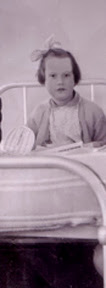
Mary Davies (nee Morris) -1951


Got this email from Mary to-day:

" Hey I would like to add to your site with my experiences.

I was in Craig-Y-Nos in 1951. The photo shows me holding a teddy bear taken in September it was a present from my family for my 9th birthday in August.
I don’t remember much about my stay only that I was out on the balcony and when I was rainy and windy they had to put tarpaulin on top of the bed to stop it getting wet. While in Craig-Y-Nos I made 3 good friends one was called Mary Jones one Jeanette Wakeham but I cannot recall the name of the 3rd one, we had a photograph taken but I can’t find it but will keep looking for it, and post it when I do.
I also remember doing lessons much to my disgust.

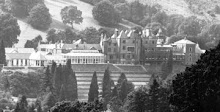
When I had a bungalow built I named it Craig-Y-Nos after my experience of the real Craig-Y-Nos, this is a picture of the bungalow.


I have been married for 46 years have 3 children and 4 grandchildren.

The thing that sticks out in my mind was my parents were only allowed to see me one weekend a month. They only came one day as it was too far to travel as we lived in Rhayader in Mid Wales

Mair Harris ( nee Edwards) 1950-52 and 2007

Mair and Nurse Glenys Davies

Mair and Ann


The photos were taken over 50 years apart: all at Craig-y-nos!
They show Mair with Nurse Davies and the lower ones are of Mair with myself. ( She reminded me that I was known as "Titch").


Mair had already started at grammar school when she went into Craig-y-nos as a 13 year old. She was there for 22 months, and she has “very pleasant memories”of her time on the balcony and the teaching she received from Miss White.

“She helped me enormously. By the time I got back to school I found I was not that far behind the other children.”

Unfortunately Mair was not able to finish her education because she had a relapse. But she later went on to become a librarian.


Mair ( in bed) with friends giving the Girl Guides salute.

Sunday, March 25, 2007

Pat Hybert ( nee Mogridge) -1951-53

Pat in the "six-bedder"


(from left to right) Pat, Jean and Babs

A disk full of photos of Craig-y-nos arrived this morning courtesy of Pat’s daughter who very kindly scanned them into the computer.

Pat was in the “six-bedder” as a 19 year old in 1951.
She says:”I recognise quite a few people from the photos you have put up on the net.
I remember Betty Jakes well. She was at one time living next door to me as we grew up.

"Betty was in Ward 4. I went to visit her in Morriston hospital after she had a lung removed and we kept in touch for quite a while.”
Betty now lives in Llanmadoc.

Craig-y-nos Castle : "the past is a foreign country"


“The past” said L.P.Hartley ” is a foreign country; they do things differently there.”

I am reminded of this as the story of Craig-y-nos Castle, the former children’s TB sanatorium unfolds.

Not only is it half a century back in time but the whole regime was so unusual, and because of the taboo surrounding the “white plague” little spoken about that only now is the true story beginning to unfold.

It is one of incredible optimism in the face of a bleak medical scenario. Until the event of drugs there was a 25 per cent death rate.

Technology is helping to piece together those memories of people who were there as patients, most of them now into their 60,70s and even 80s.
Their children, and grandchildren, are helping them gather up photos tucked away in family albums from this era and transmit them to me either by email or CD.

Saturday, March 24, 2007

Who are these girls- 1954


(from left to right):
Christine Bennett, Pam, Anne Thomas, Margaret and June. Is this correct? does anyone have any further information?

Inside Ward 2 - 1952


Both these photos were taken around the same time- 1952- and belong to the collection of Myfwany Blatchford ( nee Hoyles).
They tell very different stories: the unknown child with her bed on blocks inside Ward 2 with Norma and two teenage girls ( Mari and Florence) enjoying a walk in the ground.

Friday, March 23, 2007

Margaret Davies ( nee Maddock)-1951

Monday morning. Phone rings.
A lilting Welsh voice asks:”Are you still wanting ex- patients from Craig-y-nos?”
“Of course!”
“I was admitted in January 1951 into Ward 1."
“How old were you?”
“Four and a half. I left for Sully in February 1952."
We have a chat.
Her memories of Craig-y-nos are not pleasant.
“It was a terrifying place. I was the youngest in the ward and I only spoke Welsh. Nobody could understand me. There was a nurse, Auntie Maggie, who was Welsh speaking and that was a great help."

“I had to lie on my stomach and they put me at the foot of the bed otherwise I would not see anyone.”

She lay like that for thirteen months before being transferred to Sully for an operation to remove one lobe of her lung.

During this time she learnt to speak English and she recalls the ghost stories about Adelina Patti told by the older girls, often with the intention of frightening the younger ones.
“For years afterwards I slept with the sheet wrapped around my head.”

We share memories.

“I still sleep with a sheet around my head unless I am with my husband,” I say.
So powerful were those stories imprinted in my mind.

Like many of us Margaret has no recollection of Christmas or birthdays though she does recall going to see Harry Secombe in 1952.
“ My bed was wheeled down to the theatre. This was the only time, apart from x-rays, that I ever left Ward 1 in the 13 months I was there.”

She can’t recall any form of heating:
“ It was always cold and windy.”

Despite having lost nearly four years of schooling Margaret passed the 11 plus and went to grammar school leaving after her ’O’ levels to take a secretarial course.
After marriage and the birth of her daughter she worked as a practise manager for her local health centre in Penclawdd for 23 years.

(extract from longer interview)

"Auntie Maggie" on Ward 2 balcony


"Auntie Maggie" with Christine Bennett (right) on the balcony.
The two names that keep recurring in photos and stories are nurse Glenys Davies and "Auntie Maggie".
They are remembered with a great deal of affection by ex-patients for their kindness because they helped "humanise" the "Craig-y-nos" sanatorium experience.

Mary Davies ( nee Murphy) Craig-y-nos and Sully - 1951-52

Mary was only a toddler when she was admitted to Craig-y-nos in 1951.

She recollects being in the glass conservatory, ( the ward used for very small children) and her tears when her mother left.

“There was a black nurse and nurse Glenys Davies. I remember them. They were very good to me.”

Her father, a naval officer, had died of TB and her mother was told that she was unlikely to survive: “at one stage I was given 24 hours to live.”

After 14 months she was transferred to Sully for an operation. She still looks back upon the sharp contrast between the two hospitals.
“Craig-y-nos was dark, cold and close to the mountains. Sully was light, warm and near the sea.”


She recalls having to be reintroduced to her family when she did eventually get home.
“It was two years out of my life at a very young age”.

Mary is interested in finding out how other children survived the “Craig-y-nos experience because it was so unusual.”

Today Mary, age 56, is an art teacher, married, and living in Leatherhead.

She is the niece of Bridie Ronan, already featured in this weblog.

Nurses on Ward 2 balcony -mid 1950's


(Left) Nurse Faith Brown and unknown sister.

By this time the balcony had been enclosed . If you look carefully you can see the windows . True to tradition though they are wide open! I understand that the covering in of the balconies was the first stirring of "parent power".

Parents, so I am told, complained as they sat there with their hot water bottles that if they were cold then their daughters must be too!
All I can say is that they were lucky to get hot water bottles....

Thursday, March 22, 2007

Your age and the sanatorium regime

I thought at first that as the Craig-y-nos story unfolded there would be a noticeable change, a relaxation in the rules, in the sanatorium regime as the decades rolled by and this would be reflected in peoples stories.


True, the discipline was much more severe in the 1920’s and 30’s yet the regime remained surprising intact well into the 1950’s.

The crucial factors determing the kind of experience you had at Craig-y-nos was not the decade you were in but your age, and the stage of the disease, on admittance.

The younger you were the more upset you would be.


Yes I know its blindingly obvious to us today but in those days nothing was known of the psychological trauma children could suffer when removed from their families and placed into what would appear to a small, sick child as a cold, hostile, isolated environment.

I was reminded of this today when a woman rang up who had been in the children's ward ( the glass conservatory) as a 14 month old baby. She remembers forming a strong attachment to nurse Glenys Davies and a "black nurse" . Later she was told that her
mother was distraught because the child no longer recognized her. This was 1950.

Girls on stag - 1953


(back) Myfwany and Florence
(standing from left to right) Valerie and Mari.

The stag was a popular venue for taking photographs and it also marked an important step in your progress.
Your first five minute walk outside was between the two stags.

Eirlwyn - early 1950’s

At the end of the telephone interview Margaret Howells suddenly asked:
”Do you know what happened to Eirlwyn?”

“No”.

But I remembered Eirlwyn. She used to play with herself. They put her on the balcony thinking the cold weather and fresh air would cure her.

It didn’t.
One nurse threatened her regularly:
” I will tie your hands to the side of the bed if you don’t stop.”

It had no effect.

So for months, or was it years, Eirlwyn was in a corner of the balcony. Left to herself.
It was said she had TB meningitis and it had left her with brain damage. She had thick glasses, dark hair and was very quiet. Her parents rarely visited.

Eventually they moved her back inside Ward 2 so they could watch her.

And still she kept playing with herself.
So they put her in another corner.
On blocks.
That's how Margaret remembered her: tucked in a corner with her bed high on blocks. For years.

“I felt sorry for her,” added Margaret quietly.
“ and I often wondered what did happen to her.”

Wednesday, March 21, 2007

Mari Friend ( nee Jenkins) - 1950-53


Strictly illegal! Mari and Myfwany Hoyles boating with Alfie the gardener.

“I have very patchy memories of my time at Craig-y-nos. I know that after the first six months I was allowed up.

Midnight feasts
Mari on the castle roof

“I was one of the naughty ones. We used to have midnight feasts up on the roof. We had lots of fun even though it was a bit of a barracks.

I can’t remember any Christmases or birthdays.

Food
“The only food I remember is that on Wednesdays we had rabbit and mousse. I have hated them ever since.

“I used to smell food after I came out of Craig-y-nos. My mother couldn’t understand it. I wouldn't put anything in my mouth until I had smelt it first.”


Mari (right) with friend on the balcony of Ward 2

Treatments:
“One day a nurse came along and stuck a huge needle in my side. To this day I still don't know what it was for. It was very painful and it never happened again.


"My sister Lleu"
Relatives
“My sister, Lleu, was older than me and she was in Craig-y-nos at the same time. She talked of deaths in her ward but the children as far as I can recall didn't die.

Life after Craig-y-nos
I don't think the experience effected me afterwards though I do regret not having had proper schooling.”

Mari worked in the retail trade in Wales and then in London in Bourne and Hollingsworth returning later to Wales and training as a nursery nurse.

“As a single parent I had to find a job that fitted in with school holidays.”


Mari (right) with friend in the grounds of Craig-y-nos

Health
She was devastated a few years ago to find she had a recurrence of TB.:”They gave me tablets to take and I just stayed at home.” She suffers from rheumatoid arthritis and chronic bronchitis.


Family

Now married again Mari lives a few doors from where she was brought up in Ynsysgwas, Cwmavon. She has one son and two grand-children.

(Mari has an extensive collection of photos from her time in Craig-y-nos).

Tuesday, March 20, 2007

Christine Thornton ( nee Davies) - 1944-48 and 1952-53


Christine (left) on the balcony of Ward 2.

Extract from an interview with Christine, age 70, from Gorseinon, Swansea.


She recalls being: ”very ill” when she was admitted to Craig-y-nos as a 7 year old.

“I had TB in the hip and I was put in an iron frame with a bar separating my legs which were splayed out. I could turn my head from side to side and move my arms but my legs were strapped in this iron frame.”

She says it was Dr Huppert who discovered what was wrong with her and she believes she owes her life to her diagnosis. ( It is believed that Dr Huppert had herself suffered from TB of the hip).

“Dr Huppert was new in the hospital. She tried to straighten my leg and I remember screaming and screaming with the pain. She ordered me to be sent for an x-ray straightaway and the next thing that happened I was put in this iron frame in which I remained for a year then into a plaster cast and eventually into a calliper for my leg .”

Most of her time was spent out on the balcony.
“I was the only one in an iron frame, the others were in plaster casts. I was out there during the 1947 snow. The nurses were very good. They still came out to look after us.”

She used to eat by balancing food on her chest.

During this time she remembers there were parts of her body that were never washed though the nurses used to raise her up to put metholyated spirits over her bed sores.

:” I still have those scars today. As a child you accept it as a normal.

“It was either that or die. I believe Dr Huppert saved my life.
I know I nearly did die. The doctors told my mother that even if I survived I would never be able to walk again.”

Christine (wearing white hat) at a concert in the Adelina Patti theatre.

She was to prove them wrong. Despite a relapse in her late teens when she was readmitted to Craig-y-nos Christine went on to become a secretary in London, and later worked as both a secretary and store detective in Swansea.

“Folk never thought a lame woman would be a detective!”


Christine (left) in the "six-bedder" with Barbara Hughes.

Altogether she spent a total of 5 years in Craig-y-nos , 3 and a half years in the 1940’s and again in the 50’s when she had a relapse.


Christine with her husband .

Monday, March 19, 2007

Margaret Howells - 1955


Out of Bounds!
Ward 2 girls take to the water: three in a boat with the gardeners Edgar, Arthur and Leslie, the apprentice.
Margaret wrote on the back of this photo:

” the one with the glasses was nice, the other one was a bit forward! “
(Note where his hands are on June’s bosom!)


Margaret Howells rang me this afternoon.
“Do you remember me? We were in Llanbedr junior school together. “
She went into Craig-y-nos in 1954, five months after I left, and was there for 18 months.

Margaret lived at Ty-Croes farm, a remote smallholding high on the Table mountain above Llanbedr village.

“Our cottage had no electricity. We had nothing to do in the evening except sit around the kitchen table, and talk would get around to TB and how it had wiped out whole families in the area.

“I was in Crichowell hospital for a time then I got moved to Craig-y-nos. I asked the girls what was wrong with them and each one said “TB” and

I said ‘I've got pleurisy" and they said:

“No you haven't you’ve got TB like the rest of us.”
Well, I cried and cried for weeks cause I thought I was going to die.


“But streptomycin had arrived. I was one of the lucky ones.
“Once I realised I was not going to die I enjoyed myself at Craig-y-nos.


Margaret Howells ( right) with Christine outside the summerhouse.

“I was very happy there. I am gregarious by nature and I loved the company.
I remember one summer helping the gardeners pick caterpillars off the cabbages.
We used to have Guides with sing songs around a “pretend” fire in the middle of Ward 2.

“Dr Huppert was a nasty bit of work. She announced one day who the girls were who were allowed to put curlers in their hair and who was not allowed. She said I could but the other girls wouldn't let me. They said if they couldn't have curlers then neither was I.

”Craig-y-nos brought me out. It gave me self confidence. All this happened once I realised I was not going to die.

The staff were very good. They did our Christmas shopping for us from the Boots catalogue.

Going home was an anticlimax. I was on my own in this remote cottage as my parents were out working. I went back to school for a year then moved away from the area and got a job looking after children in Porthcawl.”


Now married with 3 daughters and 6 grand-sons, Margaret lives in Aberpergwm, near Glynneath.

Sunday, March 18, 2007

Education - 1962

This is an extract from a letter to the Brecon chief education officer in 1962 regarding the school in Pontywal hospital school, Talgarth ( where children were transferred from Craig-y-nos) over the appointment of a new teacher:

"I wish to state that Mrs Weale who holds this appointment in a temporary capacity has proved herself satisfactory in every way. Her firm but kind sympathetic understanding of the children quickly gains their respect and confidence.

This is an important asset at all times but is especially important when dealing with sick, often spoiled, children who are parted from their parents' for long periods.

I would add that Mrs Weale adapts herself willingly and wholeheartedly into the many unexpected conditions which arise in a Special School
yours faithfully

Mrs Freda Gonzalez. 22 Nov 1962"

(Source: Powys archives, Llandrindod Wells)

Patti's bedroom - the "six-bedder"


Reading through Jean’s account of her time at Craig-y-nos it struck me how the sanatorium regime varied according to the year you were in.

This is one possible explanation why so many people have such different memories of the place.

Take for example her account of freely visiting patients in the “six bedder”, Adelina Patti's former bedroom used for young female adults.


During my four years there in the early 1950’s this was strictly forbidden. Indeed I never did see inside the “six bedder” until I visited Craig-y-nos last year , some 50 years later.

Today it is derelict, and used for ghost hunting seances.

Jean Hopkins ( nee Phillips) - 1942

Jean was in Ward 2 with a TB gland in the neck as a 12 year old. She was allowed up and spent most of her time on the balcony.

This is an extract from her own written account:

“We lived in Swansea, so the journey there by bus seemed to go on forever. Mum and Dad were with me, which was very comforting. Thank heavens I was not aware of it, but I would in fact be spending my 12th birthday in July and Christmas 1942 as a patient there. I can remember feeling very sad and lonely after they had left, I know I cried quite a bit that night.

The trouble was I was the eldest child in the ward, so I could not let the younger ones see me sad. Jean Caldwell who was a year younger than me, became my friend, and after I was discharged in January 1943 she remained there.
Jean’s home was in London. She had been evacuated to relatives in Neath.
.......
“I had what was known as the “sun ray treatment”. We patients sat in a circle around a contraption, which today seems antiquated. We were given very dark goggles to put on to protect our eyes from what I can only describe as a sparking flame.

“When a new girl was admitted it was a pleasant change. I can remember one such patient arriving and was duly settled in the “six bedder” ( Adelina Patti’s former bedroom).
We were allowed to pop in to see the six patients any time we pleased.

This new patient introduced us to her hobby of writing to film stars for an autographed photograph. I for one threw my heart and soul into this and was soon in receipt of my very first one, Gene Autry and his horse Trigger.

.....
The male children were in the ward below us. Jean and I would write little notes to the boys below and lower them on pieces of our knitting wool. When someone discovered what we were up to, it was frowned upon and had to stop.

.....

All our crockery and cutlery were numbered; this enabled each patient to have the same set each mealtime. If my memory serves me correctly, I was number 44.

....
One devastating blow was the fact the children were only allowed visitors once a month. All the time I was there I did not see my three brothers and little sister who was five years old. My eldest brother says he did come to Craig-[y-nos -y- one occasion,and can remember waving to me from the courtyard, and not quite seeing me distinctly at the window.

My time was spent reading, doing jigsaws and knitting. One idiotic rule I can remember was no knitting on a Sunday.

Sister Morgan was very kind. I do not know how often we had films in the theatre. Sister Morgan would take me on the promise I would not tell the other children where I had been. ...I cannot remember how I explained my absence to Jean.


We had a lovely big Christmas tree in the ward. On Christmas Eve the nurses toured the ward singing carols. Christmas morning when we awoke there were presents for everyone at the foot of the bed.

We had a very brief period of schooling. A teacher called Miss Watkins was the unfortunate one sent to educate us. I say unfortunate, as Miss Watkins had one heck of a task dealing with children whose ages ranged from five to twelve years old. At the end of term not to anyone’s surprise I was top pupil.
I still have my report.”

Early 1950's


Marilyn and Shirley out on the balcony, early 1950's.
(No further information known).

Saturday, March 17, 2007

Adelina Patti and "The White Lady"


I was sent a copy of this readers letter the other day from Swansea.
It appeared in The South Wales Evening Post on March 2 1993:

“ Here is an anecdote I heard from a relation of a former butler at Craig-y-nos.
Madame Adelina Patti was walking in the surrounding hills and remembered she had to send a telegram.

At a village post office she said what her name was and that she had no money but wanted to send a telegram.
The Postmaster said:” How do I know you are Madame Patti ?” whereupon she stood back and started to sing thus proving who she was.”


Photo: Dorothy
“The White Lady”, the name given to the ghost of Adelina Patti, was a constant mysterious invisible companion in our childhood years in Craig-y-nos.

As children living in her former home we were less impressed with Adelina Patti's singing than her facility to materialise long after her death.

Once I was told by Dorothy, in the next bed to me, that The White Lady always appeared at the foot of the bed of the next girl to die.
Dorothy then announced she had seen her at the foot of my bed and that she had started to walk up to touch me.
I burst out crying.
“I don’t want to die!”.
Whereupon Dorothy had a re-think:” Don’t worry, she went away again.”

Nevertheless for weeks afterwards I would enquire about the exact presence of the White Lady in Ward 2.
Dorothy had as special gift, she told me, which allowed her to see "the other world".

I was 9 years old, and believed her.

Horace Batts - 1933


Top : Horace Batts
Bottom: Horace in his chauffeurs uniform with his employer’s car in Hay, 1920.

One of the first people to respond to my request for information was John Batts in Australia. He picked up the story from the BBC Mid Wales web-site, and he referred me to the archives in Llandrindod Wells where letters and photographs of a distant relative of his were kept.

They offer a rare glimpse of the sanatorium regime inside Craig-y-nos in the early 1930s.

Extracts from letters Horace wrote to his family:

Letter 1:
“We had a nice service on our wireless Sunday night. I have thought of Sunday nights I should have gone to chapel but never did I wish now I had but if God will spare I bet I’ll be different I’ve said that before haven’t I though?

Will Mam and all thank Mrs Prosser for sending eggs etc.
must close now all my love from your loving brother Horace”


Letter 2
“Since writing this I have been put on absolute bed rest...can’t write a letter, no visitors . This will be for 3 or 4 weeks to get my temperature down.
I have to be fed and can’t do a thing for myself, starting tomorrow. I can receive letters tell B don’t worry it’s all for the best please God, I might get someone to write a letter for me...love Horace

PS Don’t forget I can’t see any visitors.”

Letter 3
“Well Jill I have been put on absolute rest which means I must not move in bed, receive no visitors, write no letters, have everything done for me even to being fed, it’s to get my temperature down I suppose, don’t worry will you.
I can receive letters though you can write to me Jill only I mustn’t write.

Can you manage to send me a pair of pyjamas, the ones I got are a bit thin one pair anyway Jill.
Well, Jill it’s all for the best, I may be on this rest for or 4 weeks.


Letter 4
Dear Jill
“Just a line, I wrote to you on Sunday and gave it one of the visitors to post in Swansea. I hope you had it all right.
Thanks very much for parcels Jill and postcards they do cheer me up so I haven’t had those books the chauffeurs wife sent yet.

I should like to be down with you in the sunshine of Bournemouth.”

Letter 5

“Dear Mam and all,
Just a line on the q.t. Tell Mrs P not to send any more cakes as cakes are not allowed.

I shall want some eggs and fruit, you can send bananas, apples etc. but no pears. Sister opens all my letters, parcels, just slits them that’s all so be careful what you are sending; can you send a bandage.

It’s a funny business this being fed and everything. I have gone thinnish but that is to be expected. Remember me to all. Thank Benzo for letters. I had a pair of pyjamas from Jill but they had to be washed before I put them on.
All my love..your loving bros Horace

PS. We had a service on wireless on Sunday.”

Horace died shortly after this letter was written.

(Source material: Powys archives, Llandrindod Wells)

Friday, March 16, 2007

Hospital records-Mari Friend ( nee Jenkins)

Ann Shaw ( nee Rumsey) ( left) with Mari Friend ( nee Jenkins) Ward 2 balcony, 1952.

Mari wrote to Ystradlynglais community hsopital and received this reply saying they have no records of the time Craig-y-nos was a TB sanatorium. So what's happened to them?

John Nelson - 1947


John Nelson sent in this account:
Aberdare Monday 12 March 2007

"Idly using the laptop yesterday I typed 'craig-y-nos hospital' into Google, (strange that these words are still lodged in my memory after 60 years), and I was delighted and amazed to be taken back to my early childhood, such stories of so long ago…and I was there.

After visits to the clinic in Cathederal Road in my home town of Cardiff and scrutinising
the x-ray machine it was decided that I needed to go to Craig-y-Nos for a while, I was about 9 or 10 at the time.

I arrived some time in 1947 or 1948. My mother and I travelled from Cardiff and it took all day, the final leg of the journey being by bus (?) from Swansea.

I am amazed at the proliferation of photo's and memories from so many ladies on record, I cannot remember seeing or passing any of the fairer sex during my 15 months here apart from the nurses, possibly I was not observant enough. My recollections are of some boys but mainly
older men.
The ward I was in was just inside the balcony…plenty of fresh air inside and I was not envious of those consigned to the balcony. Their lives must have been hell in the winter, beds covered with a tarpaulin to save the bedding getting wet!

I would suggest that their lives where shortened by this primitive (“cruel“?) treatment…its more like death by mis-adventure. Thank the Lord that such harsh treatments have disappeared due to the advancement of medical science.

In my time there us youngsters were allowed onto the balcony and we would chat to the friendly bedridden who I think welcomed a fresh face.
Sometimes the person you had been talking to one day was not there the next day..…just an empty unmade bed! This happened too many times. It was a scary lesson to learn for someone of a tender age.

One other form of “cruel” treatment that upset me was the sputum check. A thin tube was passed up through a nostril where it then descended, passing the throat, into the stomach when a sample was siphoned off. The tube , when passing the sensitive throat area, always made me want to vomit.

I have no bad impressions of my stay at the Castle, the medical treatments were usual for the time and one can see now that they were rather primitive by the standards of today (to be polite).

I seem to remember that the BBC came to visit at one time and a programme was recorded,
whatever it was we were able to listen to it on the wireless.

The only regret I have now is that I cannot recall having any schoolwork at all during my stay. I later failed my 11 plus and I always put this down to this gap in my education. But perhaps I am not being fair here, it was 60 years ago and my memory is not first class. I hope to investigate this further through the link on the blog.

The question that has always intrigued me is the psychological effect of being parted from family and friends for such a long time, the strain on parents on having a child such a long distance away out of their control and the long term effect on the young immature patients.

I remember having a visit only once a month…a terrific wrench for both parent and child. For a parent to visit in my case meant a long days travel from Cardiff and back plus paying for the fares and they certainly were not rich.

After 15 months at the Castle I was moved to Highland Moors in Llandrindod, spending another 9 months convalescing, then back home to Cardiff.

T.B. is a great nuisance…after about 6 years it came back to annoy me for another two years, 18 months in Talgarth H block and then a little visit to Sully where they snipped out the naughty T.B. from my right lung. I enjoyed it at the seaside…..it was warmer than the Swansea Valley!"

.

Thursday, March 15, 2007

Gastric lavages and guinea pigs

What's the story behind gastric lavages?

The following explanation is given by Dr Carole Reeves, Outreach Historian, the Wellcome Trust Centre for the History of Medicine, University College London.

"The gastric lavage / guinea pig story is as follows: Bronchial and gastric lavage are established methods of obtaining cells and fluid contents for analysis . It's very difficult for children to produce sputum from the mouth by coughing and hawking but they will swallow sputum after coughing. Gastric lavage is therefore the only way that enough sputum (and bacteria) can be collected. The fluid is injected into guinea pigs. If they become infected, then the child still has active disease. Guinea pigs were also used to test resistance to streptomycin.


Bacteriology has moved on from guinea pigs to culture plates. Sputum or other samples are spread on plastic disks impregnated with a growing medium such as a gel. The disks are incubated at high temperature to encourage the growth of bacteria, which is then analysed under the microscope to determine the type of organism."

Roy Harry - 1944


This is an extract from Roy Harry’s memories of Craig-y-nos. Roy has also given a full “oral history” recording to the Sleeping Giant foundation in Abercrave. Now retired Roy worked most of his life as a lecturer at Atlantic College.


“ I was born on 11 July 1941 and I was probably over 3 years of old when I was admitted.

“When my mother left me on that first day I cried and screamed for her to take me with her. I climbed out of my bed and ran after her but I was carried back and strapped into my bed with a harness.

I still remember the awful feeling -I screamed and tried to reach the buckles.

I think my worst memory of Craig-y-nos was going to a treatment room which I thought was out through the double doors, a short way along the corridor and on the right. Here some nurses - 2-3- would try and put a rubber tube down my throat. It was very unpleasant and I would shout, cry and grip the tube between my teeth to stop it going down. A Sister Powell would intervene and she would complete the procedure. She was much more forceful and threatening and as a result I was terrified of her. I remember nurses would get me to comply with their requests by saying they would send for Sister Powell.

I have no memories of leaving the ward to explore or play, except to move to a small room for a while where myself and another boy of about my age stayed for some days or weeks.

Pat and Caroline 1952


Apart from being taken on the balcony of Ward 2 around 1952 nothing is known about these two except that their names are Pat and Caroline.
Anyone throw more light on it?

Photo supplied by Marilyn Blatchford ( nee Hoyle)

Wednesday, March 14, 2007

Bridie Murphy- 1927

Bridie Murphy was 7 years of age when she was admitted to Craig-y-nos in 1927.
Now 87 years of age Bridie worked as a nurse all her life in Swansea, had six children and moved to Edinburgh a few years ago to be near her daughter.

She climbed Mount Sinai in the Egyptian desert when she was 75 years of age, flew in Concorde to New York at 83 years of age and is now learning to use a computer in order to trace her family history.


Bridie has sent in this account:

“Dr Clark was the lady Medical Superintendent on my admission to Craig-y-nos in 1927.

She stands out in my dodgy memory because I believe that, above all else, it was she who was responsible for my cure. She had silky silver hair and a friendly sympathetic manner.

Following a lengthy assessment by Dr Clark and two other doctors on the first day, I was carried by a porter to the x-ray department. Next day I was taken to have a plaster cast made, which was moulded to the shape of my body, from neck to feet. It was designed to immobilise my lumbar region and legs while allowing limited movement for my arms. l It was well padded and fairly comfortable, and I was raised- complete with plaster cast- one foot above the mattress on wooden blocks to provide access for the excellent nursing procedures the beds also had large castors to give easier movement when needed.


The nursing staff were especially trained to care for children and young people,and I remember them all as dedicated, cheerful and always very kind to us.

Our balcony was home to ten young females, all like myself in plaster beds. In the next bed on my left was teenager Agnes Jenkins from Abercrave. She, poor girl, had Kyphosis ( curvature of the spine). I really pitied her, but Agnes was a strong character and she coped well. We became great friends.


We all suffered from back pain, but my own was very slight compared to others and it wasn’t long before I became pain free. Sometimes at night, when I heard my little friends groaning and often screaming, I got upset and cried for them."

Dr Williams with patients


They are ( from left to right):
Jean Shakeshaft, Dr Williams, Mari Jenkins, Norma,
Alice and 2 unknowns.
Photo supplied by Myfanwy Blatchford (nee Hoyles) taken around 1952 when Myfanwy was in for five months as a 12 year old.

Tuesday, March 13, 2007

Visitors Pass - 1924


This is a copy of Moira Morgan’s visiting pass for 1927.
It says:

“Visitors are admitted to see patients on Thursdays from 2-4 p.m.
For Medical reasons it is sometimes undesirable for patients to see their friends.
Children under 12 will not be admitted.
Visitors may bring fruit flowers and tobacco to their friends, but nothing else.

Not more than two persons are permitted to visit a patient on the same day.

Moira Grace Morgan - 1924


Bridget Robson from Northumberland has sent in the following account of her mother’s time in Craig-y-nos in 1924.

“My mother, Moira Grace Morgan of Garden City Llangennech was in Craig-y-nos in 1924.

She was suffering from acute asthma at the time and was sent there for the “clean fresh air”.
However, it was not to be one of her favourable memories - I do not think that they were that kind in those days.

Moira was born on the 23rd December 1918 and spent her 6th birthday there.
The Christmas tree is decorated with all the toys that the parents and visitors brought in and handed over to staff to put under the tree.

My mother says she never got the doll her mother brought in - so sad.

My mother is in the middle of the picture, the one wearing a white hat with a tassel.”

Moira’s parents were David Charles Morgan and Gwendoline Hannah Morgan (nee Thomas) both from Llangennech.

Monday, March 12, 2007

2 unknown nurses -1952?


Who are these nurses?
that's Mair Edwards in bed in the background.
Photo supplied by Mari Friend ( nee Jenkins) of Cwmavon.

Glynne Lowe, patient in 1927

Glynne Lowe, age 86, from Brecon is one of the oldest ex -patients to make contact.
This is an extract from an interview he did with Caroline Boyce:

“I was 6 years of age when I went in during 1927
and I was there for 7 months before being transferred to Talgarth.
“I have no memory of treatment, apart from lying in bed, though I do remember having red sores on my legs and I still have the marks today.”
“The beds were white iron cots there were 10-12 beds and possibly more in a middle row in the ward.

He has no memories of the food , or of being cold-”you don’t feel the cold when you’re a kid.”

He recalls eating at a table at one end of the ward.
“They kept sweets there, and we were given sweets after dinner.”

Christmas at Craig-y-nos:” I remember being entertained in the Adelina Patti theatre by Harold Elston, who was a ventriloquist, and Mr Whitney, a butcher who did conjuring tricks. At the end there was a big box of sweets thrown to the children.”

Glynne went to Craig-y-nos on the train from Talgarth to Brecon, then Brecon to Peny-cae station where an ambulance took him to the hospital.

He doesn't think his mother came to visit him in Craig-y-nos : “she may have, she may not have” but cousins from Aberdare came to see him.

“I didn't like it much at Craig-y-nos - a miserable damn place.”

Married with children, grandchildren and great-grandchildren he worked most of his life selling tractors, his last job being at Elston garage in Brecon.

Wilfred Pickles and the chocolate - 1955

“Remember Wilfred Pickles on the radio? I was there when he said one day that he wished he could give a bar of chocolate to every child in Craig-y-nos. Well, the next thing we know boxes and boxes of chocolate start arriving ! we had chocolate we had never seen before.”
(Story from Margaret Howells, age 65, originally from Llanbedr, near Crickhowell now living in Glyneath.)

Sunday, March 11, 2007

Who are these girls in Ward 2?


Do you recognise anyone?
I think that's Maureen on the left. e-mail me if you know- annshaw@mac.com
Photo supplied by Mary Ireland ( nee Jones), taken around 1952.

Saturday, March 10, 2007

Ann Shaw ( nee Rumsey) reading -1952


This is a photo Mari Jenkins took over 50 years ago.
One of the extraordinary aspects of researching this project is that we find ourselves looking at photographs which we never knew existed.

It's like visiting a foreign country. Was this really me? Were the beds that close together? Once we were allowed up we had nowhere to go so we sat on our beds or went for a walk in the grounds - between 2-4pm.

Often on Monday afternoons there would be a film and on Saturdays an occasional concert in the Adelina Patti theatre . If you were up you were allowed to go to them. Some photos have come in showing that in the 1940's children would go even if they were in bed. They were taken there on stretchers and wheelchairs.

This had certainly been stopped by the time I was a patient.

Sandra Thomas ( nee Elson)

Sandra Thomas of Tudor St., Ystradgynlais wrote:

I was in Craig-y-Nos as a patient for the three months before it closed as a TB Sanatorium.  I was amongst a group of children in the Headmaster’s class in Talgarth CP school who caught TB.  The Headmaster’s wife had the disease and had discharged herself from hospital.  The Headmaster contracted  it and had two cavities in his lungs.  We were 10/11 year olds.
 
My memories of those three months are a bit hazy.   I was admitted into the ward and afterwards was put out on the balcony.  I was confined to bed for three months, only getting out into a wheelchair for x-rays.  Without transport it was difficult for my parents to come from Talgarth to Craig-y-Nos to visit me.
 
There are two incidents that really stick in my memory. 
 
The first is when my parents took me into Craig-y-Nos I took a pink and silver tin with biscuits and sweets in with me, given to me by a shopkeeper in Talgarth.   Dr Hubbard took the tin from me as soon as my parents had gone and distributed it amongst all the children in the ward.  It’s not that I was bothered about the contents of the tin but it was as if she had taken my security away from me.  We used to call her ‘Old Mother Hubbard’, we were all scared stiff of her.
 
The second is that one night, quite late when out on the balcony we all heard quarrelling  below in the gardens.  When the quarrelling stopped we heard beautiful singing from a female voice.  There was nothing on in the theatre that night.  We told the nurses the following morning but were more or less told that we had imagined it.  We were convinced that it was the ghost of Adelina Patti singing.
 
All told I was in hospital for almost a year.  When Craig-y-Nos closed we were ambulanced up to Bronllys Hospital where I spent the next nine months.  This made it much easier for my parents to visit me as Talgarth is only down the road from Bronllys.
 
I remember Doctor Williams in Craig-y-Nos and also Dr Mulhall when we moved to Bronllys.”


Dr Ivor Williams' daughter.

E-mail from Mary:

“I remember Dr Ivor Williams because he was my father! I am Mary one of the two daughters. I was thrilled to access this site via my first cousin's wife Clare!
I, needless to say have many memories, but will take some time to find photographs.

Very amused to see my old pony Tosca. Obviously being ridden while I was at boarding school! “

Friday, March 09, 2007

Nurse Glenys Davies with Muriel


Many photos have come in of Nurse Glenys Davies, surely the most photographed nurse in Craig-y-nos.
Here she is with Muriel. No more details are known.

I have just realised two facts about this photograph. Muriel is in the exact spot in Ward 2 where I spent the first year of my life in Craig-y-nos only leaving it to go for the occasional x-ray.
Secondly today is March 9th, a date that always gives me a queasy feeling cause that's the date I was taken to Craig-y-nos over 50 years ago , and mother told me I was only going in for three days. I was in for 4 years and 3 days.

( Have just returned from Dahab in Egypt and arrived at midnight in Glasgow. We had a very scary landing, or rather we didn't land but took off again at great speed into an enormous snowstorm. Worse, the captain was silent...for a long time. Eventually his voice came over the intercome and he said he was going "to attempt a second landing".
Everyone clapped when we finally touched down. )

Thursday, March 08, 2007

Mary's return visit


Mary Ireland ( nee Jones) was in Ward 2 from 1950-52. She used to live in Llangattock, near Crickhowell and my mother often gave her a lift. Now Mary lives near Gloucester.

Wednesday, March 07, 2007

Rosina May Landers - Craig-y-nos- 1940-48


This photograph was sent in by Avril Owen of her mother, Rosina May Landers.
It was taken in Craig-y-nos sometime between 1940-44.

Avril from Brynmill, Swansea, says:"My mother died in 1948 when I was ten years old."

Tuesday, March 06, 2007

Pamela Hill 1958-59


Pamela says:

“One of my memories is being given a children's writing set while I was in hospital and I wrote to my father in Talgarth and also to my mother at home. I used coloured pencils and play stamps but both had my letters.

My mother was very upset when she had mine as I asked her to visit twice a week* and she could only come once a week as she was also visiting my father once a week in Talgarth.

My mother remembers Dr Huppert. She told my mother I was dull. My mother was very cross with her and said that I was quiet and if she talked to me I would answer her.
The next time she told my mother she had made a mistake and that I had a reading age of 11 at six years of age.

My brother was 3 years old when I was in hospital and sometimes mother brought him down and a nurse would look after him in the courtyard.
I was in the ward with windows over the courtyard. Robert, my brother, would sing songs up to me and always had an audience at the window. He had a cowboys outfit for his 4th birthday and I can remember him outside in it singing to me.


I can remember being very upset when my mother left. I remember being wheeled out in my bed onto the landing because they said I was disturbing the other children.”

* In the late 50’s childrens visiting was allowed every weekend instead of monthly.