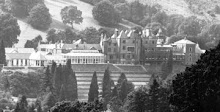
Friday, November 16, 2007

Vera Blewett (nee Paris) 1942-45


Christmas in Craig-y-nos. Vera in her cot

Going into Craig-y-nos in 1942

"My father was away fighting and my mother had died from TB, and then obviously they found that I, too, had it, and then I was in Craig-y-nos for, I understand, a year and eight months. But as a very small child, I would say two to three-years-old. I just don’t know.
My mum died March ’42. … I was born in December ’40.


I was institutionalised for a year and eight months instead of being with a family. That has an effect on you for the rest of your life.

The family secret
It was many years later that I found out that the mother I had wasn’t my real mother.

I was about, seventeen.
My real mother had died in March ’42 and my father had remarried.

Part of the story really is that within a few months of my finding out this big family secret, my father died.

So, any thoughts I might have had of talking to my father about things when I was little and my mother, I never had an opportunity. I think I found out about it in the spring of 1957 and my father died in November 1957. So, again, you know, I’ve had nobody to talk to. This is why I responded,( to the article in the South Wales Evening Post) thinking I might find out something, but I didn’t know what I might find out.


Time in Craig-y-nos
I was there a year and eight months. Somebody must have told me that, and do you know, I don’t know if that’s true.
That is what I was told. Obviously, I couldn’t refer back to my mother because she died anyway before I went there, and it wasn’t until I was sixteen, seventeen that I found out that the mother I had wasn’t, in fact, my real mother. So, I’ve never been able to talk to anybody about it.

Return to Craig-y-nos “we don’t talk about that”
Many years ago I went to Craig-y-nos with a group of people.
We ended up there for tea. And I talked to somebody there and said I was a child there and what he told me, and I can understand it, they don’t want to talk about that, you know. That is when it was a sanatorium and it’s as if they’ve swept it under the carpet. They don’t want to talk about it.

I was on the premises and I thought, well, I spent a year and eight months of my life here. Perhaps there’d be some photographs hidden away that I could have a look at, but the man I spoke to, said:, ‘No, we don’t talk about that.’ It’s as if that was in the past and not very nice to talk about and that was it.


The photographs
Now, a very dear friend of mine, I was showing them to her, and she’s a retired nurse, and when I showed her the photographs, she said to me, ‘I know that nurse. She used to work in Swansea General Hospital,’ because I live in Swansea.

And she knew her.
This nurse that was in Swansea General Hospital had also been in Craig-y-nos, and she was holding me actually, I think, in the photograph.

Singing hymns
I’m told that when I came out of hospital, the thing I loved doing most was sitting on the stairs singing hymns. Now, this nurse that my friend pointed out, apparently, was very religious. So there’s no doubt that whilst I was in Craig-y-nos, she obviously taught us hymns.


Another connection
My dear friend pointed out another nurse, who was in the photograph, and that was her mother’s best friend. Now, I thought that was amazing. And here was I, Ann and I, great friends, and her mother’s best friend must have nursed me as a child.
The local newspaper
A little fluke is the fact that I got in touch. I saw a little notice in my local newspaper. Now, I don’t take the local newspaper ever, but somebody must have given me that copy, and you know how it is, you read anything. They gave it to me and I spotted that little item and that is how I responded. If that hadn’t been given to me, I wouldn’t have known about it.

Searching for my past
I don’t know what I was hoping when I responded to the appeal in the newspaper. It’s something in my very distant past. I mean I’m sixty-six now, sixty-seven at the end of the year, and it’s a part of my life when I was very young that I really know nothing about.

Only memories of Craig-y-nos
I have only three very small memories of my time at Craig y Nos. I didn’t mention them to you at the time because I felt they were too insignificant, but as they are the only memories I have, I will share them with you.

1. Being told by another child that my ‘mother’ had come to see me. This would have been my stepmother of course. I have no recollection of her visit.
2. Some excitement about a concert? Someone (a doctor?) was going to make a violin sound like a cat. No memory of ‘the concert’.
3. Coming out of Craig y Nos and seeing sheep on the hillside opposite. I don’t remember anything about the journey home.


The affect of the Craig-y-nos experience on my life
When we talked earlier, you asked me whether the experience of being in hospital affected me later in life. I didn’t want to discuss it at the time but I have to admit that it probably did. I could probably sum it up simply by saying that:-

I have always craved affection.
Family has been all-important to me.
I don’t find it easy to be ‘touchy-feely’ (My two grandchildren in Kent are an exception).

Marriage
I divorced my husband many years ago and I’ve got two daughters but they live away from Swansea. One lives in Cyprus and one is in Kent.

Vera Blewett ( nee Paris) would love to make contact with either staff or former patients from the early 1940’s.
If you would like to contact me then I will pass the details on to Vera. e-mail: annshaw@mac.com


This is an edited account of an oral recording given by Vera Blewett to
Dr Carole Reeves, Outreach Historian with The Wellcome Trust Centre for the History of Medicine, University College London.

Thursday, November 15, 2007

Valerie Brent, ex-nurse Craig-y-nos, 1940's


Valerie Brent


Valerie Brent, former nurse at Craig-y-nos during the 1940’s and author of Life isn’t all kiwi and oranges, rang to say she met up for coffee with two ex patients in the Dolphin hotel in Swansea.


They were Mary Richard's ( nee Driscoll) and Vera Blewett ( nee Paris).

Vera was admitted as an 18 month old toddler in 1942.

She was in the Glass Conservatory but before Valerie Brent’s time (1945-47).

However she was keen to find out from Valerie what it would have been like for her to have been in Craig-y-nos as a toddler.

Her own mother died of TB before she came out and her father was away in the war. He subsequently remarried and she did not learn until she was 17 years of age that her stepmother was not in fact her real mother.

Now she is anxious to try and piece together her own early history.


Valerie was able to paint a picture of life in the Glass Conservatory during the 1940’s.


Valerie told her how the sweetie tin would be handed around three times a day after each meal, how the nurses would have singsongs in the ward with the children: ”The sun has got its hat on” and “Its a hap..happy day.”

Most of the children would be kept in cots and most would be tied to the bed: ”You had to otherwise they would get out.” Every so often though a nurse would unloosen the restraints and play with a child.

“But you were not allowed to leave a child untied alone, so it would only be for a short time.”

She remember two and three year olds “having little tantrums”.

Gastric lavages were carried out on children in the Glass Conservatory starting from about around three years of age.

Valerie recalls:
“ You had to watch your fingers because the children would bite you.”


Valerie recently took two visitors up to see Craig-y-nos Castle.
“They made us welcome and gave us a free cup of coffee.

Vera Blewett ( nee Paris) would love to make contact with either staff or former patients from the early 1940’s.
If you would like to contact me then I will pass the details on to Vera. e-mail: annshaw@mac.com

Wednesday, November 14, 2007

Craig-y-nos: Inside-Outside


Christine with her birthday cake on the balcony


An e-mail from Christine Bennett reminds me that patients memories of Craig-y-nos covered the whole spectrum of experiences and depended very much not only on age and year but also on the ward.

Those, like Christine, who were there on the balcony in the late 1950’s, have happy memories.

Christine says:

"I know that my almost four years there were, by and large, happy years.
 
I know that being a teenager, & a post-streptomycin patient, probably made all the difference to my positive memories of Craig y Nos.”


This contrasts sharply with many of the painful stories we have heard, most pre-streptromycin.

But some have been amazingly stoical accounts of children having endured what in retrospect seem primitive treatments and procedures, a sign perhaps of the resilience of children and the power of the human spirit to survive often in bleak circumstances.


Craig-y-nos Castle viewed from the lake

Those who have come forward and volunteered their stories are the survivors. Inevitably they are a self-selected group.

We know nothing of the stories of those who died there or were sent home to die.

Nor do we know anything about the children who were abandoned at Craig-y-nos. For this dark story is only now beginning to emerge.

I know from my own time there of two such children, both had TB meningitis and their brains were affected, and their parents had stopped visiting.


Another curious fact : hardly any girl from within Ward 2, either on the teenage ward on the first floor or the childrens ward on floor 2 have come forward to be interviewed.
Most of the stories are from girls who were "on the balcony".

Ward 2 had 36 beds of which around 7 were on the balcony. That leaves 29 girls unaccounted for.


Why the silence from the girls indoors?

Meanwhile plenty of young women have come forward from the Annexe and Six-Bedder wards with a fair sprinkling from Ward 1 and the Glass Conservatory.

The reason for this is unclear. Perhaps someone can come up with an explanation.

Tuesday, November 13, 2007

May Bennett ( nee Snell)- mid 1950's


May posing on the balcony of Ward 2. (mid 1950’s)

This is one of 40 new photographs to be seen for the first time in public next week when the exhibition opens in Brecon Library on Friday November 23rd.

Monday, November 12, 2007

Staff - Craig-y-nos 1960


This is the last official photo of staff at Craig-y-nos before it closed in 1960.
The question is: who are they?

Brian Jones, whose parents worked there, has offered the following names:

front row: first 6 not known, then Dr Huppert, Matron Knox-Thomas, Dr Ivor Williams, Sister Powell, next 6 not known, Edgar Davies (head gardener)

2nd row: John Barrows (engineer), Mrs Getta Hibbert (nurse), next 18 not known

3rd row: John Heavens (porter), next 17 not known

4th row: Cliff Bannister (porter), next 14 not known, David Richards (chauffeur), Jack Walters (painter)
Back row: Ken Lewis (job?), not known, Arthur Hales (gardener), Daniel John Price (gardener), a painter, next 6 not known


If you know any of the people I would be most grateful if you could let me have their names.
Thanks!- email: annshaw@mac.com

Sunday, November 11, 2007

Mary Davies (nee Morris) - return to Craig-y-nos


Please be patient with this video clip- it's got a slow start but gets better!

Mary Davies ( nee Morris) returned for the first time to Craig-y-nos Castle after leaving it as a child in 1951.

She had travelled all the way from Rhayader, the other side of Brecon, to attend the Patients Reunion - and she was the first to arrive!

And she was alone.

It was an emotional journey.

Saturday, November 10, 2007

Staff at Craig-y-nos

It was not unusual for more than one member of a family to work at Craig-y-nos since this was the main source of employment in the area.

The son of one such couple, Brian Jones, recently emailed me to say:

"My father was engineer at the hospital 1946-60, my mother was an orderly, I think, for much of that period. Dad appears in the Harry Secombe photo (looking round the door), Mum is in the Rachel photo posted 10 Oct 07.


Mrs Jones, Brian's mother, giving Rachel a wash


Harry Secombe with members of staff

Brian says:
"A story which seems amusing now but must have been a disappointment for the children at the time is that my father was in charge of the annual 5 November firework display. On one occasion, just after the show had started, a spark landed in the fireworks box and that was the spectacular but localised end of that.

Another is that a play was put on in the theatre in which my mother read the future from a crystal ball in the flickering light of a small flame. My father was in charge of the lighting and thought it would be more atmospheric if he cut the lights. Apparently it was but my mother could no longer read her crib notes. Things were a bit frosty when they got home.”


Brian is able to identify the gardeners in this photo sent in by Margaret Howells.
They are (left to right) Arthur Hales, Edgar Davies and Les Brown.


He is also able to identify one of the nurses in this
1950s photo taken by the stag (posted 8 May 2007),

“Sister Powell is second from the left, I think.”

If anyone can identify the others please let me know: annshaw@mac.com

Friday, November 09, 2007

Mary, Ann and Caroline - 1950


Mary , Ann and Caroline

How about this for coincidences....
I met up for coffee yesterday in Scotland with two women who had connections to Craig-y-nos.
Both live not far from my home in Bridge-of-Allan.
Molly Beechey is a mere ten minutes away in Blairlogie and Caroline Boyce about twenty minutes in Yetts o' Muckart.

Now the chances of 3 women living on the edge of the Scottish Highlands having connections with Craig-y-nos are pretty slim. Caroline and I were in there together in 1950 and Molly had been sent on two occasions to Craig-y-nos for x-rays because they suspected TB. She lived in Ystradgynlais where her father was the manager of a big estate in the area.

Then it got really weird for it turned out that Molly had taught Caroline at Dorset Occupational Therapy College in Oxford .
Caroline said:” I thought Molly looked familiar...”

Oh yes and my dog, Miles, goes on his holidays, when we are away , to the family who live next-door to Caroline. She knew Miles before we met up earlier this year for the first time in over 50 years...

Thursday, November 08, 2007

Comments - BBC web-site

Here are some recent comments on the
BBC Mid- Wales
web-site:

Deborah Oxley, Knaresborough
I have been delving into my family's history and knew nothing of the children with TB in these hospitals until today. My relatives (Lily and Winnie Bendelow) were in the Marguerite Hepton at Thorp Arch. Winnie had her lung removed there, and, like you, feel there should be a record of this time. I wish you well with your book and feel it would be worth extending to include Thorp Arch, especially as there seems to be a link with children being moved from the one hospital to the other. Keep on, Ann.
Sun Nov 4 19:16:59 2007

Linda Merritt
I am also interested in the life of children in hospital in the 1950s although not in this particular area. I have heard several heartbreaking stories and I too believe there is a book waiting to be written. Thank you for the opportunity to see other stories.
Thu Oct 25 13:01:27 200

Craigynos and the History of Medicine site

It is good to see our stories have found their way on to the History of Medicine site.

Click on the following link.
History of Medicine site

Lumps and TB

Several people have mentioned to me that they had lumps on their body before TB was finally diagnosed.

What caused them and were they a precursor to TB?

Dr Carole Reeves, Medical Historian, says:

“ It could be erythema nodosum. This is not how TB starts but may be symptomatic of an underlying infectious disease such as TB.

Obviously, in the days when TB was much more prevalent than now, it would probably have been amont the first things that GP's thought of when they saw erythema nodosum.”

For those who want more information go to:
erythema nodosum

Wednesday, November 07, 2007

Peter Wagstaffe, age 6, 1940-45


Peter with his mother on a cold winter's visiting day - hence the balaclava.


Life in a splint
I went in when I was a six-year-old in 1940 and I was there until 1945 – five and a half years. I had TB in the hip so a lot of the time I was on a splint with the two legs apart and straps across the chest and you could only move your head and arms really. I was a lot of the time like that.

Games on the balcony
We made our own fun when I was there. We seemed to get on alright. Of course, the visiting was only once a month. I was on the balcony most of the time – well, all the time really, apart from a fortnight over Christmas when they’d bring us in. If it rained or snowed they’d put macs over the beds.

We used to make our own games up. There were a lot of us in a row in beds on the balcony and we used to play what we called cricket. We’d have a book on one locker and that was the wicket, and we’d have a patient about three beds away with big ball of newspaper rolled up on a string. He’d bowl the ball to us and try to hit the wicket, and if we could hit it (the length of) four beds, it was four runs, and six beds it was six runs. We’d have a game of cricket like that. The girls up above used to lead strings down with notes on for us, and we’d send notes up to them.


Peter is in the centre of the photo with his grandmother on Swansea beach.

Trip to the seaside

I can remember one instance in that five and a half years when they had a bus and those that couldn’t walk they carried onto the bus, and took us down to Swansea beach for the day. I only remember it happening once all the time I was there. Our parents got to know about it and they were all down the beach waiting for us.

Arrival of Dr Huppert
There was a doctor that came there after I’d been there about five years, Dr Huppert. I think she was Austrian.
She walked with a limp herself. As soon as she came, she said, ‘Get him up, get him up.’ Then we (the children with TB hips) were up and we were home in about six months.
Yes, I wonder how long I’d have been there if she hadn’t come.
She got us out of bed and walking again, and in about six months we were all going home. I had to go back after I’d been home about six months to a year, and they locked my hip (arthrodesis) for some reason. I don’t know why they did it and I haven’t been able to bend it then since I was twelve-years-old.

I’ve got a nasty curvature of the spine and so on. I couldn’t bend the hip from the age of twelve and I had a calliper on when I came out of Craig-y-nos on the one leg. You had to swing that leg because you couldn’t bend the hip.

Peter is the one in the first bed. The big lad in front is Roy Fitzgerald from Cardiff.


Craig-y-nos food
It was pretty good. There were certain things like lumpy porridge which we didn’t get on with very well! We used to wrap that up sometimes in newspaper and throw it across the veranda into the bushes (laughs) – one way of getting rid of it.

Education
There were two teachers there and we had sums and things like that in the morning, and in the afternoon we’d do handicrafts like putting tops on stools and things like that – raffia work.
I did miss out slightly on education, and when I came home, I stayed in school for an extra year and then I did a three-year course in night school at a college in Neath.


Fishing
Another thing I can remember is that the boys who could get up and walk – they used to walk around the grounds – they had fishing lines brought up by their parents, and they’d lay night lines in the river going through the grounds. Then they’d go down in the morning and the fish (they’d caught) at the end of the lines they’d bring back and the staff would cook them for the patients who were pretty ill.
I don’t think I ever saw the girls walking around the grounds. I can’t remember anyway.


Some people have said that they were aware of children around them dying. Can you remember this?
Oh yes, I saw quite a few who didn’t last, and there were a few people that were on the balcony with me that died. One boy was covered in abscesses all over him. He went home but died .

Any other memories of Craig-y-nos?
One evening there were a few American soldiers walking around the grounds and we all shouted, ‘Have you got any gum chum?’ They said, ‘We’ll be back tomorrow night,’ and they did come back with sweets, chocolates and gum. They were from Sennybridge, I think.

Do you think that being in Craig-y-nos had a long-term effect on you, perhaps psychologically?
I wouldn’t say that. I was upset of course when I went in, with my parents leaving me and so on, but you soon got used to all the staff and patients there. We had to make our own fun.

Did you have problems adjusting to being home?
All I can remember is that it was lovely, beautiful.


Career
After being all that time in hospital, I worked forty years with the Health Service in the Treasurer’s Department. I was in Neath but the last eight years I was in Swansea. They moved us down to Swansea to centralise us.


Carole Reeves in telephone interview with Peter Wagstaffe

Tuesday, November 06, 2007

Jean Berry 1948


" I remember Barbara Pye..."

It is unusual to come across anyone who has spent less than a year in Craig-y-nos so I was amazed yesterday to talk to a woman who was in for only ten weeks, especially as this was in 1948.

Jean Berry from Clydach recalls her short time there in the Annexe:
“I was 19 years of age at the time and had just got married. They thought I had TB because I had lost so much weight but in fact I didn't have it. What had happened was that my father had got electrocuted, he was an electrician's mate in the local power station. This had caused me to go into shock and loose so much weight they thought I had TB.”

When she got into Craig-y-nos and had a tomogram they discovered she didn't have the disease.


She remembers Barbara Pye from her brief stay in Craig-y-nos: ”She was very glamorous. I have still got a drawing she did of my leg!”

Jean, who will be 80 in three weeks time, has one strong memory of her time there and that is of Sister Outram.
“She caught me filing my nails on a Sunday and I got told off.
She said: ”Sunday is God’s day and you must not do anything.”

Monday, November 05, 2007


Girls on the balcony - early 1950's (from left to right front row) Jeanette Wakeham and Mary Davies
Back row - unknown


It is almost a year since I began this blog.

It has been a time of constant surprises, of unearthed memories, some vague others vivid and a number painful.

Take this weekend for example. I got a call last night from Marlene Hopkins in California.
She was in Craig-y-nos in the early 1950’s.

She was going through her diaries and she found several entries relating to an "Ann Rumsey from Ty-Llangenny, is that you?"

“Yes, that's me.“
I was curious to know what she had written about me ....so she is going to photocopy the pages and send them on.

An hour later I get a call from Valerie Brent, author and retired nurse from Mumbles, our roving reporter, and Ambassador for the Children of Craig-y-nos project.

She had just spent some time with an ex patient in his 70’s who had broken down twice and cried as he told her of his early experiences in Craig-y-nos as a child.

And that has been one of the most startling discoveries in this journey to uncover the lost story of "The Children of Craig-y-nos". Many have never spoken about their experiences before and when they do start to talk it brings up uncomfortable memories.

I had never expected to tap into repressed grief from over half a century ago - yet this is what I am finding. Inevitably each case involves very young children.

Another photo arrives on email. How many girls do you recognize? It was taken on the girls balcony early 1950's and sent in by Mary Davies.


Oh yes Marlene in California had already viewed the video clip of the presentation to Glenys Davies which I put up on the net a few hours ago.

Sunday, November 04, 2007

Video clip- presentation to Nurse Glenys Davies


Mary Williams and Nurse Glenys Davies


Now in her 80's Nurse Glenys Davies worked at Craig-y-nos throughout her nursing career of over thirty years. At the recent Patients Reunion she was presented with a bouquet by Mary Williams from Hereford.

Mary had been admitted as a teenager and she was within weeks of death. But thanks to streptomycin she made a full recovery.

Mary says of her time there:
"I remember Nurse Glenys Davied washing my hair and she used to set lovely waves in it for me. I was very fond of "Auntie Maggie" she was Auntie Mag to everyone. She used to like sharing our sweets.
"When I stop and think, there wee many pleasant things there. I certainly would not be here today if it were not for Craig-y-nos hospital."

Saturday, November 03, 2007

Ann Shaw ( nee Rumsey) -1953: Snow on the balcony

The tarpaulins are in place, rigged up over the three remaining beds on the balcony for the rest of the girls have been moved indoors

The thermometer, hung over the railings, hovers around 29F.


My bed look like a little igloo. But getting to it is the difficult bit. I’ve got to paddle through a couple of inches of snow in my slippers. I get wet feet.

I climb into my little “tent” and put the slippers to dry in the locker. Or will they freeze?

All day I had been feeling a bit peculiar, bit feverish. So I do not complain about the weather, just glad to get into bed.

That night I vomit in the snow. It freezes. ( And I remember feeling puzzled and a bit indignant that nobody cleared the mess up.)


The following day I have a temperature and I am given two big white tablets to swallow.
But it has stopped snowing and the sun is shining.

I am faced with a choice: either stay in bed, alone and cold all day or venture outside.


So I go for a walk in the snow.


( Nothing is said. Or done. Eventually the snow thaws and the vomit melts away.)

Postscript : The “Craig-y-nos experience” and the Outer Hebrides

Many years later I am on an assignment with a photographer to a remote island in the Outer Hebrides in midwinter.

We stay in the one and only place that offers accommodation which optimistically called itself an hotel, though in reality it's a rambling old house with a couple of spare bedrooms which the owner, always eager to make a few pounds, lets out to unsuspecting visitors who happen to stray this far off the UK coastline. ( Next stop America.)

The photographer and I ( separate bedrooms) woke the following morning to find ice on the inside of our windows and our breath visible.
We have three hours to wait for our flight back to the mainland so I suggest we walk briskly along the beach.

The photographer, more at home in snug Glasgow bars, is appalled at the idea .
But he quickly sees my reasoning. The alternative is to sit and freeze indoors.

Friday, November 02, 2007

Lil Lorraine Jones 1951-52


Bring on the dancing girls!

With the opening of the exhibition in Brecon library on Friday November 23rd only three weeks away we have been very busy printing the final set of photos.

This is one from the new collection of 40 to be shown for the first time to the public. It includes this one sent in by Ann Blake, from Brecon, a niece of Lil Lorraine Jones who was in Craig-y-nos from 1951-52.

Lil Lorraine is the third girl from the left.

Thursday, November 01, 2007

Christie and Craig-y-nos


Dr Carole Reeves, Outreach Historian

One rumour circulating in the Swansea Valley for over half a century is that John Christie, serial killer and necrophiliac of 10 Rillington Place fame- worked in Craig-y-nos during the 1940’s.


But there is no evidence that John Christie ever visited Wales, let alone worked there, says Dr Carole Reeves, Outreach History with The Wellcome Trust Centre for the History of Medicine University College London.

Her research in the National Archives in Kew produced exhaustive material on every minutiae of Christie’s life, even down to every visit he made to the doctor which he did frequently because he was a hypochondriac.

So how did such an extraordinary story originate in the first place?
Well, there was a man working at Craig-y-nos during the 1940s called Mr Christie.
He did have a northern accent, and he was something of an odd ball character, a man who kept himself to himself.

But that’s where the similarities end. If true it would have been one of the most sensational horror stories of the century. So, unless anyone can produce some startling new facts the “Christie and Craig-y-nos” story will forever remain an urban myth, an example of how half a story grows legs and becomes rooted in local history.

Orderlies in Craig-y-nos (1950s)


Children often regarded the orderlies as surrogate mothers for they were less strict and intimidating than the nurses.

Wednesday, October 31, 2007

Roger Wyn Beynon - 1949


Children were often wheeled outdoors during the day for the "fresh air" treatment".
Roger was in Craig-y-nos for five years.


How did you discover you had TB?
I fell down on the back steps as a toddler and hurt my right knee. I’m given to understand from old family members who are no longer with me, a lad in the area with a similar name was suffering from worms. So they treated me for worms and him for whatever they thought I had.

After a good few months of being shifted around various hospitals, I ended up in Craig-y-nos.
I certainly do recall being on the balcony in all weathers. Also I remember the peacocks, the park, the train on the far bank, and the injections of course.


Roger in the Glass Conservatory with his father
I was up there last Christmas at a function with my wife and I showed her the conservatory.I could picture where my cot was. That was nice.

Do you remember any of the children you were with?
There was a lad alongside me whose name I’ve carried all my life (Graham Canning), whom I thought was in an iron lung, but apparently, looking into the history, it would appear that it was a plaster cast.

What happened to your knee?
When I came out of hospital, I was in a calliper for a long time.
It was replaced when I was nine by a plastic cast. This was removed when I was about ten.
Seven years ago I had a replacement knee.
For the first time in my life, I’ve got a knee that looks like a knee.
.

Roger with his father

Education
When I came out of hospital at aged seven, I certainly could read and write very well. I found my primary school was rather bland. Whether I was one of those snotty little buggers who knew it all, I don’t know, but certainly I got a grounding there (in Craig-y-nos), and for all of my life really.

Did you read a lot?
I’ve submerged myself in books and I think as a child that came to me in Craig-y-nos. My relatives would say that I was always in a book, so I think as an individual I lost myself, which is natural I would imagine anyway. Ever since then I’ve had a love of books, and Craig-y-nos certainly taught me independence.

I was independent in a way that I would think anybody who has been institutionalised for a while would be.
I think if I’d gone in like many of the other poor kids of about eight or nine upwards, it would have been a more marked effect, but what you’ve never had you never miss. I didn’t know any different.

Sport
Certainly I’ve played sports. The only thing I felt deprived of, as a child was that I was unable to correctly ride a bicycle. I did ride a bike simply because I wanted to but my right leg was sticking out all the time.

Craig-y-nos formed attitudes in me that I have to this day. I dare say as a teenage lad, like all boys who want independence and finding it suppressed, I did become very rebellious with a chip on my shoulder. That wasn’t so much at society but towards my parents.

I’ve always enjoyed a relationship with my father, but myself and my mother – it goes back to those days – that’s gone and it’s never going to come back. It’s not a sob story, that’s how it is.

Tell me about the day you went home.

I had a brother who was born while I was in hospital so coming out, I didn’t know who he was, and there was this other strange thing as well. I remember coming home – I don’t know how – but coming out of Craig-y-nos and it was a glorious summer’s day, and being on the lawn and having all these strange objects coming up to me and making a fuss. I realised afterwards that they were girls and of course I’d never seen a girl before.

I was very apprehensive. I’d never seen a girl so I’d assumed when I was in Craig-y-nos that it was just for the very young. As I say, the only person that I can recall is Graham Canning alongside me. Obviously, we didn’t move about. We were bed-bound all the time so I wasn’t aware of other children in the ward. It was only seeing pictures on Ann’s blog that I was amazed at how many were in there.


What effect did Craig-y-nos have on you?
It made me very independent. As far as the leg itself is concerned, I have a marked disability and I’m registered disabled. I have rheumatoid arthritis and the consultant told me that it was inevitable as a result of my experiences as a young boy. That’s how it is, you know. I don’t complain about it and just get on with it. The only thing I feel hurt and resentful for is that, growing up, I lived only in books.

Things were difficult on the domestic front (as a boy) -- I just wanted to get the hell out and see the world.
I left grammar school having passed my exams to join the Royal Navy as an officer.

Then I found out that I’d failed my medical as a result of my knee, and that was a real choker. It was the only thing I ever wanted to do was join the Navy, and unfortunately I was unable to do so. That’s the only legacy as far as the physical aspects are concerned.

Since the (knee replacement) operation I don’t get any pain. I suffered from pain for years and I wore a knee band constantly. I’m ok as far as the physical side is concerned. The mental scars I think have long gone and I feel myself very lucky to have survived.

(Roger ran his own engineering business)
I’ve enjoyed my life. I’ve got no cross to carry or anything like that. I’m very accepting. As I say, what you’ve never had you never miss. It’s pointless becoming bitter or twisted. What’s gone is gone.

I was in a partnership and when I was diagnosed with RA (rheumatoid arthritis) in 1995, I stuck it out till ’98 and I just couldn’t do it any more. My partners fleeced me in the last year I was on sick so I lost my business and virtually everything then.
At least I can look them in the face. They can’t do that with me.

On marriage
I’m quite content. I’ve got a good marriage and a lovely wife who is actually a psychologist and she’s helped me no end. She did her thesis on institutionalisation.


Dr Reeves on children’s emotional needs
"Roger told me that as a small child in Craig-y-nos, he missed having a cwtch (cuddle). I said that as far as the emotional needs of children were concerned, a lot of children said that they never got a cuddle. The nurses weren’t allowed to become emotionally involved with the children and they also kept some physical distance to avoid catching tuberculosis. Also, it wasn’t fully appreciated at that time how important it was to fulfil the emotional (as well as the physical) needs of children in hospital."

Roger Wyn Beynon was in conversation with Dr Carole Reeves, Outreach Historian with The Wellcome Trust Centre for the History of Medicine, University College London. (Extract from interview).

Tuesday, October 30, 2007

Sister Morgan and the poached egg


Sister Morgan

It’s strange how food can stir memories long buried.
Take fried eggs. I hate them, along with porridge.

But a poached egg?...well that’s different. Every time I eat one I think of Sister Morgan.


I had not been in Craig-y-nos long, perhaps a few months, certainly less than a year, when it happened.

We had been given a fried egg for our supper. Food by the time it reached us from the bowels of the castle, or wherever it came from on its long journey from the hospital kitchen to Ward 2, was cold.

So it was this particular evening the fried egg for my supper was not only cold but it had turned an unpleasant shade of greenish/blue around the edges.

I took an instant dislike to it and set about demolishing it in a technique I had perfected since my arrival in Craig-y-nos with food I didn't like, which was most of it.

I cut it up into small pieces then spread it around the plate thus creating the impression that I had made some attempt to eat it.


Those girls who were up could wrap uneaten food in paper and feed it to the swans on their next walk. Those on the balcony could stuff it down the drain, except porridge had a nasty habit of gurgling back up if it rained often which of course it does in Wales.

Having dissected my cold fried egg into many pieces all it needed was for a sympathetic member of staff to take it away. Nurses I knew from experience, wouldn't but orderlies, especially Mary, would. She took pity on us. Also she wanted to clear away all the plates so she could finish for the evening. Mine was the last as usual.

Would she or wouldn't she?
Mary took it without a word.

She had barely gone out of the ward when I heard the iron gates of the lift crash open.

Trouble. Big trouble.
Within seconds the loud, angry bellowing voice of Dr Huppert could be heard reverberating throughout the corridor demanding to know whose plate Mary was holding and ordering her to take it back.

I am in tears waiting for the return of the offending fried egg.

But instead in walks Sister Morgan a few minutes later brandishing a plate with a warm freshly poached egg and a piece of hot toast with some butter on it.

“Eat this!”
I do .
It tastes delicious. Why couldn't food always be like this I wonder trying to eat and cry at the same time.

Even today I cannot eat a poached egg without remembering Sister Morgan's simple act of kindness that evening many years ago.

Monday, October 29, 2007

Norma Lewis (nee Pearce) Inside Ward 2 -1953


Nurse Jones with Nanette


Pat


Norma with Jean Shakeshaft ( 1953)


Alice, Pat and Maraline

Photos taken inside Ward 2 are extremely rare so I am most grateful to Norma Lewis for supplying these.
If anyone can add more information then please email : annshaw@mac.com

Norma was in Craig-y-nos for one year and reckons she came out worse than when she went in.
She remembers the nurses tucking us in at night and the ward singing "The TB Flushes".

I have the TB flushes
I have them very bad
They wrapped me up in blankets
and put me in the van

The van was very rocky
It nearly knocked me out

And when the door was opened
I gave a mighty shout

“Mama, Dada fetch me out from this isolation home
I have been here a year or two
And now I want to be with you.”

Sunday, October 28, 2007

Patricia Stickler (nee Moore) and the "Patti ghost" -1950


Craig-y-nos viewed from the lake

Another e-mail has arrived from a girl who was in Craig-y-nos at the same time as myself.


Pat Stickler writers:
"I remember you coming in as you were the next newcomer after me and as I was teased about the 'ghost' it was now my turn to do the teasing but I was told you were too ill. At that time you were very quiet. "

Well the girl in the next bed to me, Dorothy Johnson, had no such inhibitions.

Less than a week had passed since I had been lifted from the mattress on the floor in my parents bedroom, next to a big coal fire, the only room in the damp farmhouse which my mother could keep warm, wrapped in blanket, one chill March afternoon, placed in the family car and taken over the mountains to this remote bleak castle in an area that seemed utterly desolate surrounded by high mountains.

Where where the fields of home ?
Mother had promised me I would only be there for three days. Already a week had past.

Ward 2 seemed enormous, I had never before been in a room so big nor seen so many girls much older than myself,and all the windows were kept open day and night allowing the wind to hurtle through as if taking a short cut in this valley from one mountain to another.


Once inside this freezing room where my toys had been whipped away on arrival, and I had been given cold lumpy porridge to eat, shouted at by staff who marched around the ward telling everyone to eat up and all this overseen by some strange person with a deep guttural foreign accent who looked neither man nor woman, my life had indeed taken some very unexpected turns since leaving the farm.

Ward 2 was scary enough in the day.
What could night time bring that was worse?
I was about to find out.


“I saw the White Lady last night” says Dorothy.
“She walks around the ward...all dressed in white.”

I am not surprised. So many weird and frightening things had happened to me in the past week that the announcement of some “ghost” walking around the ward in the night did not seem that unusual.

After all, anything could, and indeed did , happen in this place they called a hospital.

“She always stands at the bottom of the bed of the next girl who is going to die.”

“Where was she last night?”
“Bottom of your bed.”

I am alarmed.
Dorothy sees she has got my attention now .
“She started to walk up as if to touch you.”

I begin to cry, not too loud lest the other girls hear.

Dorothy must have decided she had over done it cause she added quickly:

“She walked away again.”

I am 9 years of age and coughing up blood.

Saturday, October 27, 2007

"Dressing -up" Barbara Pye - 1945-46


Arabian Nights?

It was not just the children who liked to dress up and create make-believe worlds.
This picture taken in the mid 1940’s from Barbara Pye’s collection shows that young women in the Annexe indulged in this practice too.

Barbara Pye is on the left.

Friday, October 26, 2007

Jeanette Wakeham, age 10, 1950-51


Entrance to the castle- some of the childrens wards


Jeanette , from Merthyr Tydfil, talks of her journey to Craig-y-nos as if it was yesterday.

“I shall always remember going into hospital. It was a horrible day, all overcast, and we had to take a bus to Brecon and another down the valley to Craig-y-nos.
The hospital looked such a strange building. I had never seen a place like that before.”


It was the first Thursday in the month, not that Jeanette knew the significance of that then. But she was no sooner settled in the ward than in came the Gospel Singers, for it was the practise in those days to give the children regular religious services once a month.


“They started singing and it was so sad. It just made me feel worse. I felt I had been dumped there. My mother had gone and there was no-one to turn to.”

Later she discovered the nurse who had admitted her that day had herself become a patient and was in the Annexe.
“She remembered me. She said “when I admitted you I didn't think I would end up here as a patient too.”

Gastric lavage
Jeanette recalls the day she had a gastric lavage, the fight she put up and how the “Enforcer”, Dr Huppert , was brought in.


Dr Huppert

“I fought the staff. One nurse held me while the other tried pushed “the pipe” down my throat. But I put up a big fight. Honest to God I put up a fight.

“So they sent for Dr Huppert. She was a formidable woman, she frightened me. She stood there and shouted while one nurse held me by sheer force and the other pushed the pipe down my throat.”

Not surprisingly she does not have happy memories of her time there.

She says it was a “bad experience”. Today if children were treated like that, says Jeanette, it would be considered abuse.


How did she come to be holding such a big teddy-bear?

“Well, it belonged to the girl in the next bed. ( Mary Morris from Rhayader ) Her uncle had brought it in for her for her 9th birthday and he photographed her with it then he gave it to me to hold. “

This girl befriended Jeanette and shared her visitors." It was a long way for my family to travel by bus and they could only manage one Saturday a month."

She did not get on with Sister Morgan and believes that for some reason Sister Morgan took a dislike to her. At one stage she found herself isolated at the far end of the balcony alone all day cause the other children were up and it was another nurse who finally moved her next to the French doors, on sister Morgan's day off, so that she would be within earshot of the girls inside the ward and at least have some company during the day.

“Sister Morgan was not pleased but she left me there.”

Hospital food
She found the food acceptable except for salads which she hated (“I still do!”) because they were always full of “creepie-crawlies”.

Out of bed
The time came for her to get up and she recalls that a nurse came along picked her up and put her in an easy chair and told her to sit there for half an hour. Then she came back half an hour later and put her to bed again.

Education
Jeanette remembers taking the 11 plus "and failing”. She learnt to do embroidery and she remembers the green canvas bag we all got when Miss White, or rather Dr Huppert decided we were strong enough to have lessons.
( One day Miss White came to “test” me and she came to the conclusion that I had not reached any standard so I was left alone to read my books).

Walking in the grounds
Jeanette recalls the excitement of going out for her first walk in the grounds only to be stopped at the last minute by Sister Morgan who decided she had a temperature.
“I went back to my bed and cried. I was so disappointed.”

Later however she did go out for lots of walks and still talks of the day the swans chased them and they had to run back across the bridge.

Ghosts
I tell her Craig-y-nos is now a hotel specialising in ghost tours and weddings.
“Well I never saw a ghost all the time I was there.”

Entertainment
She recalls that the height of entertainment in the wards was listening to Donald Peers on the ward radio,going to concerts and films in the theatre. Oh yes there was Bonfire night too.

and at Christmas time carol singers from outside and sang around all the wards.

How did Jeanette get TB?
She had rheumatic fever as a child and one day her legs came out in big bumps. She was sent to the clinic and diagnosed with TB but she had to wait for nearly six months for a bed in Craig-y-nos.
She never had any treatment there except bed rest.

Speaking about her time there:
”It was not a happy time for me. That’s why it has stuck in my mind.
“There was no-one to comfort you. I know some folk have said to me I should have told my mother and father about what went on but what good would that have done? it would have made my life worse.”

Thursday, October 25, 2007

Peter Wagstaffe -(1940-45) day trip to the seaside


A day out on Swansea beach for the children of Craig-y-nos.
Peter Wagstaffe is on the right


During the 1940’s there is evidence in the archives that children were taken to the seaside though not one person has come forward who remembers it.

Until today.
Imagine my delight when I open the package of photos from Peter Wagstaffe to find one of him sitting on the beach!

Peter, who went into Craig-y-nos as a six year old, says in his interview with Dr Carole Reeves, of The Wellcome Trust Centre for the History of Medicine:
“I can remember one instance in that five and a half years when they had a bus and those that couldn't walk they carried on to the bus, and took us down to Swansea beach for the day. I only remember it happening once all the time I was there.

“Our parents got to know about it and they were all down the beach waiting for us.”

Those of us who were in Craig-y-nos in the early 1950s will remember hearing the promise that one day we would be taken to the seaside.

There used to be endless discussions in Ward 2 about this trip to the seaside. Would everyone go, even those of us on blocks ?
Yes, we were assured all children would go. We would be wrapped in blankets and we would lie on the beach. We would be able to run our fingers through the sand , smell the sea air and watch the seagulls as they soared overhead.

It would be a day that we would remember for the rest of our lives.
Except it never happened. In the end summer past into winter and another summer came and went and so the years passed and we stopped talking about the “day at the seaside’ convinced in the end it was “just a story” like Adelina Patti’s ghost standing at the foot of your bed if you were going to die.

Whatever. We never got to the seaside.

Then in the course of research for this book I went through the Powys archives in Llandrindod Wells and came across Miss White’s school diary. Sure enough there are at least two entries:
:”School closed for day. Children taken to seaside.”

Now the interesting point is that Peter was taken to the seaside sometime in the early 1940’s yet the Adelina Patti school did not open until 1947. So it looks as if during the 1940’s this might have been, if not a regular annual event, something that happened from time to time.

So why did it stop?

Wednesday, October 24, 2007

Brecon library exhibition-opening November 23rd


What macabre games are these girls playing?


Trawling through the photographs for the Brecon exhibition - opening on Friday November 23 in Brecon Library- I was struck by the sense of black comedy evident in the games we played on the balcony.

This photo comes from my own collection and I know that games involving murder were particularly popular.

There was one winter, either 1951 or 1952, when I recall being brought in from the balcony and I was astonished to find that the girls in Ward 2 had this evening ritual whereby they played “Murder”.

Florence played the judge, a position she was very reluctant to give up though other girls also had a notion to play this superior role.

Into the witness box, a chair placed behind the piano, would jump a whole series of girls, "witnesses" who were supposed to be on bed rest, and they would be grilled endlessly by Florence. One of the most popular witnesses, if I remember correctly, is the girl in the bottom photo, the one praying.

At the time she was supposed be on strict bed rest, not even allowed to wash herself, yet each evening throughout that long winter she would leap out after lights out and be in the witness box.
The verdict was always the same:
“Guilty!”
and the sentence the same: "Execution at dawn.”

Then she would go back to bed and we would all fall asleep.

(Incidentally, where did that big carving knife come from?)

Tuesday, October 23, 2007

Gareth Wyke 1953-58 (5-10 years of age)


Gareth Wyke: early days in Craig-y-nos


and five years later...

Gareth says:
"Having read other peoples accounts reminded me of the metal cage that was over my legs and under the bedclothes.

When I was older, I was a bit ashamed about being in a cot like the
younger children, but my behaviour did not warrant being
with the older boys.

I was mad about cowboys and used to devour western comics-Kit Carson was
my favourite: he had long blonde hair,which I craved for.

The only toy I remember was a golliwog called Golly which I was
inseparable from, but to my parents surprise, I gave to one of the young
children when I left.
I was feeling very grownup!
My father brought the bow tie."

Gareth became a PE teacher, played rugby until he was 50 and lives in Stourbridge, West Midlands.

Monday, October 22, 2007

Gareth Wyke 1953-58 (5-10 years of age)


Gareth in his cot receiving the "fresh air"treatment


Brecon and Radnor Express July 4 1958

Gareth sent in the following newspaper cutting from the Brecon and Radnor Express, July 4 1958 .
It relates to the presentation of a television set to the childrens ward donated by members of the Ynisderw branch of the British Iron and Steel and Kindred Trades Association at Pontardawe Steel Works.

Sunday, October 21, 2007

Jeanette Evans nee Wakeham -1950


Jeanette (centre) with two young friends.

Yet another girl from my time in Craig-y-nos has turned up on email - thanks to her son Steffan Evans .

He did a search on the web after seeing an article in the local paper about The Children of Craig-y-nos project.
Imagine his surprise when he came across this photo of his mother, Jeanette, on the web.
It's from my own collection.

We were on the balcony at the same time. Now I am going to get into contact with her... she lives in Merthyr Tydful.

Saturday, October 20, 2007

Del Barnes ( nee Watkins 1951)


Shirley Osbourne (early 1950s)

Del Barnes emailed to say she couldn't make the reunion but she wrote the following:

"I was in out on the balcony of Ward 2 in 1951:

I remember they put me next to a young girl called Shirley Osbourne, she was on a plaster bed, and little did I think that 4 years later I would be back in hospital with TB of the spine and would myself land up lying on a plaster bed.

Do you remember the doctor (Huppert)? She was very short and was foreign, she was a bit of a tarter, as was the Sister (Morgan). I have quite a few photos of my time there, of the girls and some of the staff. I always remember the rain falling on our beds as the big tarpaulins held the rain.

It’s funny really although Craig-y-nos was rather a grim place you seem to only remember the comradeship of the girls you were with.

Streptomycin had not been out very long, and PAS always made me sick.
When I was in Cardiff with my spine the doctor told me that it would have taken far longer to get well if strep didn't suit me.
It seems to me that we were in the hospital about the same time, as for how long I was there, I don't think I was in there a year, its funny I can’t remember that.”


In an earlier email Del wrote:
" The staff nurse at the time was Glenys Maud Davies, and I remember receiving the letter to go there on my 15th birthday. I was to be admitted 2 days later.
At that time it was perceived that if you went to Craig-y-nos you would not come out of there. I went from a very loving family to this asture castle, and was not allowed visitors for 5 weeks.

Staff Nurse Davies was from Fforestfach, where I lived, and she looked after me as I was very homesick, the rumour was that Madam Patti huanted the wards, and you can imagine how scared I was never having been away from home. 
I really could go on for ever discussing the time i spent there.
I hope to come to the reunion on the 9th Sept. You have brought back so many memories.- delphine watkins.(as I then was)."

Friday, October 19, 2007

Glennis Ealston from Yorkshire and Molly Beechey from Scotland

How about this for a coincidence?

I have just learnt that Molly Beechey from Blairlogie , a small village about ten miles from my home in Scotland, attended Craig-y-nos as an outpatient in the 1940s and remembers Dr Williams.

Moreover we have known each other as distant acquaintances for a number of years having attended the same art classes together and last New Year we were at the same New Year’s Eve party in Blairlogie village.

Yet neither of us were aware of our shared Welsh history.

How did I discover it? Well, this e-mail arrived from Glennis Easlton in Yorkshire:

“ A cousin of mine from Port Talbot (found only last year!) sent me details of the Craig y Nos exhibition as I intend to visit the area next week.  My grandfather was in the hospital in 1945 and only returned home to Port Talbot, to die of TB.
He was only in his 60's, and had lost his wife at the age of 46, three sons in their early 20s, and two infant daughters. They all died in Pontadawe, but I know my grandmother had also been in the hospital, but returned home to nurse her sick sons. Brinley only survived his mother by 3 months.  My mother survived and lived to be 88 years, but a post-mortem revealed that she also had had TB.

"Like so many of your other contacts, she seemed unable to talk about her family, and would not return with me to the valley and show me her birthplace.  I only found my Welsh cousins last year. My grandparents were Edwin and Hannah Ford and lived in Alltwen, Pontadawe. My grandfather only moved into lodgings near his brother after all his family had died, and his daughter (my mother) left to nurse near London.

"Another coincidence.  A close friend of mine, Molly Beechey, attended the Craig y Nos hospital when she was a child, with suspected TB, and I sent her the web site. You share mutual friends.  She also lived in Ystradgynlais as a child but now lives in Blairlogie.”

Well, I don’t know who was the most surprised- Molly or myself!

Oh yes, the mutual friend we share is Lys Hansen, my artist mentor over the years.