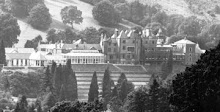
I am very aware that recording the stories of Craig-y-nos is a race against time.
Take this email I received some months ago from Milwyn Bufton.
"I read with interest you letter in the Evening Post Swansea about CRAIG Y NOS IN THE 1920'S. It was a TB hospital and I was a Patient there in 1926/7. I was about 6 or 7 years of age. There were a lot of children in those days.I am now 86 and it is difficult to remember so far back.Sorry i cannot be more helpful. I am Milwyn Bufton."
Despite several emails to her I have not had a reply.
Saturday, May 12, 2007


Friday, May 11, 2007
Allan Morgan -1954

9 year old Allan in his iron cot
Alan was browsing on Google and idly typed in Craig-y-nos. He found my web-site and contacted me .
Now 62 years of age he was admitted to Craig-y-nos as a 9 year old with his three sisters in February 1954.
A few months later his mother was transferred there too from another sanatorium.
Many people have already spoken to me about the family who were all in hospital together and how they were not allowed any contact with each other.
So I was very curious to hear Allan’s story.
He remained there for four and a half months before being transferred to Sully.
This is a brief extract from the interview I did with him.
Asked to compare the two institutions he said:
“Craig-y-nos was like a prison camp and Sully a holiday camp.”
He was tied to the bed in Craig-y-nos and regularly beaten. He was allowed no contact with his mother, except by letter and these letters had to be left open, and minimal with his sisters. If he saw them in the grounds he could wave to them.
“ I was kept in an iron cot and tied to the bed.
They would take the restrainer off at night. I had it on cause I kept getting out of bed.
My memories of the time I spent there are not pleasant ones. I remember the cruel way we were treated in the mornings.
Nurses would come around look at the bottoms of your feet if they were dirty you would be walloped with whatever they could lay their hands on.”
I never cried . I just grit my teeth except on one occasion one of the nurses, one of the Gwynne sisters hit me really hard and I cried. Afterwards she put her arms around me and tried to comfort me and apologised. But I wouldn't speak to her for weeks.”
In Sully they tackled the problem differently.
The doctor offered him a radio to listen to on condition he stayed in bed.
“I promised him I would and I did. I was never tied to the bed in Sully.”
He was told he had the kind of TB that did not respond to drugs and he had a section of his lung removed.
Today Allan lives in Bargoed.
He has three children and four grandchildren and worked all his life within the coal-mining industry.
“I was only in Craig-y-nos for less than five months. In many ways it was a cruel regime.”
Thursday, May 10, 2007
Valerie Williams ( nee Llewellyn) 1938 -1940
Whatever happened to Bridie O’Sullivan, the Irish child abandoned by her parents in Craig-y-nos?
Valerie, age 72, would love to find out.
Her parents had thought at one stage of adopting four year old Bridie as company for Valerie because they were the same age until the “monkey incident”.
“I had an uncle who had once worked as a sailor and he brought me back this big wooden toy monkey. But we were not allowed to play with toys because of the fear of infection. So they put it at the end of the ward so that everybody could enjoy it and nobody would be jealous.
“Well, Bridie got out of bed in the night and broke my monkey. I was so angry with her. I remember that.
Bridie had been left there by her parents when she was about 12 months old.
I often wonder what happened to her.”
Valerie says she has only snippets of memories of those early days in Craig-y-nos in the Glass Conservatory.
“I remember the big iron cot and looking out through the bars. I have no memory of walking about during my two years there.
“And I remember it being bitterly cold. They would wheel our cots outside. If it started to rain they was a rush to bring them back in again. Once my uncle, who was a bus driver and he used to sneak in to visit me when he was passing once a week, helped to pull the beds back into the Glass Conservatory.
We were not allowed to get damp.”
Another memory she had is of a family celebration after she left the hospital:
“We had a party for my grandmother and after it was over I put on my hat and coat to go back home to Craig-y-nos. and my mother had to say to me: “You are home.” She was quite upset .”
After she grew up Valerie worked as a telephonist with major companies in Swansea.
Now aged 72 she leads an active life swimming three times a week, ballroom dancing with her husband and going to jazz festivals.
If anyone reading this can recall any information regarding the abandoned Irish child girl, Bridie O’Sullivan, I will pass it on to Vallerie Williams.
e-mail me at: annshaw@mac.com or ring: (01786.832287)
Valerie, age 72, would love to find out.
Her parents had thought at one stage of adopting four year old Bridie as company for Valerie because they were the same age until the “monkey incident”.
“I had an uncle who had once worked as a sailor and he brought me back this big wooden toy monkey. But we were not allowed to play with toys because of the fear of infection. So they put it at the end of the ward so that everybody could enjoy it and nobody would be jealous.
“Well, Bridie got out of bed in the night and broke my monkey. I was so angry with her. I remember that.
Bridie had been left there by her parents when she was about 12 months old.
I often wonder what happened to her.”
Valerie says she has only snippets of memories of those early days in Craig-y-nos in the Glass Conservatory.
“I remember the big iron cot and looking out through the bars. I have no memory of walking about during my two years there.
“And I remember it being bitterly cold. They would wheel our cots outside. If it started to rain they was a rush to bring them back in again. Once my uncle, who was a bus driver and he used to sneak in to visit me when he was passing once a week, helped to pull the beds back into the Glass Conservatory.
We were not allowed to get damp.”
Another memory she had is of a family celebration after she left the hospital:
“We had a party for my grandmother and after it was over I put on my hat and coat to go back home to Craig-y-nos. and my mother had to say to me: “You are home.” She was quite upset .”
After she grew up Valerie worked as a telephonist with major companies in Swansea.
Now aged 72 she leads an active life swimming three times a week, ballroom dancing with her husband and going to jazz festivals.
If anyone reading this can recall any information regarding the abandoned Irish child girl, Bridie O’Sullivan, I will pass it on to Vallerie Williams.
e-mail me at: annshaw@mac.com or ring: (01786.832287)
Abandoned children at Craig-y-nos
Sometimes children were abandoned .
Their parents simply stopped visiting.
The isolation of the hospital and the sheer difficulty of getting there by public transport, before cars became common, proved to be an insurmountable obstacle to families already under a great deal of stress.
Also the death rate before the introduction of drugs was high - 25 per cent- so it is hardly surprising that some parents experienced a sense of hopelessness and despair at having a child sent ot Craig-y-nos.
One former member of staff told me it was often viewed as a death sentence, such was the taboo and fear with which TB was held in Wales, a notorious black spot for the disease.
How many children were left to grow up at Craig-y-nos? nobody knows.
All we do know is that it did happen from time to time.
On the whole it would appear that these cases were an exception. What emerges is a picture of incredible dedication on the part of parents, some who were very poor, to struggle to make the long journey to Craig-y-nos once a month to see their children often relying on relatives or friends with a car for transport.
Those who made the journey by public transport found that it would take up the whole day, often involving several bus changes especially for those coming from remote villages or rural communities.
Their parents simply stopped visiting.
The isolation of the hospital and the sheer difficulty of getting there by public transport, before cars became common, proved to be an insurmountable obstacle to families already under a great deal of stress.
Also the death rate before the introduction of drugs was high - 25 per cent- so it is hardly surprising that some parents experienced a sense of hopelessness and despair at having a child sent ot Craig-y-nos.
One former member of staff told me it was often viewed as a death sentence, such was the taboo and fear with which TB was held in Wales, a notorious black spot for the disease.
How many children were left to grow up at Craig-y-nos? nobody knows.
All we do know is that it did happen from time to time.
On the whole it would appear that these cases were an exception. What emerges is a picture of incredible dedication on the part of parents, some who were very poor, to struggle to make the long journey to Craig-y-nos once a month to see their children often relying on relatives or friends with a car for transport.
Those who made the journey by public transport found that it would take up the whole day, often involving several bus changes especially for those coming from remote villages or rural communities.
Wednesday, May 09, 2007
Nurse Glenys Davies 1943-1973

Glenys in playful mood...

Helping out with the children at the Christmas pantomine.

"Preparing" Ann for an x-ray - 1951

Ann and Glenys back at Craig-y-nos in 2007
Nurse Davies worked at Craig-y-nos from March 1943 until the hospital closed in December1973.
She started there initially as part of the war effort to get women into the workforce.
Much to the chagrin of her parents she chose to nurse TB patients instead of working on the family farm.
She enjoyed the contact with the children so much that even after the war was finished she carried on nursing there.
Her name is the one that most frequently crops up amongst ex-patients, and they all speak of her with a great deal of affection.
Today Glenys, aged 82, is still living in the Swansea valley and , while she is not as active as she was up until five years ago she still maintains her love of life, her sense of humour and her independence.
Many ex- staff and patients refer to her as “the Rock”, the unchanging figure in the turbulent history of Craig-y-nos.
This is a brief extract from an interview with her.
Mary Williams- first cure
“I remember Mary Williams from Talgarth coming in. It must have been about 1950 or 1951.
She was very ill and she was put in the sisters office so that we could nurse her. She was dying and we didn't expect her to last very long.
Well, within a couple of weeks of receiving streptomycin she had recovered.
It was like a miracle.”
Nursing regime
All patients had to have their lights out by 9.30 pm and nurses by 10 pm.
They were very strict in the nurses home.
You were not allowed to go out in your uniform, not even just across the road to the shop which was just the front room of a nearby cottage.
“if you went there to the shop you had to go in mufti and if you did go in uniform and were caught you would be very sorry for it. You would get a row from matron . “
Ghosts?
“I don't believe a word of it. I was here over 30 years and never saw a thing.”
Memories and x-rays
“I have very happy memories of my time working at Craig-y-nos.
Nurses at other hospitals were not X-rayed as frequently as we were and we had quite a number of nurses as patients from Swansea hospital, and some died.”
Tuesday, May 08, 2007
Names please! (early 1950's)


These photos are from the early 1950's but there are no names for any of the patients or nurses.
The teenagers are on the balcony of Ward 2 and the nurses are standing next to one of the famous stags.
Can anyone put some names to these people please?
Send email to:annshaw@mac.com
Monday, May 07, 2007
Mair Harris( nee Edwards)- 1950-52

Ann and Mair on the balcony

Mair and Nurse Glenys Davies on the balcony

...and 2007 in Craig-y-nos
"My memories are happy."
"When I arrived at Craig-y-nos and saw the big wall and the gate I can remember saying to my mother:” I don't want to stay in here.”
But once I had got into the ward and got to know the girls I had happy memories after that.
We had lots of fun. We had the Girl Guides. Also,we would drop letters to the boys on the downstairs balcony on a piece of string. Things like that. It was great.
I got on well with some of the staff. If I had been unhappy I wouldn't want to come back here but I come for the summer sometimes , not to go into the building, but to walk around the lake like I used to as a a teenager.
“I was 13 when I went into Craig-y-nos and 15 when I left. Most of the time I was on the balcony. I was in bed for 15 months and I had streptomycin and PAS.

Mair on the balcony
Learning to walk again
You got up for an hour the first week then this was increased to two hours, four hours, six hours and eight hours. Then it was considered you were up all day.
Theatre and concerts.
People from the area would come in and give us concerts.
Miss White, the teacher
Yes I remember Miss White. She was quite good to me actually. She helped me a lot I was in the grammar school when I went in and she told me to bring my books.
When I went back to school I wasn't very far behind the other children and I was able to catch up quite easily with them.
I felt she did quite a lot of work for me.
Dr Huppert
I did hold her in awe though I was never punished by her.

Shirley and Mair
Christmas
Christmas was fantastic. I used to go to the Adelina Patti theatre and there would be Santa Claus and presents from Friends of the Hospital. I remember having a huge jigsaw.
Other children put up stockings.We were allowed to put up pillow cases that were full of parcels that had come from home. I remember having a huge pillow case with 70-80 presents.
Christmas was worth remembering.
On leaving
I went back to grammar school for 2 years then I was unlucky. I had two relapses, in 1954 and again in 1956 and I was sent to other hospitals.
After that I didn't bother to go back to school. I went to work in the library. And that was it until I got married. I worked in the library throughout my career then I retired.
How did TB affect my life?
I missed out on my teenage years. I went into hospital when I was 13 and I was 19 before I was better so I didn't have the fun that the others were having like going out to the cinema. I missed out on all that.
But otherwise I don't think it really affected me.
I was going to go in for teaching but my mother felt it was best that I stayed at home rather than go away to college. So I went into the library.

Girl Guides: Mair in the centre with other Guides
Craig-y-nos
It made me stand on my own two feet. I have very positive memories of my time there. You only saw your parents once a month so you were depending on the staff to take their place to a certain extent but otherwise you had to do everything on your own.
It taught me to be independent. My memories are happy."
Saturday, May 05, 2007
Jean Shakeshaft - 1953

Jean in the grounds of Craig-y-nos with the balconies clearly visible in the background.

Jean ( left) with Pat and Jean ( June 1953)
Jean Shakeshaft keeps cropping up in lot of photographs sent in by ex-patients.
Where is she now?
Friday, May 04, 2007
Pioneer of “fresh air” treatment
Ever wondered who introduced “fresh air” treatment for TB into this country?
Well, Caroline Boyce ( nee Havard) who was in Craig-y-nos at the same time as me, and is helping with some of the interviews, found this newspaper obituary in Dollar museum.
“ Dr Jane Walker 1938
Open-air treatment of consumption.
“Dr Jane Walker, C.H., M.D., pioneer of the open-air treatment of tuberculosis in this country - her sanatorium at Nayland, Suffolk, of which she was Medical Superintendent, was founded in 1901- and one of the oldest women doctors practising, died yesterday at Harley Street, at the age of 79.
.....
“Early in her career she satisfied herself by experiment that one of the most efficacious methods of combating consumption was systematic fresh air treatment, and in 1892 she was the first to introduce the open-air treatment of the disease into England.
“A centre was opened at Downham Market, Norfolk, which was moved to Nayland as it developed. It has become a model in tubercular institutions. Sections for working-class people, for children, and for soldiers were added to it.
Recently she said that the ravages of tuberculosis had been halved in the last 30 years.
She recognised, too, that measures had to be taken not only to cure tuberculosis, but to prevent it, and throughout her medical life she had emphasised the importance of improving social conditions and the necessity of abolishing insanitary and overcrowded slum dwellings. She lent her support to every effort made to secure adequate nutrition, for those unable to afford to provide it for themselves.
...
Her publications included:” Modern Nursing of Consumption” (1904) second edition 1924.”
Well, Caroline Boyce ( nee Havard) who was in Craig-y-nos at the same time as me, and is helping with some of the interviews, found this newspaper obituary in Dollar museum.
“ Dr Jane Walker 1938
Open-air treatment of consumption.
“Dr Jane Walker, C.H., M.D., pioneer of the open-air treatment of tuberculosis in this country - her sanatorium at Nayland, Suffolk, of which she was Medical Superintendent, was founded in 1901- and one of the oldest women doctors practising, died yesterday at Harley Street, at the age of 79.
.....
“Early in her career she satisfied herself by experiment that one of the most efficacious methods of combating consumption was systematic fresh air treatment, and in 1892 she was the first to introduce the open-air treatment of the disease into England.
“A centre was opened at Downham Market, Norfolk, which was moved to Nayland as it developed. It has become a model in tubercular institutions. Sections for working-class people, for children, and for soldiers were added to it.
Recently she said that the ravages of tuberculosis had been halved in the last 30 years.
She recognised, too, that measures had to be taken not only to cure tuberculosis, but to prevent it, and throughout her medical life she had emphasised the importance of improving social conditions and the necessity of abolishing insanitary and overcrowded slum dwellings. She lent her support to every effort made to secure adequate nutrition, for those unable to afford to provide it for themselves.
...
Her publications included:” Modern Nursing of Consumption” (1904) second edition 1924.”
Thursday, May 03, 2007
Douglas Herbert 1945- 48

Douglas was admitted to Craig-y-nos as a five year old.
He has many vivid memories of his time there and he will be doing a full oral history recording with the Sleeping Giant Foundation.
Meanwhile here are two of his stories.
Derby Day
“I remember the 1947 Derby Day. All the visitors were clustered around my bed because I had the only workable radio. My father had put a 6p bet each way on My Love and it won.
“A couple of years ago there was this pub quiz. They said there was a free pint of beer to anyone who could tell them the winner of the 1947 Derby. Well, I put my hand up.....My father was astonished because he knew I had no interest in horses. So I reminded him of that day in Craig-y-nos ..."
Less happy memories are the times he was force-fed cold cabbage.
“One of the things I couldn't stand, and I can’t now is cabbage.
They got so used to me throwing up after swallowing the cabbage that the nurse would bring a bowl along at the same time so that I could be sick into it.
After I was sick they were happy. The nurse would take the bowl back to the sister to prove that I had swallowed it.”
Looking back on his time there he asks:“I often wonder what they did for us. I don't think we really had any treatment. You either made it or you didn't.’
Douglas still remembers with sadness his close friend Andrew, a plaster bed patient, who died six weeks after he left.
He voices the view of many ex child patients when he says:
“I always felt I lost my childhood.”
He adds:
When I left Craig-y-nos I was happy for every day that came along.
And I still am.”
Douglas works as an accountant in Swansea.
Wednesday, May 02, 2007
A toddler in Craig-y-nos
Receive a phone call this morning from Mary in Surrey, a 56 year old art teacher. She was in Craig-y-nos for 2 years entering the hospital as a 14 month old toddler..
She only has vague memories of the place except she does remember nurse Glenys Davies.
She says:” I am grateful to the staff for they saved my life.
Nevertheless what happened to us was traumatic and should be acknowledged.
She goes on to say:
“It is unfair to erase this part of our history. We have a right to remember it for we lost our childhood.”
Mary will write her own account of her memories of that time and the course her life took as a result of TB.
The most obvious ones she says is that streptomycin affected her hearing.
She only has vague memories of the place except she does remember nurse Glenys Davies.
She says:” I am grateful to the staff for they saved my life.
Nevertheless what happened to us was traumatic and should be acknowledged.
She goes on to say:
“It is unfair to erase this part of our history. We have a right to remember it for we lost our childhood.”
Mary will write her own account of her memories of that time and the course her life took as a result of TB.
The most obvious ones she says is that streptomycin affected her hearing.
Treatment for TB - in the 21st century

Mari Friend ( nee Jenkins)
A few years ago Mari had a relapse. She doesn't know who was the most surprised: herself, her family or the doctors who were doing tests for cancer.
She says:
”They gave me drugs and told me to carry on living as normal. I didn't even have to stay indoors and rest!’
We both marvel at the change in the regime for treating TB. Over 50 years ago (the time we first had it) the treatment was all about fresh air, high calorie diets, bed rest and operations.
But the universal introduction of drugs wiped out all these medical procedures for they were found to be of doubtful value: at best palliative, at worst, useless.
Tuesday, May 01, 2007
Caroline -1953/54

Can anyone throw any light on this photo? All we know from the information on the back is that the girl’s name is Caroline and that it was taken either in 1953 or 1954 on the balcony of Ward 2.
She is tied to the bed. This procedure was known as “restraints", a practise used on children who would not stay in bed.
Monday, April 30, 2007
Craig-y-nos 1953- Scotland 2007

Ann (left) and Mari on the balcony of Ann's home in Bridge-of-Allan - 2007

Ann and Mari on the balcony of Craig-y-nos - 1953
Delighted to see Mari Friend ( nee Jenkins) yesterday. She called in with her husband Peter while on their touring holiday of Scotland.
Mari and I were close friends while at Craig-y-nos and after we left we still kept in touch for a number of years even sharing the same hostel accommodation ( Bourne & Hollingsworth) when we moved to London.
Yesterday we took the opportunity to have a photo taken together.
It is interesting to note - though I had never thought of it before - that my home in Scotland for the past 20 years has a house with a balcony facing mountains ...just like Craig-y-nos.
Saturday, April 28, 2007
Rosie Pugh - 1941-42
Rosie was evacuated to Wales as a 6 year old and caught TB.
Among her many recollections of her time there are memories of a "nurse who brought in comics, being on complete bedrest on the balcony, sleeping under tarpaulin sheets and being terrified to go to sleep at night because of the noise of the owls. And at night the children died."
Rosie is the latest of a number of ex-patients to have given a full oral history recording to Cynthia Mullane at the Sleeping Giant Foundation, the organisation helping me with my research.
Among her many recollections of her time there are memories of a "nurse who brought in comics, being on complete bedrest on the balcony, sleeping under tarpaulin sheets and being terrified to go to sleep at night because of the noise of the owls. And at night the children died."
Rosie is the latest of a number of ex-patients to have given a full oral history recording to Cynthia Mullane at the Sleeping Giant Foundation, the organisation helping me with my research.
Friday, April 27, 2007
Edgar the Head Gardener- 1953

Remember Edgar?
We used to go and sit in the gardeners shed with the men while all the time Sister Morgan and Dr Huppert thought we were marching around the grounds filling our lungs with fresh air.
The older girls flirted with the gardeners while the younger ones, like myself, sat and watched, fascinated by this glimpse of "normal" life.
emails - reunion
I am getting e-mails coming in from ex-patients who have read an account of the re-union in the South Wales Evening Post and say they knew nothing about it.
BBC web-site
These two postings have appeared on the BBC Mid Wales website:
Debbie Evans Ystalyfera
This is a wonderful insight to peoples memories. I am too young to remember the TB hospital but My Mam was a patient there, and used to go to respite a couple of times a year and sadly died there . I myself spent a few days there with a chest infection at the age of 17 & I found it scary, later on when the castle was changed to a restraunt I was the cook. My memories of the snow falling and being able to sit by the roaring log fire are so different to the memories of the children of the castle. My Father who is from Abercrave has retold many stories of the Hospital, and I am looking forward to reading & learning more about the years people spent there.
Thu Apr 26 14:20:11 2007
Geraint Morgan, Llandod
My gran was there, and I think she has dug out a bunch of old photos from her time there for either this book or some similar project. She was a much older patient though, in her 20s. Had to make arrangements for treatment when she was on her honeymoon in Aberystywth.
Wed Apr 25 14:56:46 2007
Debbie Evans Ystalyfera
This is a wonderful insight to peoples memories. I am too young to remember the TB hospital but My Mam was a patient there, and used to go to respite a couple of times a year and sadly died there . I myself spent a few days there with a chest infection at the age of 17 & I found it scary, later on when the castle was changed to a restraunt I was the cook. My memories of the snow falling and being able to sit by the roaring log fire are so different to the memories of the children of the castle. My Father who is from Abercrave has retold many stories of the Hospital, and I am looking forward to reading & learning more about the years people spent there.
Thu Apr 26 14:20:11 2007
Geraint Morgan, Llandod
My gran was there, and I think she has dug out a bunch of old photos from her time there for either this book or some similar project. She was a much older patient though, in her 20s. Had to make arrangements for treatment when she was on her honeymoon in Aberystywth.
Wed Apr 25 14:56:46 2007
Thursday, April 26, 2007
Drinking 5 pints of milk a day
Sylvia Moore, ex patient and later member of staff at Craig-y-nos in the late 50's, says she remembers drinking four to five pints of milk a day while a patient at Craig-y-nos.
I find this extraordinary! Do other ex- child patients remember this?
I find this extraordinary! Do other ex- child patients remember this?
Re-union-Craig-y-nos -last night
Over 60 people turned up for the re-union of staff and ex-patients at Craig-y-nos castle.
Most of the people were retired nursing staff, office workers and general maintenance workers. They even had a cake with a doctor and a nurse on it.
But one ex-patient who did attend said; "It was a bit disappointing. I had hoped to meet other ex-patients but I would say there were less than 10 there out of about 60 people," she said.
On the other hand as a staff re-union the evening was successful.
Another ex child patient who did go tells me that the staff did not believe her when she told them how she was treated as a child in the hospital.
She is hurt because the experience as a child traumatised her and now she discovers 50 years later that she is not believed!
Other ex-patients say that they would have liked to have gone but they did not know about it.
Most of the people were retired nursing staff, office workers and general maintenance workers. They even had a cake with a doctor and a nurse on it.
But one ex-patient who did attend said; "It was a bit disappointing. I had hoped to meet other ex-patients but I would say there were less than 10 there out of about 60 people," she said.
On the other hand as a staff re-union the evening was successful.
Another ex child patient who did go tells me that the staff did not believe her when she told them how she was treated as a child in the hospital.
She is hurt because the experience as a child traumatised her and now she discovers 50 years later that she is not believed!
Other ex-patients say that they would have liked to have gone but they did not know about it.
Subscribe to:
Posts (Atom)