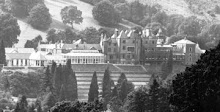
Just had an e-mail from the son, Philip , of the first sister Margaret Lewis to be appointed to Craig-y-nos in 1921 when it was converted into a sanatorium.
He says his mother and the matron were the first staff there and that they were involved in the conversion ot the building.
Also, he's got some photos and will be sending them to me.
This is great news! I am really short of information from this early period of Craig-y-nos.
Tuesday, July 31, 2007


Take Nine...girls : 1955

Who are these girls? maybe Christine Perry ( nee Bennett) can help us. They are from her enormous collection.
I think that is Christine in the back row on the right.
Christine has provided the following information:
Front row from left: Pat, Gloria, Astrid Thomas, Heurwen,
Centre- Barbara
Back row from left: Alice Maund, Pam Nicholls, Ann Davies, Christine Bennett
Monday, July 30, 2007
Streptomycin - Dr Carole Reeves, Outreach Historian
Streptomycin wasn't available anywhere until 1946, having been discovered by an American soil biologist, Selman Waksman, in 1943. The drug was very expensive and the British government were unable to import much of it into the country. I believe the bulk amount was 50 kg. As a result, there was only enough to treat a few patients with tuberculosis so the Medical Research Council devised a fair trial whereby some patients received streptomycin and bed-rest whilst another group received bed-rest only. Bed-rest being the standard treatment for TB. One hundred and seven patients were enrolled into the trial - 55 received streptomycin (the treated group) and 52 received bed-rest only (the control group). The trial began in January 1947. This means that officially, nobody in Britain received the antibiotic before that date. Since there was a black market for streptomycin, some wealthy individuals may have been able to import it from America, but not those in a government-funded sanatorium. You can read more about the context in which the trial was set up and conducted at:
http://www.jameslindlibrary.org/trial_records/20th_Century/1940s/MRC_bmj/crofton.html
You can read the BMJ paper, published in 1948, which gave the results of the trial.
http://www.jameslindlibrary.org/trial_records/20th_Century/1940s/MRC_bmj_article_1.html
One of the things I'll be investigating is whether Craig-y-nos patients were enrolled on the first and subsequent trials but anyone who received streptomycin in 1947 was almost certainly on a clinical trial.
http://www.jameslindlibrary.org/trial_records/20th_Century/1940s/MRC_bmj/crofton.html
You can read the BMJ paper, published in 1948, which gave the results of the trial.
http://www.jameslindlibrary.org/trial_records/20th_Century/1940s/MRC_bmj_article_1.html
One of the things I'll be investigating is whether Craig-y-nos patients were enrolled on the first and subsequent trials but anyone who received streptomycin in 1947 was almost certainly on a clinical trial.
Lost Friends
If going into Craig-y-nos was upsetting then leaving the institution several years later was equally traumatic.
Nothing prepared us for the outside world which had changed, or adjusting back into family life.
Dozens of girls talk of returning home and longing for the friendships they had left behind.
Rosemary from the Brecon area says she could not bear to sleep in the bedroom and for months after leaving Craig-y-nos had a bed in the barn.
Another, Beryl , talked of going for long walks with her mother along the seashore late at night because she couldn't stand being in the house.
And many girls, myself included, cried quietly back in our home bedrooms for our lost friends.
Nothing prepared us for the outside world which had changed, or adjusting back into family life.
Dozens of girls talk of returning home and longing for the friendships they had left behind.
Rosemary from the Brecon area says she could not bear to sleep in the bedroom and for months after leaving Craig-y-nos had a bed in the barn.
Another, Beryl , talked of going for long walks with her mother along the seashore late at night because she couldn't stand being in the house.
And many girls, myself included, cried quietly back in our home bedrooms for our lost friends.
Saturday, July 28, 2007
Joan Collins (née Coughlan) -1949, age 15

" I admired Dr Huppert greatly." - Joan
How did you feel about going into Craig-y-nos?
I was so ill that I really didn't know what was going on, if I'm honest. I was in ward 2.
I went in 2nd March 1949 and came out in November.
Oh, that was quite quick then, wasn't it?
It was a miracle, really, because I was so ill going in. I was the first to have streptomycin.
How long were you on streptomycin?
I think it was two months, four injections a day. That was it, two months.
Do you remember beginning to feel better?
Oh yes, yes, taking notice, and I remember … I wasn't allowed to sit up, you see, I was told you'd got to lay, and one of the girls - I think she'd had a camera or something brought in. And when the visitors had all gone, and we were all so excited and I sat up, and as I sat up, who walked in but Dr Huppert. Oh, I tell you what, I never sat up again.
The next thing I was down sister's office in a wheelchair, and she really laid in to me, which she had every right to. I remember her saying, 'We worked so hard on you and this is how you're repaying us.' Oh, I felt dreadful. I never sat up after until I was told.
What else do you remember about Dr Huppert and Dr Williams?
Dr Huppert was Austrian if I remember, and she was disabled, a very strict, very disciplined doctor.
She was good … I mean, what she said and did was for my own good. She was very, very strict, but she had to be. We were young. I remember the morning I came home, my mother came to fetch me, bless her.
We didn't have cars, we had a bus. And Dr Huppert was in sister's office with us, and she said, 'I want you to remember,' I can hear her now, 'one thing. You are not quite out of the wood yet.'
She said, 'You are to rest every afternoon at least two hours, and I mean that.' And she looked at my mother and she said, 'You are to see that she does.' And my mother did. But she was doing it for my own good. I don't know about you,
… people who have got discipline I admire.
As I say, I didn't dislike her, she was telling me for my own benefit. She had worked hard to save me. She couldn't afford to let me go back then, could she?
Oh, I admired her greatly although I was only young. I still admired her.

Dr Williams doing Long Round watched by Sister Morgan
Dr Williams was a nice gentleman, very pleasant. He'd make his rounds once a week, and he was always nice and gentle with us, and I remember … I'm going back, oh, as I say, we were only youngsters … and we all put a bow of ribbon in our hair, and we all said before he came to do his round 'If he sees us like this, he can't avoid getting us up out of bed.'
And we all had these ribbons in our hair. … I can see him now, coming in the ward and looking as much as to say, 'Well, what have we got here with all these ribbons.' But it was all fun. We enjoyed it.
Dr Williams had a young family, if I remember rightly.
Did you ever meet any of his family?
No, no. No children were allowed on the wards, which you could understand, although we were children. In those days, it was a killer.

Nurse Glenys Davies and Auntie Maggie
Staff
They were kind to me.
I remember Staff Nurse Rees, Nurse Davies, all the staff, but I can't remember the sister.Yes, Auntie Maggie, we always called her. A lovely, bouncy, pleasantly plump lady.and the other was a Mrs Harris. Well, they'd be called auxiliaries today We had two porters, Langford and Thomas, and Mr Hughes was the radiographer.
A very nice man.
Do you remember the food ?
Well, as far as I know it was all right. I don't think you would have complained like you would today. I think we accepted more, we were grateful.
Did you make friends with the other girls?
We were like one big family there, really, because you spent all your time together, and we were all there for a long time. So you did become like a family. It was quite strange then when you left and went home.

The lake
When you were up and about they would let you go down into the back, which were lovely grounds, beautiful grounds there. Of course, you weren't allowed in the front, which made sense. So, it was quite pleasant there.

Shirley
We did have a surgical little girl. She was by me, in fact - Shirley - I don't know if she ever made it, and they used to lay her … every so many hours, she had to be on her tummy one time and it would be on a bed of plaster of Paris moulded to her body. And then, after a certain time, she'd be turned over and they'd have another one that took her back. And oh, she was just a bag of bones. I mean, I wasn't fat but she was even thinner.
Was it cold?
Well, I can remember there was snow - where I laid, the doors were never closed, you had big French doors where I was, you see, and because it was so cold and because I was so frail, if you like, I was given a hot water bottle.
I can remember my mother and my aunt coming up and of course they had to sit at the side, and their teeth would be chattering, and I'd be giving them the hot water bottle. It was cold but you see you couldn't have doors closed. You had to have them all open and these on the balcony were worse off but they had coats on and gloves and scarves. But you didn't notice it. You never noticed it, strangely enough.
Gastric lavages
Like if you weren't coughing up a lot, that's what they would do then.
Not very pleasant to talk about.
Children dying
I remember there was a young little girl. She'd only been in a little while and they took her down to sister's office, but what happened we don't know. She was just staring into space, apparently, and they just took her down there, and she was nursed in there. But what happened to her I don't know.
You'd ask after her and sister or nurse or whoever you asked, would say, 'Yes, she's doing all right,' but whether she ever came out I don't know. It was sad.
Balcony patients
They were geared up with their coats and their gloves and their scarves. Well, they weren't allowed in the ward, you see. That was day and night. The only time they came in the ward was when they were going for X-ray.
General atmosphere
I never knew anyone to be nasty there. all right, we'd have our crying days, but you'd expect that. That came with the illness.
Some people feel that it was a bad experience for them. You don't feel that?
No, I was just grateful that I was well and came out. Not for me it wasn't a bad experience.
Work
I was seventeen before I was allowed to work and I got a job at Lovells in St Helen's Road, Swansea.
Well, the front of it was one side pastries, the other side confectionery, and then towards the back that was a restaurant, but I only worked in the shop part.
Children
No, I was never told or asked about whether I wanted children. I just had them. Two boys. But I was monitored and for that I was very grateful.
I look at them sometimes … my youngest son is six foot four, so I think, well, I'm so lucky that I could see them grow up. One son lives in Berkshire. He's a male nurse, in Broadmoor, the high security hospital. My oldest son lives here in Swansea. He's with BT.
Edited extract from an interview given by Joan Collins to Dr Carole Reeves, Outreach Historian, the Wellcome Trust Centre for the History of Medicine, University College, London.
Friday, July 27, 2007
TB. and Shambo the Bull - 2007
Welsh poet Gwyneth Lewis read an elegy to the slaughtered bull, Shambo, belonging to monks in west Carmarthen, this morning on BBC Radio 4.
This case highlights the deep fear and taboo that still exists within Wales regarding the disease for there was no reason why the animal, not destined for the food chain, could not have been treated with drugs.
In our struggle to become a multi-cultural society what sort of message does it convey to the rest of the world - and the world did watch the removal of Shambo because the monks had a webcam on the temple's website showing real-time images of the condemned beast.
This case highlights the deep fear and taboo that still exists within Wales regarding the disease for there was no reason why the animal, not destined for the food chain, could not have been treated with drugs.
In our struggle to become a multi-cultural society what sort of message does it convey to the rest of the world - and the world did watch the removal of Shambo because the monks had a webcam on the temple's website showing real-time images of the condemned beast.
Riding Lady in the woods- 1956
Christine Perry ( nee Bennett) says:
"We weren't allowed over the bridge. That was meant to be the limit of our wanderings. Lady, however, was restricted to the other side of the bridge in the woods and around the big lake where there were swans. As the bridge was clearly visible from the hospital, crossing it was risky. However, it didn't stop us from crossing it to ride Lady but we had to be furtive!!

Pam riding Lady
It was a lot easier in the Summers. The river level was lower which meant that, if we went down past the tennis courts, we could ford the river without being seen from the hospital . When on the other bank, then we could move up through the woods without being seen from the hospital. That way, we could get to ride “Lady” and access the lake to see the swans without getting caught!!"
"We weren't allowed over the bridge. That was meant to be the limit of our wanderings. Lady, however, was restricted to the other side of the bridge in the woods and around the big lake where there were swans. As the bridge was clearly visible from the hospital, crossing it was risky. However, it didn't stop us from crossing it to ride Lady but we had to be furtive!!
Pam riding Lady
It was a lot easier in the Summers. The river level was lower which meant that, if we went down past the tennis courts, we could ford the river without being seen from the hospital . When on the other bank, then we could move up through the woods without being seen from the hospital. That way, we could get to ride “Lady” and access the lake to see the swans without getting caught!!"
Thursday, July 26, 2007
Streptomycin
I am trying to establish when streptomycin was first used in Craig-y-nos. Dr Reeves has interviewed one woman who believes she was given it as part of a drug trial in the late 1940's.
Nurse Glenys Davies remembers a young woman called Mary Williams being the first in Ward 2 to receive it either in late 1950 or early 1951.
Therefore it came as a surprise to read in Clive Rowlands autobiography that he received it in the mid 1940's, though an exact date of his time in Craig-y-nos is not given.
Nurse Glenys Davies remembers a young woman called Mary Williams being the first in Ward 2 to receive it either in late 1950 or early 1951.
Therefore it came as a surprise to read in Clive Rowlands autobiography that he received it in the mid 1940's, though an exact date of his time in Craig-y-nos is not given.
Clive Rowlands- Highland Moors

Clive as a six year old in his best Sunday suit, 1944
Haydn Beynon who was in Craig-y-nos during the 1930s asked if we had any knowledge of boys being sent to Highland Moor in Llandrindod Wells, Mid-Wales.
So I checked Clive Rowlands, the Welsh rugby star's autobiography, and sure enough he was sent there from Craig-y-nos.
He says:
"At the age of only eight, I faced the horrible reality of having to leave my mother and father. Thankfully , though, I didn't have to travel far as I was to be treated at the former home of the world famous singer singer Adelina Patti, in Craig-y-nos, by Abercraf.
Imagine my mother's consternation and despair. Two of her children had died, her husband was ill and her remaining three children were located in separate hospitals. Somehow, my parents dug sufficiently deep, physically and financially, with either or both visiting the separate hospitals on a weekly basis, with the arduous journey to North Wales endured every fortnight.
Along with regular helpings of healthy food and tons of fresh air, streptomycin was my constant companion at Craig-y-nos, and another pick-me-up came my way with the news that Megan would join me.
However, this period was not to last long before it was decreed that I was to be transferred to the Highland Moor hospital in Llandrindod in Mid Wales
Although English was not unfamiliar, up until that point my whole upbringing had been conducted in the medium of the Welsh language. I was soon to have my first experience of culture shock."
Extract from "Top Cat" by Clive Rowlands. published by Mainstream, price £9.99.
Putting history together: like a jigsaw puzzle.
Len Ley, the local historian, rang me to talk about the book he is writing on the history of Craig-y-nos Castle. We discuss the fact that we have to rely so much on anecdotal evidence and this is often contradictory. He believed Adelina Patti's boudoir , the "Six Bedder", was used by teenagers girls.
Not so, I tell him, this was only in the last couple of years . However, the women who have told him this were themselves there as teenagers in the late 1950's.
Neither of us know what Ward 2 was used for in the days of Adelina Patti. We suspect it was for guests bedrooms, after all she liked to entertain on a lavish style, but we have no proof of this.
Not so, I tell him, this was only in the last couple of years . However, the women who have told him this were themselves there as teenagers in the late 1950's.
Neither of us know what Ward 2 was used for in the days of Adelina Patti. We suspect it was for guests bedrooms, after all she liked to entertain on a lavish style, but we have no proof of this.
Wednesday, July 25, 2007
Waiting for visitors - 1956

This photograph from Christine Perry ( nee Bennett's) collection shows clearly the fire escape and windows as it was at the time of a TB sanatorium.
Christine is waiting for visitors.
Ann -"My first night in Craig-y-nos -March 1950"

Ann on the farm
Only hours before I had left the farm and my warm bedroom with its piles of quilts, flannel blankets and a coal fire in the corner.
Now as night falls the chattering girls sleep and the silence of the night is broken by a low but insistent cacophony of sounds in Ward 2.
For the March wind plays its own vicious tune with the castle fittings rattling through barred windows and doors never designed to be left open in such conditions.
It hurtles through the ward like some invisible demented demon and out through the open French windows to the balcony and mountains beyond.

Craig-y-nos Castle from the courtyard
The cavernous room with its crowded beds , so close you can touch the girl in the next one, acts as an auditorium to this unexpected duet: the wind howling its own wild tunes accompanied by the choir of endless coughing.
My sobbing has stopped for now I have a new and more immediate fear: I am cold, very, very cold...
I am 9 years of age and four months. Mother promised I would be here for only three days.
Tuesday, July 24, 2007
Pat Mathoulin goes to Craig-y-nos in 1945

Pat Mathoulin, age 9 years
My Auntie’s house
Pat has just sent me a written account of her arrival at Craig-y-nos as a 5 year old. She has already given a full oral history interview to Dr Carole Reeves.
This is an extract:
“No sooner had I finished my breakfast when my mother announced, in a matter-of-fact tone, that I was going to spend a few days with my Auntie Renee, who I had only seen on the one occasion when she had come to visit us.
I can’t remember feeling all that excited at the prospect for not only had I sensed that my mother hadn’t appeared all that wholehearted about my impending holiday but she had also been very quiet all morning.
I also thought it rather strange that my sister wasn’t going with me. Instead she had gone off to school quite happily. it did seem odd and yet I didn’t question it.
After what had seemed a rather lengthy bus journey, and still unable to summon up any sort of enthusiasm about my visit, we finally arrived at my auntie’s house which was surrounded by a very high wall that had prevented me from being able to see the front of the house.

A large wooden door had been incorporated into this wall with an attendance bell to the side of it.
As soon as the bell had been rung then an elderly gentleman immediately opened the door and showed us through in to a large impressive looking courtyard that had a beautiful working fountain in the centre.

At last I was now able to view my Auntie’s amazing house which was, to say the least, awesome, foreboding, having been constructed of dark grey stone.
It looked unreal somehow, certainly uninviting, and altogether horribly scary.
My very first impression of it had absolutely terrified me and I knew immediately that I wasn't going to enjoy my few days there.
£50 donation
Yet another donation to “The Children of Craig-y-nos” memorial fund has come in this time from Dr Carole Reeves, the Outreach Historian helping me with this project. Carole is half Welsh .
She says:"My mother came from Ferndale in the Rhondda valley,
and I know that she would have wanted me to do this project."
Like most people with family connections in the Welsh mining valleys she too knew what it was like to have TB in the family.
She says:"My mother came from Ferndale in the Rhondda valley,
and I know that she would have wanted me to do this project."
Like most people with family connections in the Welsh mining valleys she too knew what it was like to have TB in the family.
Monday, July 23, 2007
Mary Williams-1951-first to get streptomycin in Ward 2
Does anyone remember Mary Williams, the farmers daughter from Talgarth?
She was the first person to receive streptomycin in Ward 2, and she made a recovery within weeks.
Nurse Glenys Davies remembers her arriving , it was either late 1950 or early 1951, she is not sure, and she says Mary was dying so they put her into sisters office so that they could nurse her.
They didn't expect her to live.
Within weeks of receiving injections she started to get better.
Glenys describes it as :"miraculous!"
Mary's parents delivered milk to the schools around Talgarth and after Mary was admitted to Craig-y-nos all the children had to be tested.
I am going to put a note about this in the Brecon and Radnor Express in the hope that we can find Mary and invite her to the Patients Reunion on Sunday September 9th in Craig-y-nos Castle.
She was the first person to receive streptomycin in Ward 2, and she made a recovery within weeks.
Nurse Glenys Davies remembers her arriving , it was either late 1950 or early 1951, she is not sure, and she says Mary was dying so they put her into sisters office so that they could nurse her.
They didn't expect her to live.
Within weeks of receiving injections she started to get better.
Glenys describes it as :"miraculous!"
Mary's parents delivered milk to the schools around Talgarth and after Mary was admitted to Craig-y-nos all the children had to be tested.
I am going to put a note about this in the Brecon and Radnor Express in the hope that we can find Mary and invite her to the Patients Reunion on Sunday September 9th in Craig-y-nos Castle.
Sunday, July 22, 2007
Haydn Beynon - 1931

Haydn was in Craig-y-nos for one year as a seven year old in 1931.
He was then transferred to Highland Moors hospital. He says there has been no mention of Highland Moors on the blog so far.
This is correct. Haydn is the first person to come forward who was transferred there from Craig-y-nos.
He recently re-visited the Castle, and an interview with him will appear shortly.
Saturday, July 21, 2007
The ponies - 1956

Edgar, the Head Gardener, with Tosca and Lady

Pam riding Lady

Christine Bennett and Beryl Rowlands with Lady. What are they trying to do with the pony?
These photographs of teenage girls enjoying (illicit) time riding Dr Williams daughters ponies shows just how the sanatorium regime had slackened off by 1956.
Mary, one of Dr Williams' daughters has already contacted us saying she was surprised to learn that her ponies were being ridden while she and her sister were away in boarding school.
( If Mary is reading this I wonder if you would be good enough to email me again- several attempts to contact you have resulted in "bounced" emails. Thanks! Dr Reeves would like to interview you).
Friday, July 20, 2007
The dentist
Pat's story reminds me of my visits to the Craig-y-nos dentist and the bucket of drawn teeth he kept beside the dental chair.
Anybody else remember it?
Anybody else remember it?
Pat Hybert (née Mogridge), age 19, 1952 -1953

Mari and Pat on the stag
"I went into Craig-y-nos in December. It was snowing, and very, very cold, and I was disappointed going in then but there you are, we were all in the same boat up there .
We missed a lot of teenage years, didn’t we in those days?
But still, I was very lucky anyway. I’d had treatment before I went in … streptomycin … so it was only a case of bedrest. When I hear them complaining about hospitals these days, they were quite dragons, the sisters there then,
especially one of them.
I always remember, we had a relief sister on at one time and I was, at the time, able to get up, and she said, ‘Well, you can dress.’ And, of course, the other sister had always said we couldn’t dress. And when she found out that I had been dressed this day, she wasn’t very pleased about it.
We were like a lot of children in school really.
There was one particular woman, Sister Williams, and we had a very nice nurse there, a nurse Davies.

Pat in the "Six-Bedder"
I’m seventy-five this year and we did wonder whether we’d all reach that age at that time. I thought, well, when you went in you really thought it might have been the end of you after a bit because, I mean, people were still dying of it when we were in there then.
And there were a lot of them in a bad way, but, as I say, we were very fortunate. There was a young lady in the next bed to me. Well, she did sign herself out. I can remember a Joyce Rees and I know she died so she couldn’t have been very old but she did have one child.
I was in the “Six-bedder,” (Adelina Patti’s former bedroom) and in the next ward was the children’s ward.
I can remember being in there when it snowed in the winter and they had ground sheets on the beds nearest the window. It would be freezing. And the children wonder why I can’t stand the heat now. It’s terrible being in a room with everything closed up.
Well, I think it toughened us up.
Did you have any brothers and sisters who had TB?
No, I found out afterwards that my father had had it, and he was in Talgarth, but he got over it and he was in his late seventies when he died.
But, on the whole, it wasn’t too bad I suppose (Craig-y-nos) when you look back. We had some fun there as well.
What sort of fun?
Well, we used to have a bit of entertainment with film shows. We’d have films in the cinema, in the Adelina Patti Theatre.

Harry Secombe
I can remember Harry Secombe coming there, that was on the Christmas, but I wasn’t allowed to go because I got out of bed and I shouldn’t have done. Now I wouldn’t have taken it, but I suppose at the time you just did as you were told.
Yes, we were very naive really compared with these days. We did miss a lot of things in life, I suppose, by being there. I mean, we couldn’t go dancing after you came out.
You had to be careful what you were doing. Well, I was very wary of what I was doing afterwards, I was having check-ups then still, for years.
And you’ve remained fit and well?
That’s right
I remember a lot of the children.There was one little girl in particular. She lived down in Gorseinon, not far from me. Norma, I think her name was. Norma Pearce, and I often wonder what happened to her because she must have only been nine, but the children used to write letters to us in the six-bedder ward. They sort of befriended us, sort of thing. Yes, everybody had a sort of pen pal.
We couldn’t go in and see, and I remember my husband (as he later became) used to creep round the door to go in and see her.
And I often think of that.
What about the food there?
Oh, don’t ask. It was diabolical. I can always remember. There’s only one or things I don’t like, and one of them is porridge. And I can always remember them coming round, the first day I was there with this porridge for breakfast. It looked disgusting, and she said, ‘Oh, you’ve got to eat it. You’ve got to eat the food.’
‘Well,’ I said, ‘If I never go out of here, I am not eating porridge.’ And I did stand by that. I thought I could never eat it, and I used to think then, I can always remember … and when I see people eating porridge, it always reminds me of that. Lumpy. And parsley sauce, the same. That used to come round.
No, the food wasn’t all that clever there. I remember they used to give us a lot of milk to drink, thinking that would do us good. Well, of course, we all put on a tremendous amount of weight, didn’t we? I was up to nine stone when I was in there. My normal weight was eight stone four. But it soon came off once you started walking about. But the food wasn’t very good. I can remember we always used to be glad when weekends came and the family came with something to eat. Something decent.
.
I had a friend living in Abercraf, as it happened, not far from Craig-y-nos, and her mother used to make the most delicious Welsh cakes. She always had a box of them, and I used to share these Welsh cakes. We were always so glad when my friend came up with a box of Welsh cakes. But, you know, things like that you appreciated. And when family came in, of course, you always had nice sandwiches of some sort. No, the food (in Craig-y-nos) was pretty grotty there but anyway, we all survived it.

Edgar, the gardener, rowing some of the girls on the lake
Visit to the dentist
I can remember going to the dentist because I had a bad tooth. When I came back up to the ward I thought, ‘Well, he hasn’t taken the tooth out that he should. He’s taken the next one out, twit.’
I couldn’t believe it. I said to one of the girls I could feel this tooth, and of course, my mouth had been dead, and I said, ‘Which tooth has gone?’ I thought he was taking the two front teeth out because one had gone anyway. He’d taken the one next to it so I had two gaps.
He took this other one out and of course I had to wear false teeth, I couldn’t eat anything when I had these two false teeth on a plate.
I came home and when my dentist saw them, he said, ‘Oh, I can’t believe this. I can’t believe what I’m seeing.’ He said, ‘I’ve never seen such awful teeth (the false ones). I remember trying to eat crisps or something once, and I thought, ‘Oh, my God, they’ve taken the wrong teeth out.’ When I got home, I had to have my teeth done.
Never mind, I survived. So, that was another episode up there.
When they said I was going for sputum tests, I was frightened to death. But they used to say, well they do this or they do that or you get the magic eye, you know, and I used to think, ‘Oh, please don’t let me have anything like that.’
What was a magic eye?
I don’t know whether that was to check your lungs or whatever. No idea.
(Could have been a bronchoscopy – Carole)

Dr Huppert
We had the Austrian doctor, Huppert or Hubbard or something. We used to call her Dracula. She used to come round with her load of blood tests. When we heard her coming, I used to think, ‘Oh dear, she’s coming for blood again.’ But, ah dear, dear.
How often did you have to have blood tests?
I don’t remember. I think we used to have them pretty regular. There was Dr Huppert and there was a Dr Williams. He was very nice, but she was a good doctor, I suppose.
The streptomycin affected my hearing. I’m completely deaf in one ear now, but I could feel my ears tingling and I remember, telling the doctor, and they had a look in my ears and things to see if they wanted syringing, but I don’t think they were very interested, really. All they were interested in was getting you cured.
But anyway, it was a small price to pay, I suppose, for being fit and well again, isn’t it?
Work
I had a job before I went in. I came back out in the June, and I think I was home for about six months. They told me my job was still open, luckily. I worked in an office and they let me go back part-time. They were very good.
How many children did you have?
Two. The girl is forty-seven now and the boy is forty-five.
And I’ve just had a new grandchild, a little boy, and I’ve got another two grandsons. One is fifteen and the other one’s five.
On the whole Craig-y-nos wasn’t too bad when you look back. "
Pat Hybert was interviewed by Dr Carole Reeves, Outreach Historian, the Wellcome Trust Centre for the History of Medicine, University College London.
Thursday, July 19, 2007
Money- Mrs Lewis, 2007
Receive a cheque for £20 this morning for “The Children of Craig-y-nos” from Mrs Lewis in Brynmawr.
She says:” A wonderful project and every success to you and the Sleeping Giant......good luck, take care also be lucky.”
Thank-you Mrs Lewis!
My first reaction is that the donation should go towards funding the first ever exhibition of photographs of The Children of Craig-y-nos” which takes place in the Ystradgylais Welfare Hall from Friday September 9th.
On second thought why not use it to launch a memorial fund for some kind of a plaque for the grounds.....
We made it, hundreds didn’t.
She says:” A wonderful project and every success to you and the Sleeping Giant......good luck, take care also be lucky.”
Thank-you Mrs Lewis!
My first reaction is that the donation should go towards funding the first ever exhibition of photographs of The Children of Craig-y-nos” which takes place in the Ystradgylais Welfare Hall from Friday September 9th.
On second thought why not use it to launch a memorial fund for some kind of a plaque for the grounds.....
We made it, hundreds didn’t.
Subscribe to:
Posts (Atom)