Mud glorious mud....that's the reason for no blogs. Can't carry the laptop along with wellies, umbrellas, cagoules etc to the Festival site from the carpark without getting soaked.
Today the rain has stopped but they have closed all the car parks because the fields are now deep in mud ( yesterday you were only allowed in one if you had your wellies on). So have found a free Wi Fi site in the Granary restaurant this evening and, more important, a car park space.
The police are busy sticking parking fine tickets on all the cars parked on the Llanignon road which I think is a bit steep since there is literally nowhere to park.
Oh yes we had a citizen arrest on the Festival site last night. George Moinboit tried to grab the former US American ambassador John Bolton to the United Nations on his part in the illegal war in Iraq.
He had primed~Brecon police and the media beforehand so everyone was prepared.
Thursday, May 29, 2008


Tuesday, May 27, 2008
Mary Slater (nee Davies)- Hay Festival

Ann ( left) and Caroline in Scotland.
"We live within 15 miles of each other. I don't have a photo of Mary as she is today. She recognized me from my blog" - Ann

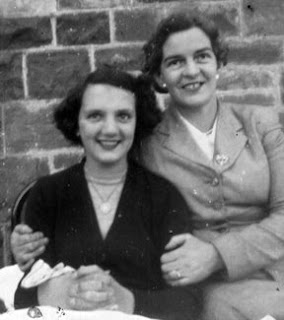
Mary Slater (nee Davies left,) Ann Shaw ( nee Rumsey( in bed) and Caroline Boyce (nee Havard)
Standing in the queue at the Hay Festival yesterday a woman next to me says:"Are you Ann Shaw?"
"Yes"
" I was four beds away from you in hospital. I am Mary Slater."
You could have knocked me down with the proverbial feather. I couldn't place the tall distinguished looking woman standing there with anyone from my childhood in Craig-y-nos.
Nows of course when I checked my blog I know instantly. This is the red-haired girl who went on to become a senior manager within the National Health Service.
My apologies Mary!
Sunday, May 25, 2008
Barbara Paines 1952-53
I started work when I was sixteen, I did have a few jobs until I found one in a polish factory that suited me. I was quite happy as the bosses were really nice. If I had a bad day they would give me the easy jobs.
I got married when I was twenty one, I had a daughter who was born with no problems. On having my second daughter I found out that I was having a blue baby. Which meant she was born premature and had to have her blood changed. I lost my first son who was also blue and died at birth. I then had two more sons which had the same problem as my second daughter. The last three children all weighed under 5 lbs. They were all christened at birth, my two boys were two months old before they were allowed home. Each of them were given the BCG jab when they were born as a precaution, luckily they were alright.
My sisters first daughter died of TB meningitis when she was four years old. My sister was taken into Sully hospital with her two young boys, so the whole family had to have regular check-ups at Cathedral Road, Cardiff. My youngest daughter then had TB when she was in the juniors age nine, so we were back and forth to the chest clinic yet again.
My father then passed away in 1983 with cancer, my mother moved in with me. She was with me a while until she got her own flat, she then got TB and had to go into hospital for a couple of weeks. My mother passed away then at the age of 88 in 1995.
I enjoy being outdoors, I like gardening and walking even though I am shattered when I get back home.
I also like crochet, knitting, sewing and puzzles as it keeps me occupied. I am still not free of hospitals as I have osteoporosis, so I go for regular infusions and scans.
But I have got good family, friends and neighbours that help me out with jobs that I can’t do on my own.
But you carry on and not give in after all we have all had to fight, otherwise we wouldn't be here to tell our stories.”
I got married when I was twenty one, I had a daughter who was born with no problems. On having my second daughter I found out that I was having a blue baby. Which meant she was born premature and had to have her blood changed. I lost my first son who was also blue and died at birth. I then had two more sons which had the same problem as my second daughter. The last three children all weighed under 5 lbs. They were all christened at birth, my two boys were two months old before they were allowed home. Each of them were given the BCG jab when they were born as a precaution, luckily they were alright.
My sisters first daughter died of TB meningitis when she was four years old. My sister was taken into Sully hospital with her two young boys, so the whole family had to have regular check-ups at Cathedral Road, Cardiff. My youngest daughter then had TB when she was in the juniors age nine, so we were back and forth to the chest clinic yet again.
My father then passed away in 1983 with cancer, my mother moved in with me. She was with me a while until she got her own flat, she then got TB and had to go into hospital for a couple of weeks. My mother passed away then at the age of 88 in 1995.
I enjoy being outdoors, I like gardening and walking even though I am shattered when I get back home.
I also like crochet, knitting, sewing and puzzles as it keeps me occupied. I am still not free of hospitals as I have osteoporosis, so I go for regular infusions and scans.
But I have got good family, friends and neighbours that help me out with jobs that I can’t do on my own.
But you carry on and not give in after all we have all had to fight, otherwise we wouldn't be here to tell our stories.”
Hay Book Festival-2008
If posts get a bit erratic over the next few days it is because I am at the Hay Book Festival. Sometimes access to the internet gets a bit erratic. The area is Wi-Fi but it still means I haveto carry the laptop from my converted barn to the festival site. Rain, gales, mud..yes it is typical Hay Festival weather today though yesterday was grand with lots of sunshine, people eating ice-cream and lying on the grass reading The Guardian newspaper.
Today it is survival time ploughing through fields of mud and struggling to keep dry.
Hay is "neither here nor there" - neither English nor Welsh.
Today it is survival time ploughing through fields of mud and struggling to keep dry.
Hay is "neither here nor there" - neither English nor Welsh.
Friday, May 23, 2008
Barbara Paines 1952-53

(from left to right) Jean Griffiths, Barbara Paines and Jean Shakeshaft in the grounds of Craig-y-nos Castle
I can remember meeting Norman Wisdom, he came into the hospital with Ann Morris’ father.
Norman Wisdom was telling us how to escape from the hospital by tying the sheet together and getting over the wall.
On the Christmas we had a pantomime with Harry Secombe and afterwards he came on to the wards to see the ones who couldn't go down to watch and he was really funny.
One night inside Ward 2 a few of us were messing around after lights out, I was by Rose Ryan's bed when we heard someone coming. So I got into Rose's bed when I heard it was matron, I was so frightened I wet in her bed.
They were changing her bed in the morning and she got into trouble. But she didn't say it was me because we would have all been in for it.
I can remember the time that Dr Huppert was stuck in the lift and Sister Morgan saying: “A shilling to look” .
Quite often when we heard Dr Huppert in the lift upstairs we would open our lift door so that she couldn't do go down.
Then there was the Coronation and we all sat around a small black and white television to watch. After it had finished we all received a certificate and a small mug and a coin that I still have. I also still have a book given me called “The Little Men.”
Once you were on so many hours a day you were allowed into the grounds more, you had to make sure you had your meals. We used to go for walks down to the lake and a have a bit of fun on the boats.
When I was out on the balcony my bed was right by the locker where the school bags were kept, so I had the job of handing them out to the other girls. They were green bags with ties on and also your name. One day I was doing my work and I could hear a lot of bees buzzing above me, so I started shouting.
Miss White came to my bed and told me not to be so stupid and sent me into the corridor, until I could behave myself.
That night I put all the bags back into the cupboard but I placed them all to the front, so that when I was told to get the bags out they fell to the floor Miss White was shouting at me to pick them up, so as I did I started throwing them off the balcony. I think three of us were sent downstairs to retrieve them
Another time I remember tipping water over the balcony, while Miss White was downstairs. She must have been leaning on the balcony as she got all wet.
The following morning she came on to the ward shouting “whose the one throwing water off the balcony?” nobody answered her.

High jinx on the balcony: Jean Shakeshaft(left) and Barbara Paines
I didn't have many clothes as I had been in bed for over a year at home, so one of the girls altered a pleated skirt to fit and then I ended up with a little wardrobe so that I could go out with all the girls.
Whilst going out for walks we had to go past the Six Bedder ward, I looked in one day and saw this young woman who waved at me. After that we used to talk to her and she used to pass little notes to us. There was myself and Mari Jenkins, she gave us both a photograph of herself.
Mine was somehow torn in half. I only have the top half, when I look at it I can still see her smiling face. Her name was Joyce Reece and she was 23 and married to Ken and they had a three year old son called Stephen.
I think I was up for about eight hours a day because we did have more time to ourselves. We were out in the grounds more, we used to go to the field to help Edgar and Alfie, put the hay on the back of the trailer. When it was full we would have a ride to the bottom of the field . I think that was the best part of my stay in hospital, because I was free and out in the open.
Then came the time when I was told that I would be going home soon. I started crying and Dr Huppert said :”I told you that you would be crying because you don't want to go home.”
But she was wrong.
I did enjoy my stay at the hospital because our ward was one big happy family. But I don't think it would have been if it wasn't for Sister Morgan and Auntie Maggie and Annie Reece, Nurse Davies, Nurse Moidwen Edgar and Alfie Repado, who had told the staff he was my cousin because our mother had met on the bus one day, when my mother was coming to visit me.
And not forgetting all the girls that were on the ward with me , and the rest of the staff and doctors that I have not mentioned.
( Second extract from Barbara's own account of her stay in Craig-y-nos)
Wednesday, May 21, 2008
Barbara O'Connell (nee Paines) 1952-53

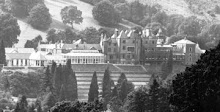
Craig-y-nos Castle (the red crosses mark Ward 2)
“The first time I arrived outside this big house, I said to my mother I'm not going in there. I started crying and said take me back home mum I don't want to go in there. But ended up being in there for about 12 months, from 1952-53.

Barbara O'Connell (nee Paines)
I'm not sure what happened when we got inside because I was crying too much. I was taken in a lift to the upstairs and put to bed in this big ward. Where I was left to settle down.

Dr Huppert
The following day I was seen by the famous Dr Huppert whom I took a dislike to straight away.
As time went by I did get used to being there, but it was a case you had to be because there was nowhere else to go.
When we graded on to so many hours a day, we were allowed to go to the pictures. I remember watching the “Scarlett Pimpernel” and “Tony draws a horse”. We were also allowed to go to a little shop that was down in the basement where you could buy stationery, toiletries and other things.
We did have nice food, I can remember waiting for the Wednesday because we used to have rabbit stew. I was turned off boiled eggs because they were boiled for so long that the inside was black and the yolk was all dried up. to this day I cannot sand the smell of them. Another thing that I liked was the moose it came in different flavours, I liked the chocolate one the best. But I had not tasted this until I came to the hospital. We also had pilchards for breakfast, which I thought was unusual to have for breakfast. But I got used to it.
Whilst I was in hospital my three older sisters were taken into hospital with TB. They were all in Denbigh, so my mother was back and forth between the two hospitals. Plus looking after my youngest sister who had been in a sanatorium with TB meningitis, so she really had her share of worries.
I used to have a gastric lavage every month, you used to be taken into this little room for it. I thought they were trying to choke me, when the tube was pushed down the back of my throat I thought I was going to die as I couldn't breathe properly .
That was the most terrifying that that had ever happened to me.
This is the first extract from Barbara's own written account -more will follow over the next couple of days.
Collective intelligence and collective memories

Rachel Lewis (known as “Ray”) went into Craig-y-nos in 1951.
One of the big advantages of using the internet to write"The Children of Craig-y-nos", a record of the collective memories of children who were in this TB sanatorium, is that the web also allows for the input of other people to.
So I am able to tap into the collective intelligence of the whole community. Take today for example. I have just received a letter from Ann Morris pointing out that the photo I attributed on the web to her mother sitting in a deckchair knitting was not in fact her mother but someone else.

unknown woman knitting on the balcony
I am very grateful to Ann for pointing this out. When you are dealing with a period of photographs taken over 60 years ago it is often very difficult to ascertain the correct names so I do indeed rely on the collective intelligence of those who remember the people who were in Craig-y-nos at the time.

Ray's father, Ivor Thomas, with Staff Nurse Mathews on the left.
Ann has also been able to identify the people in this photograph.
Thank-you!
Tuesday, May 20, 2008
Post traumatic stress syndrome?...
Are any of the “Children of Craig-y-nos” suffering from post traumatic stress syndrome?
I mention this after listening to a television programme on memory .
They said that a characteristic of post traumatic stress was the clarity and freshness with which people remembered a painful event even though years have passed.
This is certainly the case with many of the Craig-y-nos stories .
It appears that when the right memory buttons are pressed all that time spent in Craig-y-nos comes rushing back.
And they are not all joyful ones...
.
I mention this after listening to a television programme on memory .
They said that a characteristic of post traumatic stress was the clarity and freshness with which people remembered a painful event even though years have passed.
This is certainly the case with many of the Craig-y-nos stories .
It appears that when the right memory buttons are pressed all that time spent in Craig-y-nos comes rushing back.
And they are not all joyful ones...
.
Monday, May 19, 2008
Myra Elizabeth Rees (née Thomas), age 7, 1943 – 1 year

Myra Elizabeth Rees (née Thomas) was in Craig-y-nos as a seven year old for one year in 1943.
“I have no sad thoughts about being in Craig-y-nos.” - Myra
"I’m one of nine children,( my mother buried some) and after my older sister died of TB, she was 15, we were all tested.
I was the skinny one and I was so puny and ill-looking that they took me into hospital for observation. I was one year in Craig-y-nos, in 1943, then a year and a half in Llanybyther.
But I don’t know if I had TB…
My father took me on the bus to Craig-y-nos.
They searched my hair for nits then put me to bed and I remember crying for my mother. I was in a state … I didn’t understand what was happening to me.

Sister Morgan with an an adult young patient
Myra remembers little about her year in Craig-y-nos except “ there were no sad memories”.
“The only person I remember is Sister Morgan. She was a white-haired woman and she was a bit strict, but I didn’t dislike her.
Nobody was nasty. I can’t remember anybody being nasty.
“ There was a woman who cleaned the floors. She always used to throw tea leaves … you know the tea leaves that have been used for making tea? She used to scatter that over the floor.
(Many children have referred to this method of floor cleaning and it is clear that it fascinated them ).
Her father visited her regularly, though her mother only on two occasions for she was pregnant again and the journey to Craig-y-nos by public transport was long and involved several bus changes. Sometimes her father walked from their home in Banwen to Craig-y-nos.
“We had to go out every day, for walks, and you would be given a little white shoulder bag on your shoulder and they used to give you cheese and a tomato in this thing and we had to eat that while we were out.
I didn’t like cheese so I used to throw it away.
I think the food was allright but I was such a poor eater, a terrible eater.
Returning to Craig-y-nos many years she said:
I could smell the same smells of the trees.
I didn’t go there till I got married. My husband took me in the car.
We didn’t have a car when I was a child … it wasn’t a very easy place to get to … well, you had to catch so many buses, you know, to Craig-y-nos. It wasn’t very far really when you go by a car.
Today Myra lives in Glynneath.
“I was living in Banwen when I was little, on the Banwen Road, between Banwen and Glynneath.
When I started school they put me to sit by this girl who lived not far from me.
And her mother objected to me sitting next to her. I always remember that, but I sat with somebody else then. That was a little bit of a stigma.
On leaving school Myra went to work in a factory and has enjoyed good health all her life.
“I’ve been married now a long time. I’ve got two children and I’ve got four grandchildren and I’m a great-grandmother.
Her memories of her time in hospital are hazy:
I just remember that I knew I was in hospital, and do you know, like you get used to being there. And when they take you away from Craig-y-nos, it’s a bit of a wrench.
I think it was because I didn’t go home. I went to another place. I can’t explain my feelings but I didn’t feel glad or anything, you know. I cried when I got in there first … I remember crying for my mother.
When she did eventually come home again it did feel a bit strange.
“I still knew my sisters names and everything, but I hadn’t seen my youngest sister because she wasn’t born before I went in.
And I was talking a bit different
I was amongst different people and I picked up their way of talking.
I expect I was saying lots of things different.
We didn’t have no running water, no electric or anything. We had coal fires, that’s all, and my mother had a place to cook and things like that.
We bathed in a tin bath. We didn’t have none of the mod cons where we lived, and we used to walk two miles to school every day and walk home.
We lived on the outskirts of Banwen. I always had company, you see, with my brother and sisters. We’d go further on and there’d be some more children living nearer the school and we’d be catching up with them too, and we’d be walking with them as well.
Then, of course, the Labour Government came in then and we had taxis to go to school because we were living more than two miles from the school.
I’ve got cousins over the Rhondda … they used to come down in the summer to us because we were a lot of children.
My father’s sister, she had ten children, and some of them used to come down and stay with us for the summer holidays. My mother was from a farm.
My granny gave my mother and my father land to build a bungalow. That’s why we built a bungalow.
So, we had a lovely childhood."
Sunday, May 18, 2008
Rachel Ann Lewis( "Ray") - 1951/52
.web)
Rachel, better known as "Ray", on the balcony with members of staff.
This is from the collection of photos belonging to her daughter Ann Morris. Does anyone know the names of any members of staff in this photo? if so please email:annshaw@mac.com
Saturday, May 17, 2008
The past is a foreign country
We interpret it in different ways from varying perspectives depending on our experiences at the time.
And this is true of “The Children of Craig-y-nos”.
What to one child was a horrific experience - like having a gastric lavage to another was merely “something they did to you...”
Also, it is possible for one person to have different memories of the same event depending on who they are talking to and the time lapse between the stories.
I came across a clear-cut case of this today while editing one story.
Doris ( not her real name) was in Craig-y-nos in the late 1940s “for observation."
She first contacted me about a year ago . These are some of her memories :
On Dr Huppert
“That short limpy woman? she was nasty! I was petrified of her. She shouted at me to get my pinky curlers out of my hair.”
1947 blizzard
“Some were moved indoors but I was kept on the balcony during the blizzard. My Gran asked if it was right that we should be left out there in those conditions and she was told that it was part of the treatment.
gastric lavage
“ I used to have a tube pushed down into my stomach. I don't know what for.”
Five months later she gave an official oral history recording and I had to double-check that it was the same person.
“I remember Dr Huppert. She was short and used to walk with a limp and you could hear her coming, like, but she was good.”
“My mother did ask why we were out, but I don't think I was out there the next time they came because they (sanatorium staff) told them then that that was the treatment.”
“And I had this tube thing going down. It's only to sort of make you heave and make you get up whatever it is. It wasn't too bad.”
It is just that the second version in all these accounts has become sanitised. I had been warned that this would happen in recording memories of people.
It is not that people are being economical with the truth but the simple fact that the more we talk about the past the safer it becomes, a haven, a place of nostalgia.
And this is true of “The Children of Craig-y-nos”.
What to one child was a horrific experience - like having a gastric lavage to another was merely “something they did to you...”
Also, it is possible for one person to have different memories of the same event depending on who they are talking to and the time lapse between the stories.
I came across a clear-cut case of this today while editing one story.
Doris ( not her real name) was in Craig-y-nos in the late 1940s “for observation."
She first contacted me about a year ago . These are some of her memories :
On Dr Huppert
“That short limpy woman? she was nasty! I was petrified of her. She shouted at me to get my pinky curlers out of my hair.”
1947 blizzard
“Some were moved indoors but I was kept on the balcony during the blizzard. My Gran asked if it was right that we should be left out there in those conditions and she was told that it was part of the treatment.
gastric lavage
“ I used to have a tube pushed down into my stomach. I don't know what for.”
Five months later she gave an official oral history recording and I had to double-check that it was the same person.
“I remember Dr Huppert. She was short and used to walk with a limp and you could hear her coming, like, but she was good.”
“My mother did ask why we were out, but I don't think I was out there the next time they came because they (sanatorium staff) told them then that that was the treatment.”
“And I had this tube thing going down. It's only to sort of make you heave and make you get up whatever it is. It wasn't too bad.”
It is just that the second version in all these accounts has become sanitised. I had been warned that this would happen in recording memories of people.
It is not that people are being economical with the truth but the simple fact that the more we talk about the past the safer it becomes, a haven, a place of nostalgia.
Friday, May 16, 2008
Talk - "The Children of Craig-y-nos"
Dr Carole Reeves, Outreach Historian with The Wellcome Centre for the History of Medicine, University College London has been asked to talk at a very prestigious conference this autum in London on "The Children of Craig-y-nos".
She says: " I have been asked to give another paper on the
Children of Craig-y-nos - at the British Society for the History of
Paediatrics and Child Health annual conference (12-13 September 2008) at the
Courtauld Institute, London. "
Who would have thought that our stories would one day become embedded in the history of medicine?
She says: " I have been asked to give another paper on the
Children of Craig-y-nos - at the British Society for the History of
Paediatrics and Child Health annual conference (12-13 September 2008) at the
Courtauld Institute, London. "
Who would have thought that our stories would one day become embedded in the history of medicine?
Thursday, May 15, 2008
Jean Shakeshaft - 1953

Jean Shakeshaft (left), other girls unknown

Just spoken to Barbara Paines. She decided to trawl through the phone book to see if she could contact any of the girls from Ward 2.
She got through straightaway to the brothers of Rosina Davenport and Jean Shakeshaft, only to be told that they had died. Rosina passed away five years ago in South Africa having suffered from heart problems.
And Jean Shakeshaft died of cancer.
Barbara rang Norma Pearce with the news.
" Norma said she went quite cold " says Barbara. There's a silence. We both feel a shiver going down our spines.
In my imagination the "Children of Craig-y-nos" are forever children running around the grounds of former opera diva Adelina Patti's castle.
Wednesday, May 14, 2008
Unknown trio - early 1950s

I came across this photo in Mari Jenkins collection. It has no names.
Does anyone remember these girls?
If so , let me know. annshaw@mac.. Or ring .01786.832287.
Tuesday, May 13, 2008
Relationships: The doctor and the teacher

Dr Huppert

Miss White
As children we all knew that Miss White the teacher and Dr Huppert were close friends, that Miss White would carry tales to Dr Huppert relaying all our naughtiness when they shared afternoon tea together.
But as adults looking back perhaps we have a greater understanding of that relationship between the two women.
Both were outsiders: Miss White an English woman,( I think) and Dr Huppert an Austrian Jewish emigre. Neither would have fitted easily into this close-knit Welsh community.
Why both, independent of each other, should have been drawn to Craig-y-nos Castle and to spend the major part of their working lives there remains a bit of a mystery.
Yet these two women, along with Sister Morgan, represented to us, as children the official face of "grown-ups": cold, distant, officious. It was left to Nurse Glen, and "Auntie Maggie" to bring some warmth into the wards along with some other members of staff though their names are no longer remembered.
This trio of women - Huppert, White and Morgan-
determined the quality of our every day life in Ward 2. There was an added frisson to this relationship because Sister Morgan did not like either Dr Huppert or Miss White whom she had scant regard for.
It is easy to see how Sister Morgan came to be spending her life in Craig-y-nos Castle but one wonders what brought Miss White to this remote corner of Wales. As for Dr Huppert, she must have been glad to find a niche for herself, especially one where she could exercise her own strident medical regime.
Monday, May 12, 2008
Mari Friend ( nee Jenkins), 1950-53

Coronation Year - balcony girls with some of the decorations ( 1953). (Back) Mari Jenkins (front row from left) unknown, Florence, Ann, unknown
Mari went into Craig-y-nos as a nine year old.
" I often think there wasn't a great deal wrong with me but I think a lot of it was to do with the fact that my sister was there.

Sister Outram with Llywella Jenkins
My sister Llywella was sent home and she was in bed on blocks. She had injections every day. She was told she could never have a baby because she wasn't well enough and that she would have to rest every afternoon.
They did worry about other children in the family. I think I was in there as a precaution.
I only remember having one injection with Dr Huppert and it frightened the life out of me. It was one where they stuck a needle in your side. It was quite a big long thick needle and I remember it was when I was in the bed by the piano. I had to lay on my side. I actually saw this big needle coming and I thought 'oh my god'. I don't remember any pain or anything after. I got the distinct impression they were draining something.
I remember having something out of a bottle rather than tablets and I don't like taking medicine now.
Ghosts
"I remember one night seeing someone sitting at the piano with a white sheet over them. I don't know for a fact it was someone because everybody denied it had been them. I was young and didn't think about ghosts. I had heard about ghosts but we did play tricks on each other and I am presuming that was one of them. I could be wrong because nobody ever actually owned up."
I had a doll in there and I've still got it. I remember they checked your parcels.

Alfie Repado, the gardener with Mari and Myfawny boating on the lake. This was all strictly forbidden.
Fun and games
We had a lot of fun in there. I remember midnight feasts on the roof. I spent more time on a 'couple of hours' so I was able to go out some part of the day. I was quite naughty. I would skip around in the night.

Mari on the roof of Craig-y-nost Castle - strictly forbidden!
"Only remember the good bits"
I think when you're young you do forget. It's like having a baby. You do only remember the good bits. I think that must happen with other parts of your life as well. I think we have blocked out parts of it.
I don't remember ever having gastric lavages. I could have blocked it out because it wasn't nice.
I don't remember many bad memories. I just remember the fun we had. Doing silly things like going up on the roof, going to the lake when it was out of bounds and guiding out in the woods.

Christmas 1951 in Craig-y-nos
I don't remember much about Christmas, birthday or visitors but I know I had visitors because I've got photographs of visitors there. I do remember attending concerts and films in the theatre and I'm sure we probably went there for Christmas as well. I had a feeling we used to go every Monday.
Regime at home
I remember at home we all had our own cutlery, our own cups, our own towels. It was a bit of a regime.
I am paranoid about the bed being untidy. I still make beds with hospital corners.
I do open the window every day. I was in hospital recently and it was very hot. The window would only open about 4 inches, 'in case people throw themselves out'. I was telling the doctors and nurses I was a child on a veranda – and people didn't throw themselves out.
Hospital regime
Yes, it was a harsh regime, but it was normal because that was the way they treated patients then. They told you what to do.
The one thing I remember about the floors was that they used to come round every day and throw tea leaves over them and the tea leaves used to pick up all the dust.

Mari with Ann in the background
There was no play room or day room – you just played in the ward.
If you weren't on the veranda you went to visit people out there and you spent your time either in bed or talking to your next-door neighbours.

Matron Knox-Thomas receiving a gift ( we think it is the piano) from Friends of Craig-y-nos in 1952. Mari is in the front row second from the end, right-hand side
I don't remember being cold. I do remember having the tarpaulins and they were sort of tied above your head when it was wet or snowing or whatever.
The only meal I can remember was on a Wednesday when we had rabbit and mousse which I hated and still do.
If you were up you would eat your meals around the big table in the centre of the ward.
I don't remember any form of heating.

Balcony girls 1953. (from left to right - back row)Florence, Maair and Ann. (front row)Myfwany, unknown, unknown.
It was the other patients who helped you to settle. That's why you got so close to them because obviously they were the ones you were in contact with daily. They told you what was going on.
Modern treatment of TB
When I had TB recently, they didn't tell you anything. Just told me to take these tablets every day. They don't tell you not to mix with people. You're never told to rest. In a way I would prefer it if they told you. It goes against everything we were told when we had it originally.
Life after Craig-y-nos
I missed my 11plus and when I came home they wouldn't let me go back to school till I was 14. I went back to school for a whole year before I finished school at 15. I didn't have much education really."
"I found going back home a problem. I found it all rather small. I was used to being in a big ward. My mother said I used to smell all the food.

Mari on the stag
I think the experience of Craig-y-nos does have a long lasting effect. I realise more so now because I have talked about it. I realise now I am paranoid about the bed, I know I'm fussy beyond and I'm still very wary of smells.
I also think that was the reason for me choosing to work in a big shop.
I do think it's only now I realise the effect when you start to think about it. We still have our own cups and saucers. Our cutlery was washed separately. I think my mother must have been told to do that."
Mari worked in a store in Port Talbot and then moved to London to work in Bourne and Hollingsworth:
"I always wanted to work for a big store." ( When I moved to London I stayed in the same hostel as Mari - Ann)


Mari and Ann on the balcony in Craig-y-nos and last year on the balcony of Ann's home in Scotland
Mari is married with one son. After her divorce she returned to Wales and lives in the same street where she was brought up. As a single parent she had to find a way of earning a living and trained as a nursery nurse. She has since re-married.
Sunday, May 11, 2008
Joan and Mair - 1951

Joan Powell ( left) and Mair Edwards
Here is a photo of two girls I was very friendly with on the balcony. Joan ( in plaster) was a very close friend of mine. She was in the next bed. After I was moved out of Ward 2 and put next to Joan, a girl of a similar age, my life in Craig-y-nos improved.
Met up with Mair at the first reunion but have not been able to make contact with her again which is a pity because Mair has got a most impressive photographic album. If anyone knows Mair, or if Mair should read please, then please get in touch: annshaw@mac.com
Saturday, May 10, 2008
Shirley Osborne with friend - Ward 2-early 1950s

This is a rare photo taken inside Ward 2 . It shows Shirley Osborne with a friend and comes from Mari Friend ( nee Jenkins) extensive photographic collection.
The most obvious reason for lack of photos inside the ward was insufficient light. Even so this photo is very dark. Many girls remember Shirley, a plaster case, because of the years she was in and afterwards, when she was up, the top half of her body was encased in some giant waistcoat which restricted her movements.
it would be lovely to know what happened to Shirley...and the girl with her.
Friday, May 09, 2008
The Marguerite Hepton Hospital -blog
Jane Freeland and another ex-patient, Fred Dubber are running a blog on childhood experiences in the Marguerite Hepton Hospital
near Leeds. So far they have got nine people who have come forward but they are beginning to generate some media coverage so this should bring in more people.
Do check it out
Marguerite Hepton Hospital
I have also put a link to it on my site ( see side panel).
near Leeds. So far they have got nine people who have come forward but they are beginning to generate some media coverage so this should bring in more people.
Do check it out
Marguerite Hepton Hospital
I have also put a link to it on my site ( see side panel).
Subscribe to:
Posts (Atom)