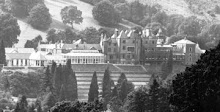
Saturday, June 23, 2007

Some Adelina Patti ghost stories


I make no apologies for adding these ghost stories to my history of Craig-y-nos as a TB sanatorium for children because the aura of Patti was with us every day we were there. She was an invisible, benign presence.

The child soloist
Eleven year old Anne Davies was a patient in Craig-y-nos in 1928 . She loved to sing and she had a good voice. She was in the choir.
In those days the children gave concerts for the parents and staff.

On this occasion she was also standing in for the soloist. On the night of the concert the girl who should have sang was suddenly taken ill and Anne had to step into the role.


She was standing in the wings feeling very nervous when she became aware of somebody standing alongside her.
She turned and saw this woman in a Victorian dress with her hair in a bun and a bustle at her back.
The woman said:”You will be all right.”
She kept telling her this, offering words of encouragement and Anne stepped forward and sang as she had never sung before.
She went back to thank the woman but she had disappeared.

(Source of story: Haydn Harris, ex -patient).

Haydn adds:”Anne used to belong to the same Writers Circle that I did in Swansea. She was 83.
We urged her to write it down as a short story, to make it a bit more dramatic. But she refused. She would say:”That is how it happened. That is my story. it is true.”


The clock tower

Doug Phillips was employed as a maintenance engineer at Craig-y-nos and he was the least likely person to experience anything out of the ordinary but he did on one occasion.

He went up into the clock tower to wind the clock up and he became aware of a presence behind him . He looked down at the floor and he saw these scalloped edge of a dress and as he raised his eyes up the figure disappeared.

(Source : Cynthia Mullan of The Sleeping Giant Foundation )

Victorian Ladies
"I looked out of the window one summer evening and saw three ladies dressed in Victorian clothes with big bustles walking in the grounds. It didn't bother me. I just went back to sleep," said Gaynor Jones ( nee Morgan) who was a 5 year old patient in Craig-y-nos at the time.

Friday, June 22, 2007

Valerie, balcony boss -1953/54


Valerie with unknown girl on Castle roof.

It was Valerie, the balcony boss, I had a fight with which resulted in a permanent small mark in my right eye.
Opticians still pause thoughtfully when they examine it and ask how long I have had it. When I tell them they say:”Oh that’s all right,” and move on.

I remember that fight.
Towards the end of my stay at Craig-y-nos I had become something of a “street fighter”, while lacking the physical strength of the older girls I had developed a neat way of scratching, biting and pinching.

Valerie, a big tough teenager, claimed I was stirring the younger girls up in rebellion against her authority, something I strenuously denied though there might have been some truth in it because we were all afraid of her.

She grabbed a pillow , pushed me down in the bed and jammed it hard in what she thought was my mouth but was in fact my eye.


( Years later I was to become a trade union official in Glasgow, a campaigner on environmental issues, and founder member of Falkirk Women's Aid...maybe it all started with a deep sense of injustice in Craig-y-nos - thanks to Valerie!)

Thursday, June 21, 2007

Sylvia Cottle (nee Price) 1952-53, age 20, feeding swans


This is another photograph from Sylvia's vast collection and shows the beautiful grounds and lake of Craig-y-nos Castle.

Christmas carols on hospital radio?

Have had an e-mail from Mary Sutton-Coulson, one of Dr Ivor Williams daughters, who was growing up at Craig-y-nos at the same time as us.

"The young doctor in Sylvia’s album was Dr Mulhall. 

Also my pet badger that Sylvia was holding was called Bonzo and I used to take him out for walks on a lead!! He lived in our stable for a year or more before we managed to persuade him to go back to the wild.

  Regarding Harry Secombe, I definitely remember him doing at least one pantomime in the Adelina Patti theatre and having tea with Matron Knox Thomas whilst sitting on his knee!!

Do any of the patients remember my sister and I singing Christmas carols over the internal radio on Christmas morning?  "

What happened to Sully hospital?

Just got this reply from Carol Hughes:

"Sully is still there . It is closed now at one time it was used for the mentally ill  then that closed there was talk of placing  refugees  there but nothing came of that
So as far as I  know the building is just left a shame it was such a lovely place."

Thank-you Carol for this information.

Wednesday, June 20, 2007

Peggy Tizzard 1939-41


Photo: "Images of Wales: Around Brecon" by Mike Davies, published in 2000.
Barely visible on the photo are the words:" 104 children in Adelina Patti Hospital"


My name is Catherine Margaret Tizzard but I am known as Peggy.
I was born on July 21 1936. I was living in Crofty when I was admitted to Craig-y-nos as a 3 years old.

Arrival in hospital
“I was told I was going on holiday and wore a red coat and a red beret. Then they left me in a cot with lots of other children. I can remember crying quite a lot when I was put into this cot but after that the nurses were very kind so I settled quite all right.

Treatment.
Every morning I had injections. Later I was told that they were gold and sulphur injections.


Rules.
The rules were strict. There were certain areas you couldn't go to.

You were not allowed to go downstairs and you were not allowed to go into the kitchen and obviously you were not allowed to go outside.

Would you be punished if you broke any of those rules?
Yes, when I was allowed out of bed I decided I would go walkabout and I went outside and they found me by the lake.
I was sitting in this wooden building throwing sticks at the swans and ducks.
They had a big search party for me. When they found me they took me back and tied me to the bed.
I was put into a canvas sort of contraption.

I remember that experience.

Were you ever cold?
Yes I was cold and I was told that if you are cold just pull the blankets up around you and snuggle down under the blankets. And that was it.


How did visitors cope with the cold?
Well, when my mother came she used to keep her coat on.


Can you describe your daily meals?
I can remember having chips and porridge. The smell of porridge today I just cant stand because they used to put syrup on the porridge and it brings back so many horrible memories of the food.


Did you have anything special at Christmas time?
I cant remember Christmas at all. Just one day seemed like another day.

Once I was given a balloon but whether that was for my birthday or Christmas I don’t know.


Can you recall going to the Adelina Patti theatre?

Yes when I was allowed out of bed one of the nurses wrapped me in a blanket and sat me in the theatre and I can remember sitting there looking at the picture of Madam Patti and thinking how lovely she was and then suddenly a woman picked me up and cuddled me and I started to cry because this person was a stranger and I didn't realise that person knew me but I didn't know her.

She was from my village.


Did you make any friends amongst the children?
No because we were in cots so we had very little contact with each other. I can vaguely remember some of the children sitting there playing with pieces of paper but other than that nothing. We were not allowed soft toys because they would have to be fumigated .

Were you moved into the women's ward?

Yes , after a while I was taken upstairs into the women’s ward. I was the only child there and was spoilt rotten.

Did you ever see other children?
No, except once when Dr Jarman brought his son in who was the same age as myself and we spent time rolling this thing, like a round ball, down the stairs. Eventually Dr Jarman came back and he picked it up. He said it was an orange and he peeled it and we ate it.
It was the first orange I had ever seen.

Can you remember any members of staff?
Yes I can remember Sister Morgan who I used to follow around once I was allowed out of bed. She was my favourite. She was so kind.
Also Dr Doughty and Dr Jarman. Dr Doughty went to war and when he came back on a visit he walked into the ward and saw me and picked me up and carried me around the ward which he used to do before he went away.

Visitors
A special bus came up from Swansea and waited for the visitors and took them back again.


Were they allowed to bring you anything?
No, we were not allowed to receive anything but on one occasion my mother brought in chocolate biscuits that the villagers had collected coupons for me to have because it was wartime and she fed me the chocolate biscuits and I was promptly sick

Do you remember any upsetting moments during your stay at Craig-y-nos?
No...other than when my father was leaving and I didn't know he was being sent home to die.

I was wrapped in a blanket and carried downstairs.

He hugged me and I cried because he was walking away and I didn't know that he was going home to die and I wanted to go with him wherever he was going and he gave me a book which I was not allowed to keep because of the risk of infection.
So that was the last gift from my father.


How did you pass your time?
My local teacher sent in a slate and a piece of chalk .
Then I was allowed some bricks and they had pictures on four sides and I played with them quite a lot.

I was able to bring them home. I passed them on to my nieces and nephews and now their children.

What can you remember about going home?
I had never been outside for two years so when my mother came to take me home she forgot to bring shoes. I always wore slippers. So I got on the bus to go home to Swansea wearing slippers.
I found it difficult because the house was full of people, strangers, obviously they were neighbours but I didn’t recognise them. They were waiting to welcome me home.
But my father wasn't there.
So I took my teddy bear and went upstairs to bed.

What effect did the stay in Craig-y-nos have on your life?
I think it has made me appreciate other people, also tolerance, and I can enjoy my own company.

Peggy Tizzard was interviewed by Maureen Mountford, volunteer oral historian at The Sleeping Giant Foundation.


Additional research Ann Shaw:
Peggy became a nurse then a teacher.
She recalls being told by her headmaster that she was “too dull” to take the 11 plus.
Later she got an opportunity to go to grammar school but she was interviewed in Welsh and she was so nervous she replied in English.

She left school at 15 and became a nursery nurse. She suffered a relapse and decided to go into teaching. She went to Trinity College Carmarthen and after that took a diploma in education from the University of Swansea.

This project is supported by the Heritage Lottery Fund.

Tuesday, June 19, 2007

Unknown Nurse - 1952-53


Can anyone put a name to this nurse? I am not sure of her exact status from the uniform she is wearing.

Orderlies/cleaners wore pink and white striped pink garments.

(Photo from Sylvia Cottle’s collection ).

Monday, June 18, 2007

Christine Perry (nee Bennett) 1954-57

Christine has just e-mailed me the following information:

"The young doctor was Dr. Mulhall and he was so handsome that he was worshipped!!
He didn't reside at APH but came down one day a week from Brecon ( probably Talgarth).
He accompanied Dr. Williams & Dr. Huppert on their rounds and had lunch with them.

I've revisited Ward 2 recently, and I reckon that 20 beds was about the number but, you're right, when you say, looking at it now, it seems hard to believe that such a room could hold that number of beds but it did!! The beds must have been small and close together at the time but it couldn't have been significant to us.

(Re Christine's photographic album from Craig-y-nos)
"... before long, you should start to get to see my two albums containing three and a half years worth of a very happy period in my life. "

Octogenarians re-union!

Heard yesterday from a relative of Caroline Boyce (nee Havard) that a group of octogenarians who were in Craig-y-nos together and live in the Brecon/Sennybridge area had recently met up for a lunch-time reunion.


Suddenly people are beginning to meet and talk about their childhood experiences in the Adelina Patti Hospital.

September Patients Reunion and Photographic Exhibition

Date for your diary

To coincide with the opening of an exhibition of photographs of life inside Craig-y-nos as a childrens TB sanatorium a Sunday lunchtime reunion will take place at the Castle on September 9th.

The exhibition will be held in The Welfare Hall, Ystradglyais from Friday September 7th to Sunday September 23.

More details to follow. Meanwhile keep this date free if you want to meet up with folk who were in Craig-y-nos with you.


The cost of the set Sunday carvery lunch is £11.95.

Saturday, June 16, 2007

Carol Hughes (nee Davies) 1951-53


The Secret Power of Objects

The arrival of Carol's Coronation certificate on e-mail coincided with a review I have just read of Sherry Turkle, Professor at MIT, new book"Evocative Objects".

She talks of the secret power of objects we hold dear to unlock memories from the past. This is something that I have become very aware of in my research for this book as a result of the wealth of photographs, most are tiny fragile faded objects that are clearly treasured by their owners, not to mention the autograph albums even one containing a lock of nurses hair held in place with a now rusty pin and birthday cards.

Friday, June 15, 2007

Ward 2 - how many children?

I am still trying to establish how many beds there were in Ward 2. My own memory is 16- 18. Others have suggested 14 so I was interested to hear that Rose Hunt thought it was closer to 20.

When I re-visited the derelict childrens ward earlier this year I couldn't believe it would have been possible to get so many beds into that room. I would have estimated 8, maybe ten. Now with the passing of time it does not seem such a vast room after all.

There was an occasion, probably in the winter of 1952/53, when there was only three of us left outside and it began to snow heavily.
That night there was a new young night nurse on duty and it was the first time she had seen the full -blown "fresh air" treatment. She was shocked at the severity of it.
But we didnt mind the snow. In fact we were quite cosy and had built little igloos from tarpaulin over our beds. We revelled in the snow. It added excitement to our lives.


"You poor things! I can't leave you out there!" So she wheeled our beds in. There were only three of us. We had great fun in the ward that night dancing on the table and having races over the beds, jumping easily from one to another throughout the ward.

Next morning Sister Morgan pushed us back outside saying that a bit of snow never harmed anyone.

The proximity of the beds lead to sexual experimentations by the older girls. Night sister once found two kissing behind their locker and they got a fearful row.

Robert on balcony 1952


No information is known about Robert except that the photo was supplied by Sylvia Cottle. She just remembers him as Robert.

Thursday, June 14, 2007

The doctors at Craig-y-nos


Dr Ivor Williams

(Unknown) Young doctor at Craig-y-nos


Found these two photographs in Sylvia Cottle’s album. I recognise Dr Ivor Williams but who is the other one?


Let me know if you can put a name to him.

I remember Dr Williams with a particular fondness, not that we saw much of him except once a week on the infamous Wednesday morning “Long Rounds” when we would sit in our chairs, if we were up, or lie motionless in bed with sheets tucked in and lockers immaculate until Dr. Williams and Dr.Huppert escorted by Sister Morgan had completed their weekly morning round.

One day Dr williams tickled me behind my ear. It seemed such a totally unexpected friendly gesture that it stuck in my mind. I was 9 years old.

What do you remember about the doctors? do you have a story to tell? if so email me at: annshaw@mac.com

Wednesday, June 13, 2007

Ann's tadpoles - 1952

Reading Rose Hunt’s account of the staff reminded me that it was the cleaners we turned to for help and advise - anything from the “facts of life” to how to keep tadpoles alive.
The nurses, along with Sister Morgan and Dr Huppert, were regarded as authority figures. They were people to be feared; people who gave out medicine and punishment. The exceptions were Nurse Glenys Davies and "Auntie Maggie".

I remember it was a cleaner who brought in huge Bell jars for me to keep my tadpoles and black slugs, not in the same jar I hasten to add.
( Some of my black slugs went missing and I often wondered what happened to them: did they eat each other? how did they escape? if so where were they? these were worrying times for me with my little collection of living things).

It was the same cleaner, Mavis, I believe she was called, who told me that I needed to collect water from the lake for my tadpoles because they kept dying on me.
I was using tap water.

After that, much to Miss White’s (teacher) annoyance I would be seen wandering through Ward 2 armed with jam jars full of lake water. Once she hit me on the head with a rolled up newspaper as I passed and demanded to know when I was going home.

Sylvia Cottle (nee Price) 1952-53, age 20, with lamb


Sylvia is holding a pet lamb belonging to one of the gardeners.

Tuesday, June 12, 2007

Rose Hunt- 1941-43

(Extract from interview given by Rose Hunt , age 72, of Gorseinon to Cynthia Mullan, oral historian at the Sleeping Giant Foundation.)

Rose was an evacuee who caught TB in Wales.

“ I was 6 year old when I was admitted to Craig-y-nos in 1941.
I didn't settle easily. I came from a very caring family and they were very strict rules in the hospital.
The atmosphere was not conducive to being happy as a child

“There was no treatment. I was kept in bed.

The nights were the worst. I was out on the veranda and I used to be terrified of the noises. There was an owl in the fir tree and foxes that made high pitched noises though I didn't know what they were except that I knew they were not dogs.

I was afraid to go to sleep. That's when people died. Nurses would say:”So -and -so died in her sleep.”

I didn't want to die so I wouldn’t go to sleep.


In the ward it was worse: there you had the groans and moans, coughing and spitting.

How many in Ward 2?
I have thought about this and I have come to the conclusion its about 20.

The beds were so close, separated only by a narrow locker, that if you were upset in the night you could always put your hand out and touch the person in the next bed.

I had an uncle in the Merchant Navy and he was allowed to come in to see me even though it was not visiting and he brought with him a big bunch of bananas. The bananas were cut in half and there were just enough for everyone in the ward to have one. That's why I think there must have been close on 20 beds in there.


Life on the veranda.
I always remember the porridge which had big lumps in it. The other girls would give it to me and I would push it down the drainpipe. One day it rained so heavily the porridge bubbled back up!...
You had to own up who did it otherwise everyone would have suffered. a
And you really did suffer! I had a terrible row.

Staff
The ladies who came in from outside who were cleaners were absolutely marvellous! they would bring us comics and sneak in sweets. But the nurses...am I allowed to say this?...some were bitches. I suppose they had a job to do.
Some of them took great delight in tucking you in so tightly in bed that you couldn't move and you wouldn't dare move anyway.

Reading
There was no schooling. This was 1941. I had already learnt to read and write and I found some books there that used to belong to Adelina Patti. One day I said to my mother:”If I ever get out of here I am going to go to this place.” It was a book on Rome. There were other books too on Greece, India and China. I read whatever I could.
Ralph “the books” in Swansea used to give my mother damaged comics to bring in to me.
I wasn't able to start my travels until I was 50.

Visiting“Once my mother missed the bus in Ysterfera and the postman saw her standing there crying. He put her in the back of the van with the mailbags and dropped her off at Craig-y-nos.”

Friends

If you made friends all too often the girl would be moved to another ward as she got older or she died.

Rats“One night there was this rat in the ward.
It jumped from the table on to one of the beds and I screamed and screamed.

Life afterwards“Did Craig-y-nos have an effect on me? Definitely! it made me a much stronger person, made me able to stand on my own feet...except I still cant sleep at night and I hate porridge, rats and mice.”

(This interview is supported by the Heritage Lottery Fund.)

Monday, June 11, 2007

Legs galore!- 1950


Who are these dancing girls?

This photograph was taken in the boathouse adjoining the gardeners shed - much we suspect to the delight of the gardeners! But who are the girls? Their names remain a mystery.

(From the photographic collection of Mari Friend's (nee Jenkins) sister, Llywella, who was a patient at Craig-y-nos but sadly died a few years ago.)

Saturday, June 09, 2007

Robert Spetti 1952


Sylvia and Robert inside Ward 3

It's rare to get photos taken in any of the wards so a special "thank-you" to Sylvia Cottle for this one of her inside Ward 3 with young Robert Spetti, one of the boys on the balcony.

Says Sylvia:”I shall always remember Robert. He was such a sweet child.”

Friday, June 08, 2007

Boys on the balcony- 1950


Young boys getting the "fresh air" treatment

Photographs of the boys who were in Craig-y-nos are rare so I was delighted to find several in the latest collection of photos I have received from Mari Friend (nee Jenkins) of Cwmavon.

Mari and I were in Craig-y-nos together.

The photos belonged to her sister Llywella Jenkins, who sadly died a few years ago, so its difficult to put names and dates to them.

Llywella was in Craig-y-nos in Ward 3 on the ground floor which led to the boys balcony.

One boy, standing between the two members of staff, appears to be wearing some white contraption on his head and another, sitting semi- naked on the bed, has what looks like a calliper on his leg.

I wonder where these children are today?

Thursday, June 07, 2007

Sylvia Cottle (nee Price) 1952-53, age 20, with badger


Sylvia with pet badger, Bonzo, belonging Dr Ivor Williams daughter, Mary.

Extract from interview
Winter
“It was very cold in Craig-y-nos. My fiancé used to visit me and I shall always remember him sitting there with snowflakes on his shoulder blowing in through the window which of course we were not allowed to close.
Birthday
I was there for my 21st birthday and my mother brought in a cold chicken for me. The girls in the ward bought me a Toby jug. I still have it.

Boys
“There was a little black boy on the balcony. I shall always remember him. There were half a dozen other boys out there too .”

Bedrest
“I had started on strep and bed rest at home but I found that when I got into Craig-y-nos bedrest was very strict.
We had rest hours and silence. You were not allowed to do anything.

Punishment
I had been there less than a week when I leant out of bed to pick something up off the floor and I got a terrible ticking off from the nurse followed by another from Dr Huppert.
I cried and cried for ages...it really upset me.
That's when I learnt that bed rest meant lying absolutely still in the same position.
Treatment
My bed was put on 18 inch blocks and I had to lie on my side.
It’s amazing what you can still find to do even though you are lying like that. I used to do embroidery .

I had a pneumothorax to collapse the lung but it didnt work so I was sent home to wait for a bed in Morriston.

How did Craig-y-nos compare to other hospitals?
“I was used to ordinary hospitals but Craig-y-nos was so strange! It was so strict unlike anything I had experienced before.
You had to lie perfectly still.

“You accepted things in those days.
You were conditioned to, people didn't protest like they do now.
You did what you were told. They were only doing what they thought was for the best for you.”

Deaths
I remember Jane a young girl dying. I think the disease was too advanced for the drugs to cure her.

Marriage
After one year at home I was allowed to marry only I was told: “no children for three years”.

Sylvia went on to have four children and now at 75 years of age she lives in Mumbles, Swansea. She has kept very well all her life.

TB the taboo disease

Having spent the last week in Wales at the Hay Book Festival I took the opportunity to visit family members I had not seen for years.

Mentioned to cousins about the book I am researching on Craig-y-nos and there is surprise.

My sister-in-law’s family who farm just outside Abergavenny, about 15 miles from Ty-Llangenny farm near Crickhowell, had no idea I had spent 4 years as a child in Craig-y-nos Castle with TB.

One asked :” Is that the same as consumption? I mentioned to an aunt about your book and she said that Craig-y-nos was somewhere you were sent if you had “the consumption”. She spoke about it in a hushed whisper, as if it was a place you went to and never came out again.”

Another cousin’s husband had a step mother, a young woman in her early 20’s, who was in Craig-y-nos at the same time as I was, she was there was for several years before being sent home to die on the farm, a lingering death that took six months. Yet it had never been spoken about outside the immediate family. I knew nothing of it.


Another cousin remembers visiting me and standing in the courtyard next to a fountain and waving up at the barred windows on the second floor. She was too young to go inside.


Other cousins had vague memories that I had been been ‘sent away” because I had something that was never talked about, a bit like a child prison for
“being naughty”.


Behind all these stories lies the unspoken taboo: you never talked about TB. It was eluded to in hushed tones, whispered behind hands.

For the first time in our lives we talk about it. Why did this wall of silence exist? was it because of fear, fear that even the very mention of the “white plague” would bring the disease to the house? or was it a sense of shame, of social disgrace?

Not surprising as soon I grew up and had a fistful of certificates I caught the train to Paddington, to London where my past no longer haunted me .

Yesterday I spoke to Mari Friend ( nee Jenkins) to thank her for the latest set of photographs she has sent me. I mention to her my visit to Wales and how even now I am remembered as “the sick child”.
She had a similar experience recently when an acquaintance of long ago met up with her and her first words were:”You were the sick child” and Mari thought “Good grief! that was over 50 years ago!”

Carol Hughes (nee Davies) 1951-53


Carol, aged 8 years.

I have just received this email from Carol who was in Craig-y-nos for three years from. She went in as a 5 year old.

“I read your blog often  and some of the comments there I can remember like being given  so much milk to drink .
I wont touch milk in anything now.

I  can remember having restrainers on  and being tied to the bed.
I cant remember why.
  I can remember sneaking onto the roof once in all the time I was there 
I look through the photos but I cant remember any of the girls there even though I would have been there the same time.

I still have my certificate from the Queens coronation even though it is falling apart. We had an old black and white TV that day and Nurse Glenys  Davies watched it with us. I always remember her saying when they showed St Davids church in Neath she said :”Look that is where you are from!”

In 1953 I had a letter from my mother on a Thursday. Glenys Davies gave me the letter  and the letter said my mother would be taking me home on the Tuesday. I can always remember that letter.”
 

Wednesday, June 06, 2007

Astronomy -1953


I think this is the first ever “stunted photo” that I was involved with, an early premonition maybe of a later life in journalism..

Florence and I shared an interest in astronomy and we decided one day to have a photograph taken of ourselves looking at the sky.

After all we had easy access to our material from our beds on the balcony.

The cardboard box Florence is holding contains all our books and sky maps.

We belonged to an astronomy society, a postal club which we had found in the back of the Childens Newspaper and this club would send us information monthly on what to look out for and they would also send diagrams on how to find the releveant stars and planets.

The cupboard at the end of the verandah is where all our school books were kept though neither Florence nor I had the slighest interest in Miss White’s lessons.
We taught ourselves.

Sunday, June 03, 2007

War 1941


It is difficult to gauge the impact of World War 2 on patients in Craig-y-nos though it must have added another level of stress for both patients and family.

This 1941 entry in Agnes Holden’s album is one of rare references to it:”Let’s pray that this dreadful war will soon end and ask God for help for our allies to win.”

Agnes died in 1942 and this album is in the possession of her daughter.

Friday, June 01, 2007

Remember the swans?


We remember the swans.
There were two lakes one on the left of the castle with rowing boats next to the gardeners shed and the other, more secluded in the wood.

When I re-visited Craig-y-nos earlier this year there were still swans, or rather their descendants, on both lakes.

Pictured here is Marian (1954) with Jean

Thursday, May 31, 2007

Photographic exhibition and re-union

I am in Hay for the Book Festival and have taken the opportunity today to slip down to Craig-y-nos and to visit the Sleeping Giant Foundation. They have given me all the oral recordings they have done so far and Cynthia very kindly helped me to find a venue for a photographic exhibition for all the photos I have received from former patients.

The Ystraglynais Miners Welfare Club may not be an obvious venue but we much preferred it to the Pontadarwe Arts Centre which seemed bleak and also had a two year waiting list for those proposals which were accepted. The official in charge of exhibitions was "too busy" to see us which was just as well because it saved me from the embarrassment of explaining that I found the venue inaccessible and unsuitable though their web site had painted a much more optimistic picture.

In contrast the Welfare club literally welcomed us with open arms and offered us a choice of sites all on the ground floor, unlike the Pontadarew Arts Centre which had a gallery tucked away undere the eaves on the second floor.
And the lift did not work.
Have already approached the Dylan Thomas Arts Centre in Swansea and been turned down.

Checked out some dates with the staff at Craig-y-nos Castle for a reunion of patients this September. More later...

Castle roof (1957)


This story was sent in by Christine Perry (nee Bennett)

As it was Summer holidays and there was no schooling, we decided to see what the view was like from the roof. We knew that the door of the stairs to the roof would be locked, so we went through the window of the toilet of the Childrens' Ward upstairs. We knew that the window next to it would allow us onto the stairs if we could swing over from one window to the next!!

So, we managed to do that and we were up on the roof admiring the view. Not satisfied with that view, we wanted to see the view from the other end of the roof but we were prevented from accessing that end by a small wall. Fortunately, there was a small opening in the wall & we all got through except one. Pat was larger than the rest of us and she managed to get herself stuck!!

By now, the children had split on us & Nurse Glen was calling us. We hid on the roof but Pat, who was stuck fast, was plaintively calling for “Help”. So, we had to reveal ourselves. Nurse Glen gave us a right telling-off &, of course, she was obliged to report the incident to Sister.

In due course, we were up before Dr. Huppert in her office. The punishment for each of us was being confined to bed for a week. We didn't go up there again!!

Tuesday, May 29, 2007

Castle roof feasts. Mari Jenkins - 1952


Midnight feasts on the castle roof

I wonder how many remember the midnight feasts on the castle roof organised by Mari Jenkins?....would love to hear some of these stories.

Mari tells me these feasts occurred after visiting and she would hide the food in her bed waiting for night sister to do her rounds before they would all get up and go on to the roof.

( I was still in bed, so was never part of these escapades).

Monday, May 28, 2007

Welsh Country Life - 1953.

Hay Book Festival
I am in Hay for the week so I thought I would put up on the blog this little story told to me the other day by Mrs Olive Hughes from Swansea.

While I was growing up within the walls of Craig-y-nos Castle life on the farm went on as usual.

Mrs Hughes, now in her 92nd year, told me this about my parents.

She had read about my project in the South Wales Evening Post.

Her husband, Eddie, had been the vicar of Llangenny church and he had baptised me.


“We had just finished eating our evening meal in the vicarage when there is this “tap,tap” on the door.

Eddie goes to answer it. Standing there is Bill Powell. You remember Bill Powell? ( How could I ever forget him, a local character a gentle garrulous soul given to doing all kinds of odd jobs that nobody else would do. And he had one such errand tonight.)

“Jack Rumsey has had a very good day at the market, a very good day “and he nodded and winked at the vicar.

“Where is he?” asks Eddie.

“He’s in the Dragon.”
Eddie nodded. Just as he thought. The pub was known as the ”gluepot” because of the way it attracted all the local men.

“Jack is afraid to go home,” says Bill.

Still the vicar said nothing. He had only been in the parish for a couple of years and coming from an industrial area the ways of country people still surprised him.

What was he supposed to do?

“He wants you to take him.”
Eddie wondered if escorting drunken farmers home to their wives came within the remit of his pastoral duties.

He had heard that Mrs Rumsey was a woman of ferocious character, quite handy with the farm pitchfork or which ever implement was near at hand. He hoped God was with him as he agreed to the request.

“You had better come with me,” Eddie said to me.


We only had an old Singer car at the time. It was a tight crush getting the four of us in with the two men, merry with drink, in the back of the car.

Well, when we go to Ty-Llangenny farm, Jack gets out and he says:
“I think vicar, you had better go in first.”

So he took me and Bill around the farm buildings to see the electricity. Ty-Llangenny was the first farm in the area to have electricity and it was marvellous. Jack opened each shed and switched on the light and there they were: all the animals, cows, calves, and horses.

We came to the last shed and Jack says as he is about to open the door:
“This is the fella that pays our rent.”

And there standing in this big shed on his own was this huge bull!”

We went into the farm kitchen and your mother was sitting beside the big kitchen fire. Not a word was said. It was as if nothing had happened.

She had a bad cough and she had a big jug of lemon and honey keeping warm on the stove.”

But she gave us a good welcome and made us a cup of tea.
As we left she whispered to me:”Thank you for bringing Jack home.”

Saturday, May 26, 2007

Unusual viewpoint- Craig-y-nos


This a rare viewpoint- taken from the hill opposite the front of the castle and supplied by Marian Thomas ( nee John).

Friday, May 25, 2007

Christine Bennett - Girl Guides - 1956


Girl Guides on the bridge at Craig-y-nos

Christine Perry ( nee Bennett) has sent in the following story:

"I enjoyed Guides so much, and was so very enthusiastic about guiding activities, that I was promoted to Leader. Three of us were asked to escort the Standard to Abercrave Church so that it could be blessed.

We, of course, needed to have Dr. Williams's permission to go. This was granted and Dr. Williams, and his wife, took us in their car. We were very excited as, for me, this had been the first time I had been outside the hospital grounds in two years.

We had a lovely day but for me the outcome wasn't so good as shortly afterwards, I suffered my third relapse and had to return to bed yet again. "


Her husband Larry says:" Christine took a long time to settle back into home life after coming out of Adelina Patti Hospital and longed to return as she missed the life, would you believe!"

They recently celebrated their Ruby Wedding by going back to Craig-y-nos for a family party.

Thursday, May 24, 2007

The Gleed sisters 1956-58

I wonder if anyone remembers the 3 Gleed sisters, Sandra, Sue and Pat (5, 6 and 7) who were in Craig-y-nos from 1956-58?

Sue went to the staff and patient reunion the other day. She says: :
“I had gone to put memories to bed”
especially the horrific one she has carried with her all her life of the night Dr Huppert ordered her bed to be pulled out into the corridor along with her sister for talking after lights out.


The next morning her sister Pat was wheeled back into the main ward.
But Sue was put into a locked room on her own and there she remained for days.
Her food was brought into her and nobody was allowed to talk to her.


Dr Huppert said it was to “teach her a lesson”. When her mother visited and found her in this locked room she complained to Dr Williams and she was put back into the main ward.

But the experience of those few days has been with her all her life.

“I was in restrainers...you remember restrainers but that was not as frightening as being locked up on my own.”

Sadly none of the staff at the reunion either remembered Sue or believed her story.
But her sisters, Pat and Sandra, are able to corroborate the incident.

Some may remember Pat for she was the little girl with a limp having contacted polio at six months of age.

Her father also had TB and was in hospital ( Talgarth and Sully) at the same time.
“My mother had a dreadful time trying to visit us all.”

Sue believes the traumatic experience in Craig-y-nos has affected her all her life:
“It’s made me very nervous, very anxious.”


Sue is now Mrs Turner, age 57, married with 1 child and 3 grandchildren and has fostered children for the last 20 years.
“I know what these children are going through because I have been there myself.”

She lives in a small village near Newport, Gwent about a mile from where she grew up.

Wednesday, May 23, 2007

The Departure - 11 March 1954


This is a photo of my bed on my last morning in Craig-y-nos on March 11th 1954.

My mattress, on which I had lain for four years and two days, is neatly rolled up, and the blankets folded into a tidy pile.
All my possessions are tied up in parcels with most of them in one big cardboard box.
A long piece of string is dangling from the bed waiting to wrap up any items that might have been forgotten.


The front door of Craig-y-nos.
You were allowed to go through it twice- first on entry ( 4 years ago in my case) and on departure.

The red crosses mark the windows of Ward 2

Going home

I had so looked forward to this day.
In Wales we call this longing ‘hireath’, a pining for that place we call home.
But nothing had prepared me for that move back into the outside world, to that place I had thought of as home.

Why was returning to the farm so uncomfortable? why did I feel so isolated and lonely?
I had left the farm as a sick child and returned four years later as an institutionalised adolescent, though neither my parents nor I realised this at the time.

Here after all I was surrounded by my family.
Except I no longer fitted into the family circle.

I found it claustrophobic.
I didn’t like home.

Mother suspected my unhappiness though she never said so in so many words just asked if I wanted to go back to Craig-y-nos to see the girls.

So we did. At the next visiting.
And they were still lying there in their beds, just as I left them barely a month or so ago.

I had changed.
They had a not.

Now I was in limbo, neither at home on the farm nor could I go back to Craig-y-nos.

Tuesday, May 22, 2007

Molly Barry (nee O'Shay) -1950-52

"The robin story"

Speak to Molly from Swansea this morning.
We discover we were in Craig-y-nos at the same time- except she was 10 years older and in the Six-Bedder.

Molly talks about the robin she befriended.
"It came into our ward every day and would perch on the end of my bed."

I tell her about my budgies.
She is astonished: "You were allowed birds!”


It's my turn to be surprised. “Did you not know about the budgies in Ward 2?”

The Six Bedder was only about 20 yards from the entrance to Ward 2 yet she knew nothing of the existence of my budgies!
We shared the same nursing staff and were in adjoining wards at the same time for years yet communication between the two was non-existent.(I have heard though of some women at one stage writing letters to the children).

This highlights another curious fact about life in Craig-y-nos: we knew there were other children in the building yet we never saw them for mixing was strictly forbidden.

In my four years in Craig-y-nos I never went into another ward. Indeed the first time I saw inside the Six-Bedder was earlier this year. It's now derelict and used for ghost tours and seances.

In later life Molly worked as an auxiliary nurse and looking back at Craig-y-nos she is struck by how few nurses there were.
Indeed it is the same names that keep recurring in peoples memories: Dr Williams, Dr Huppert, Sister Morgan, Nurse Glenys Davies, “Auntie Maggie” and a handful of other names.
There were certainly many people working behind the scenes in administration, kitchens, laundry maintenance - witness the popularity of staff reunions

As a young adult in Craig-y-nos Molly’s memories are positive:

“For a child it must have been a frightening place to be but for and adult, once I had settled in and was allowed up I enjoyed going for walks in the beautiful grounds,” she said.

She got engaged while in there:“My boyfriend was wonderful, we met dancing as you did in those days,and he used to visit me in hospital. We got engaged while I was there. He brought in a sample of rings for me to try on.”

She had only been home for a few months before she had a relapse so they hurried to get married and had special dispensation from their priest.

“Married on the Friday and back into Craig-y-nos on the Monday.”

Sister Morgan used to tease her that she went out Molly O'Shay and came back in Molly Barry.

Molly’s been married 56 years and she has a daughter, son and 4 grandchildren.

Monday, May 21, 2007

Balcony 1951


Yet another photo showing the close-knit community and camaraderie that existed on the balcony.

Here I am in bed surrounded by a group of friends. The only names I can remember are Rosemary Harley (second from left) and Mair Edwards ( far right).

Saturday, May 19, 2007

Doreen Farley, age 91

Receive this letter today from Mrs Doreen Farley in Swansea:

“I felt I would like to get in touch with you after reading about the reunion at Craig-y-nos hospital.

My memories of Craig-y-nos go back to 1924.
My sister was a patient there and died there on 2nd March 1924.
She would have been 18 years old on the 31st March 1924.
When I visited with my mother ( my Dad died of TB in Talgarth in 1916) there was a young Irish girl in the next bed who was very ill. Her sister used to visit her.
I can remember that my mother always took things for the young girl as she did for my sister.

My sisters bed was close to the double doors which opened out on to a veranda where were beds out in the open with tarpaulin on top of the bed clothes.

For an eight year old like me I couldn't understand it, in fact I thought it was terrible of course in later years I learnt all the reasons...

I hope you don't mind me writing to you have been blessed with a good memory so such things really stand out for me.”

Friday, May 18, 2007

Letter in the Powys archives regarding education for children

This is an extract from a letter in the Powys archives, Llandrindod Wells. Note the reference to the:"sick, often spoiled, children who are parted from their parents' for long periods."

It is not clear whether these are all children with TB or if they included mentally handicapped children too.

It is to to the Brecon chief education officer in 1962 regarding the school in Pontywal hospital school, Talgarth ( where children were transferred from Craig-y-nos) over the appointment of a new teacher:

"I wish to state that Mrs Weale who holds this appointment in a temporary capacity has proved herself satisfactory in every way. Her firm but kind sympathetic understanding of the children quickly gains their respect and confidence.

This is an important asset at all times but is especially important when dealing with sick, often spoiled, children who are parted from their parents' for long periods.

I would add that Mrs Weale adapts herself willingly and wholeheartedly into the many unexpected conditions which arise in a Special School
yours faithfully

Mrs Freda Gonzalez. 22 Nov 1962"

Thursday, May 17, 2007

Girls on the balcony 1953


Some names are missing but the ones known are: (from left to right, front row) Ann Rumsey, unknown, Florence, unknown
(back row) Jean Shakeshaft, Mari Jenkins, unknown, unknown.

If anyone knows these missing names I would much appreciate it if you could let me know -contact:
annshaw@mac.com or (01786) 832287.

Photo supplied by Mari Friend ( nee Jenkins)

Wednesday, May 16, 2007

Lotte Munson (nee Lewis) -cleaner Craig-y-nos -1950-53

Lotte rings me this morning from Edinburgh.
“I have just been sent this cutting from the South Wales Evening Post about the reunion.”

“I worked in Ward 4 with the small children. I got paid 8 shillings a week. In those days we had to live in . Remember Matron Knox-Thomas? she was Scottish.
"I also worked in the plaster room, the light room and the scullery.
“There was always plenty of food. Lots of porridge and mince and tatties.”

Lotte, now 73 years of age, promises to ring again when she has more time. She has to go to work.

Married with five children she has lived in Scotland for 43 years .

Tuesday, May 15, 2007

“Creepy crawlies in Craig-y-nos”

Roy Harry says his mother was amazed when he returned home in 1946 after a long spell in Craig-y-nos :
“Singing in Welsh with nits in my hair!”


I was reminded of this story while transcibing an account of 11 year old Beryl Richards early days in Craig-y-nos some 10 years later .
She asked why one new girl had her head swathed in towels and was told it was because she had “creepy crawlies” in her hair.

It resurrected a long buried, shameful, memory from that summer of 1951 when Frances, the girl in the next bed to me on the balcony, and I discovered we had head lice.


We knew about new girls having their heads searched on arrival and how they would have to have their hair covered in evil smelling liquid and how girls would stare at them .

But we had been in for years. And in bed. How come we got nits?

Tell the staff? no way!
We would have to suffer the humiliation of having our heads disinfected.

We came up with a plan.

It was summer with long light evenings.

After night sister had made her evening tour we got out mirrors and combs and caught the nits. We lined them up in neat rows. Killed them and counted them. That first night produced a lucrative haul of nearly 100 nits. We compared our nights work.
I had more nits that Frances.

By the end of the week our perseverance was rewarded. We were down to eggs. We carefully cracked them with our finger nails to make certain they would not hatch.

Finally we declared our heads clean.

And nobody knew about it.

Our heads were never checked for lice, except on admittance.

Many have commented on the fact that Craig-y-nos taught us to be self-reliant, independent, you had to sort things out for yourselves cause nobody else was going to do it for you.

We were 11 years of age.

Monday, May 14, 2007

Pen-friends - 1950


Pen-friend June from Dundee

How did we pass the time?

Those of us who were too ill to receive lessons from Miss White found our own methods of entertaining ourselves.

Twice a day a trolley came around and we would buy comics.

Horror comics were particularly popular and I remember frightening myself silly over one story. Even today I cannot look at a coach load of people without remembering that scary story of a young girl who got on a bus in the depths of the countryside one evening only to find that everyone on the bus was dead. She had to sit next to these corpses; and they looked so lifelike.

Most of the time I read. Or wrote letters. I had lots of pen-friends, names collected from the back of the weekly Childrens Newspaper.

These girls would send me photos of themselves which I would carefully stick in my photograph album. One was June from Dundee.

I was very proud of this photo because unlike my other pen pals photos which showed only their heads this was a portrait.
June had a ribbon in her hair that matched her dress. She sat on a sofa with soft cushions clutching her dog, and she had ornate curtains on her window. It was a glimpse into another world.


What did I send her in return? What kind of a picture, as a 9 year old, did I paint of life inside Ward 2?

I can only hazard a guess. Would I have told her about the morning Sister Morgan pulled the curtains across the glass door so that nobody would see the little ritual, the “mark of respect for the dead” , except the curtains were not fully drawn and I got to see.

Two porters stood there with a stretcher containing a dead body from Six-Bedder and they stopped outside Ward 2 while Sister Morgan rushed in and picked up a bunch of fading flowers from the table in the middle of the Ward and placed them on the dead woman’s body.
I saw it . Would I have written about it to my pen-friend?

The morning post with letters from my pen-friends was the highlight of the day. They told of a world outside of which I knew nothing, for these were city children not from a country background like myself.

Saturday, May 12, 2007

Milwyn Bufton - 1926

I am very aware that recording the stories of Craig-y-nos is a race against time.
Take this email I received some months ago from Milwyn Bufton.

 "I read with interest you letter in the Evening Post Swansea about CRAIG Y NOS IN THE 1920'S. It was a TB hospital and I was a Patient there in 1926/7. I was about 6 or 7 years of age. There  were a lot of children in those days.I am now 86  and it is difficult to remember so far back.Sorry i cannot be more helpful.     I am Milwyn Bufton."

Despite several emails to her I have not had a reply.

Friday, May 11, 2007

Allan Morgan -1954


9 year old Allan in his iron cot

Alan was browsing on Google and idly typed in Craig-y-nos. He found my web-site and contacted me .


Now 62 years of age he was admitted to Craig-y-nos as a 9 year old with his three sisters in February 1954.

A few months later his mother was transferred there too from another sanatorium.

Many people have already spoken to me about the family who were all in hospital together and how they were not allowed any contact with each other.

So I was very curious to hear Allan’s story.

He remained there for four and a half months before being transferred to Sully.
This is a brief extract from the interview I did with him.
Asked to compare the two institutions he said:
“Craig-y-nos was like a prison camp and Sully a holiday camp.”

He was tied to the bed in Craig-y-nos and regularly beaten. He was allowed no contact with his mother, except by letter and these letters had to be left open, and minimal with his sisters. If he saw them in the grounds he could wave to them.

“ I was kept in an iron cot and tied to the bed.

They would take the restrainer off at night. I had it on cause I kept getting out of bed.

My memories of the time I spent there are not pleasant ones. I remember the cruel way we were treated in the mornings.
Nurses would come around look at the bottoms of your feet if they were dirty you would be walloped with whatever they could lay their hands on.”

I never cried . I just grit my teeth except on one occasion one of the nurses, one of the Gwynne sisters hit me really hard and I cried. Afterwards she put her arms around me and tried to comfort me and apologised. But I wouldn't speak to her for weeks.”

In Sully they tackled the problem differently.
The doctor offered him a radio to listen to on condition he stayed in bed.
“I promised him I would and I did. I was never tied to the bed in Sully.”

He was told he had the kind of TB that did not respond to drugs and he had a section of his lung removed.

Today Allan lives in Bargoed.
He has three children and four grandchildren and worked all his life within the coal-mining industry.
“I was only in Craig-y-nos for less than five months. In many ways it was a cruel regime.”

Thursday, May 10, 2007

Valerie Williams ( nee Llewellyn) 1938 -1940

Whatever happened to Bridie O’Sullivan, the Irish child abandoned by her parents in Craig-y-nos?

Valerie, age 72, would love to find out.
Her parents had thought at one stage of adopting four year old Bridie as company for Valerie because they were the same age until the “monkey incident”.

“I had an uncle who had once worked as a sailor and he brought me back this big wooden toy monkey. But we were not allowed to play with toys because of the fear of infection. So they put it at the end of the ward so that everybody could enjoy it and nobody would be jealous.

“Well, Bridie got out of bed in the night and broke my monkey. I was so angry with her. I remember that.

Bridie had been left there by her parents when she was about 12 months old.
I often wonder what happened to her.”

Valerie says she has only snippets of memories of those early days in Craig-y-nos in the Glass Conservatory.

“I remember the big iron cot and looking out through the bars. I have no memory of walking about during my two years there.


“And I remember it being bitterly cold. They would wheel our cots outside. If it started to rain they was a rush to bring them back in again. Once my uncle, who was a bus driver and he used to sneak in to visit me when he was passing once a week, helped to pull the beds back into the Glass Conservatory.
We were not allowed to get damp.”

Another memory she had is of a family celebration after she left the hospital:
“We had a party for my grandmother and after it was over I put on my hat and coat to go back home to Craig-y-nos. and my mother had to say to me: “You are home.” She was quite upset .”


After she grew up Valerie worked as a telephonist with major companies in Swansea.
Now aged 72 she leads an active life swimming three times a week, ballroom dancing with her husband and going to jazz festivals.


If anyone reading this can recall any information regarding the abandoned Irish child girl, Bridie O’Sullivan, I will pass it on to Vallerie Williams.
e-mail me at: annshaw@mac.com or ring: (01786.832287)

Abandoned children at Craig-y-nos

Sometimes children were abandoned .
Their parents simply stopped visiting.
The isolation of the hospital and the sheer difficulty of getting there by public transport, before cars became common, proved to be an insurmountable obstacle to families already under a great deal of stress.

Also the death rate before the introduction of drugs was high - 25 per cent- so it is hardly surprising that some parents experienced a sense of hopelessness and despair at having a child sent ot Craig-y-nos.
One former member of staff told me it was often viewed as a death sentence, such was the taboo and fear with which TB was held in Wales, a notorious black spot for the disease.

How many children were left to grow up at Craig-y-nos? nobody knows.
All we do know is that it did happen from time to time.

On the whole it would appear that these cases were an exception. What emerges is a picture of incredible dedication on the part of parents, some who were very poor, to struggle to make the long journey to Craig-y-nos once a month to see their children often relying on relatives or friends with a car for transport.
Those who made the journey by public transport found that it would take up the whole day, often involving several bus changes especially for those coming from remote villages or rural communities.

Wednesday, May 09, 2007

Nurse Glenys Davies 1943-1973


Glenys in playful mood...


Helping out with the children at the Christmas pantomine.


"Preparing" Ann for an x-ray - 1951


Ann and Glenys back at Craig-y-nos in 2007


Nurse Davies worked at Craig-y-nos from March 1943 until the hospital closed in December1973.

She started there initially as part of the war effort to get women into the workforce.
Much to the chagrin of her parents she chose to nurse TB patients instead of working on the family farm.

She enjoyed the contact with the children so much that even after the war was finished she carried on nursing there.

Her name is the one that most frequently crops up amongst ex-patients, and they all speak of her with a great deal of affection.

Today Glenys, aged 82, is still living in the Swansea valley and , while she is not as active as she was up until five years ago she still maintains her love of life, her sense of humour and her independence.

Many ex- staff and patients refer to her as “the Rock”, the unchanging figure in the turbulent history of Craig-y-nos.

This is a brief extract from an interview with her.


Mary Williams- first cure

“I remember Mary Williams from Talgarth coming in. It must have been about 1950 or 1951.

She was very ill and she was put in the sisters office so that we could nurse her. She was dying and we didn't expect her to last very long.
Well, within a couple of weeks of receiving streptomycin she had recovered.

It was like a miracle.”


Nursing regime
All patients had to have their lights out by 9.30 pm and nurses by 10 pm.

They were very strict in the nurses home.
You were not allowed to go out in your uniform, not even just across the road to the shop which was just the front room of a nearby cottage.

“if you went there to the shop you had to go in mufti and if you did go in uniform and were caught you would be very sorry for it. You would get a row from matron . “


Ghosts?
“I don't believe a word of it. I was here over 30 years and never saw a thing.”

Memories and x-rays
“I have very happy memories of my time working at Craig-y-nos.

Nurses at other hospitals were not X-rayed as frequently as we were and we had quite a number of nurses as patients from Swansea hospital, and some died.”

Tuesday, May 08, 2007

Names please! (early 1950's)


These photos are from the early 1950's but there are no names for any of the patients or nurses.

The teenagers are on the balcony of Ward 2 and the nurses are standing next to one of the famous stags.

Can anyone put some names to these people please?
Send email to:annshaw@mac.com

Monday, May 07, 2007

Mair Harris( nee Edwards)- 1950-52


Ann and Mair on the balcony


Mair and Nurse Glenys Davies on the balcony


...and 2007 in Craig-y-nos

"My memories are happy."
"When I arrived at Craig-y-nos and saw the big wall and the gate I can remember saying to my mother:” I don't want to stay in here.”

But once I had got into the ward and got to know the girls I had happy memories after that.
We had lots of fun. We had the Girl Guides. Also,we would drop letters to the boys on the downstairs balcony on a piece of string. Things like that. It was great.

I got on well with some of the staff. If I had been unhappy I wouldn't want to come back here but I come for the summer sometimes , not to go into the building, but to walk around the lake like I used to as a a teenager.


“I was 13 when I went into Craig-y-nos and 15 when I left. Most of the time I was on the balcony. I was in bed for 15 months and I had streptomycin and PAS.

Mair on the balcony
Learning to walk again
You got up for an hour the first week then this was increased to two hours, four hours, six hours and eight hours. Then it was considered you were up all day.

Theatre and concerts.
People from the area would come in and give us concerts.

Miss White, the teacher
Yes I remember Miss White. She was quite good to me actually. She helped me a lot I was in the grammar school when I went in and she told me to bring my books.
When I went back to school I wasn't very far behind the other children and I was able to catch up quite easily with them.

I felt she did quite a lot of work for me.

Dr Huppert
I did hold her in awe though I was never punished by her.

Shirley and Mair
Christmas
Christmas was fantastic. I used to go to the Adelina Patti theatre and there would be Santa Claus and presents from Friends of the Hospital. I remember having a huge jigsaw.
Other children put up stockings.We were allowed to put up pillow cases that were full of parcels that had come from home. I remember having a huge pillow case with 70-80 presents.

Christmas was worth remembering.


On leaving
I went back to grammar school for 2 years then I was unlucky. I had two relapses, in 1954 and again in 1956 and I was sent to other hospitals.

After that I didn't bother to go back to school. I went to work in the library. And that was it until I got married. I worked in the library throughout my career then I retired.

How did TB affect my life?
I missed out on my teenage years. I went into hospital when I was 13 and I was 19 before I was better so I didn't have the fun that the others were having like going out to the cinema. I missed out on all that.
But otherwise I don't think it really affected me.
I was going to go in for teaching but my mother felt it was best that I stayed at home rather than go away to college. So I went into the library.


Girl Guides: Mair in the centre with other Guides

Craig-y-nos
It made me stand on my own two feet. I have very positive memories of my time there. You only saw your parents once a month so you were depending on the staff to take their place to a certain extent but otherwise you had to do everything on your own.

It taught me to be independent. My memories are happy."

Saturday, May 05, 2007

Jean Shakeshaft - 1953


Jean in the grounds of Craig-y-nos with the balconies clearly visible in the background.


Jean ( left) with Pat and Jean ( June 1953)

Jean Shakeshaft keeps cropping up in lot of photographs sent in by ex-patients.
Where is she now?

Friday, May 04, 2007

Pioneer of “fresh air” treatment

Ever wondered who introduced “fresh air” treatment for TB into this country?

Well, Caroline Boyce ( nee Havard) who was in Craig-y-nos at the same time as me, and is helping with some of the interviews, found this newspaper obituary in Dollar museum.

“ Dr Jane Walker 1938
Open-air treatment of consumption.


“Dr Jane Walker, C.H., M.D., pioneer of the open-air treatment of tuberculosis in this country - her sanatorium at Nayland, Suffolk, of which she was Medical Superintendent, was founded in 1901- and one of the oldest women doctors practising, died yesterday at Harley Street, at the age of 79.
.....
“Early in her career she satisfied herself by experiment that one of the most efficacious methods of combating consumption was systematic fresh air treatment, and in 1892 she was the first to introduce the open-air treatment of the disease into England.

“A centre was opened at Downham Market, Norfolk, which was moved to Nayland as it developed. It has become a model in tubercular institutions. Sections for working-class people, for children, and for soldiers were added to it.

Recently she said that the ravages of tuberculosis had been halved in the last 30 years.

She recognised, too, that measures had to be taken not only to cure tuberculosis, but to prevent it, and throughout her medical life she had emphasised the importance of improving social conditions and the necessity of abolishing insanitary and overcrowded slum dwellings. She lent her support to every effort made to secure adequate nutrition, for those unable to afford to provide it for themselves.

...
Her publications included:” Modern Nursing of Consumption” (1904) second edition 1924.”

Thursday, May 03, 2007

Douglas Herbert 1945- 48


Douglas was admitted to Craig-y-nos as a five year old.

He has many vivid memories of his time there and he will be doing a full oral history recording with the Sleeping Giant Foundation.

Meanwhile here are two of his stories.
Derby Day
“I remember the 1947 Derby Day. All the visitors were clustered around my bed because I had the only workable radio. My father had put a 6p bet each way on My Love and it won.

“A couple of years ago there was this pub quiz. They said there was a free pint of beer to anyone who could tell them the winner of the 1947 Derby. Well, I put my hand up.....My father was astonished because he knew I had no interest in horses. So I reminded him of that day in Craig-y-nos ..."

Less happy memories are the times he was force-fed cold cabbage.
“One of the things I couldn't stand, and I can’t now is cabbage.
They got so used to me throwing up after swallowing the cabbage that the nurse would bring a bowl along at the same time so that I could be sick into it.
After I was sick they were happy. The nurse would take the bowl back to the sister to prove that I had swallowed it.”

Looking back on his time there he asks:
“I often wonder what they did for us. I don't think we really had any treatment. You either made it or you didn't.’

Douglas still remembers with sadness his close friend Andrew, a plaster bed patient, who died six weeks after he left.

He voices the view of many ex child patients when he says:

“I always felt I lost my childhood.”
He adds:
When I left Craig-y-nos I was happy for every day that came along.
And I still am.”

Douglas works as an accountant in Swansea.

Wednesday, May 02, 2007

A toddler in Craig-y-nos

Receive a phone call this morning from Mary in Surrey, a 56 year old art teacher. She was in Craig-y-nos for 2 years entering the hospital as a 14 month old toddler..

She only has vague memories of the place except she does remember nurse Glenys Davies.

She says:” I am grateful to the staff for they saved my life.
Nevertheless what happened to us was traumatic and should be acknowledged.


She goes on to say:
It is unfair to erase this part of our history. We have a right to remember it for we lost our childhood.”

Mary will write her own account of her memories of that time and the course her life took as a result of TB.

The most obvious ones she says is that streptomycin affected her hearing.

Treatment for TB - in the 21st century


Mari Friend ( nee Jenkins)

A few years ago Mari had a relapse. She doesn't know who was the most surprised: herself, her family or the doctors who were doing tests for cancer.

She says:
”They gave me drugs and told me to carry on living as normal. I didn't even have to stay indoors and rest!’

We both marvel at the change in the regime for treating TB. Over 50 years ago (the time we first had it) the treatment was all about fresh air, high calorie diets, bed rest and operations.

But the universal introduction of drugs wiped out all these medical procedures for they were found to be of doubtful value: at best palliative, at worst, useless.

Tuesday, May 01, 2007

Caroline -1953/54


Can anyone throw any light on this photo? All we know from the information on the back is that the girl’s name is Caroline and that it was taken either in 1953 or 1954 on the balcony of Ward 2.


She is tied to the bed. This procedure was known as “restraints", a practise used on children who would not stay in bed.