Thursday, August 21, 2008

Death rates in Craig-y-nos


Dr Carole Reeves writes:

We’ve been curious to discover the accurate death rates since there are few existing records relating to the hospital. Many people talk about friends ‘disappearing’ during the night but it’s hard to get at the actual numbers.

I was very disappointed to find at the National Library of Wales that there were only two Annual Reports of the Welsh National Memorial Association, one for the year ended 31 March 1935 and one for 1945. Whatever happened to the others?

The most comprehensive was the 1935 Annual Report, which revealed that from December 1933 to December 1934 the death rate in Craig-y-nos was about 15 per cent but most of these (12.5 per cent) were adults. At the time, the hospital was still admitting adult men. The ratio of adults to children during that year was exactly 50:50.

The death rate from TB for the whole of Wales in 1938 was 0.08 per cent compared with the rate in England of 0.06 per cent. At the moment, I’m not sure that it will be possible to find a good set of death rate figures for Craig-y-nos over the years but the rate for 1934 does reveal that children were better survivors than the adults.

Wednesday, August 20, 2008

David Pearce - St Brides hospital, 1947-52

David Pearce just rang with his story.

He was in St Brides hospital with TB in the leg in 1947 as a 11 year old. He was there until 1952.

He has written a book ( self-published) about his experiences and says that on the whole his time there left him with many happy memories. He remembers on one occasion the boys bought stink bombs through the Beano magazine and let them off one night...


He organised the first reunion in 2002 and over 100 people turned up. Now he has them annually and the next one will be on the weekend of May15-17.


David lives in Preston and before he retired worked for British Rail- in the complaints department.

Tuesday, August 19, 2008

Craig-y-nos -No attempt to train nurses


Dr Carole Reeves writes:

In November 1945, members of the General Nursing Council for England and Wales visited Craig-y-nos to assess its suitability as an approved Training School for Nurses. This is part of their report:

‘A country mansion adapted as a Hospital which is neither compact nor convenient. The large rooms make four wards but the sanitary annexes were inadequate. There were no facilities for nurses’ handwashing except the kitchen sink, and no attempt was made to sterilise the patients’ crockery. Main kitchen was not good. Laundry small but adequate with disinfector adjacent.’

The single storey nurses’ home accommodated 18 nurses in 8 single and 5 double rooms, with 6 handbasins, 2 baths and 2 w.c.’s. The Sisters slept in a separate home and the night nurses in a flat apart from the home. Only Matron Knox-Thomas and the Assistant Matron were state registered nurses (SRN). The 4 ward ‘sisters’, 1 night ‘sister’ and 4 ‘staff nurses’ were not state registered. In addition there were 12 assistant nurses with over 2 years’ experience and 6 student nurses who were preparing for the Tuberculosis Association Examination. The day nurses worked 54 hours a week and the night nurses 72 hours a week. Teaching facilities were considered ‘poor’. Lectures were given in the Patti Theatre by the Deputy Medical Officer (Dr Hubbard) and the Assistant Matron.

The inspectors summed it up: ‘There is no attempt to train nurses. Apart from the Matron and Assistant Matron there is no trained supervision, day or night. The patients appear comfortable and happy. Disinfection is adequate, sputum properly dealt with, gowns provided for nurses.

A number of boys between 4 and 8 years, and several children under 4 were tied in bed with restrainers, except at night. The poison cupboard key was left hanging in the Duty Room.’

Recommendation: ‘That this Hospital should not be granted approval as a Training School for Nurses.’

Had things improved by the time the inspectors visited in 1950? Read the next installment to find out.

Monday, August 18, 2008

The real Mr Christie

Dr Carole Reeves writes:

Although the name ‘John Christie’ can’t be too unusual, there happens to have been a porter of that name working in Craig-y-nos around the same time that the infamous murderer was at large. Christie the murderer’s association with Timothy Evans from Merthyr Tydfil adds a further intrigue to the story.

Roy Harry, who was in Craig-y-nos as a three-year-old in the early 1940s, has always been certain of a connection between the two Christie’s after seeing a photograph of the killer in a newspaper and ‘recognising’ him as the porter.

Last year I looked at some of the Christie files in the National Archives and came away fairly certain that he was never employed at Craig-y-nos. Christie’s jobs, addresses and war service records are very well documented. However, in the National Library of Wales, I discovered the Craig-y-nos porter’s staff file – a most unexpected and welcome find. It does confirm that John G Christie, employed by the Welsh National Memorial Association from 1913, couldn’t have been the man behind the murders at 10 Rillington Place.

John G Christie was appointed Head Porter at Glan Ely Hospital, near Cardiff on 30 April 1913, the very year that the other Mr Christie left school at 15 and started work as an assistant cinema operator near his home in Halifax. Our Mr Christie was transferred to Craig-y-nos on 7 August 1922, soon after the hospital opened. His employment record from 1913 to 1935 is continuously documented (confidentiality rules prevent access to documents after this date), and others recall him being at Craig-y-nos during the 1940s.

It’s interesting to speculate whether Christie the Porter was teased for sharing the same name as the gruesome killer or whether people simply kept quiet. From what we know of his character, our own Mr Christie wouldn’t have seen the funny side.

Friday, August 15, 2008

Kensington TB hospital, St. Brides, Pemb.coast


Kensington TB hospital, St. Brides

Dr Carole Reeves writes:

Dr Ivor Williams forced to leave Craig-y-nos

Dr Williams’ daughter Mary, hinted that her father had been at Craig-y-nos twice but didn’t know any details. I managed to find the full story in his staff file at the National Library of Wales.


Dr Williams was first appointed Medical Superintendent in October 1937 on the retirement of Dr Lizzie Clark (who’d been at Craig-y-nos for 10 years). He’d previously been Senior Resident Medical Officer at Glan Ely Hospital, a sanatorium near Cardiff. Dr Williams and his wife settled into newly refurbished accommodation near the Patti Theatre.

By the summer of 1939, however, he was asked to transfer to Kensington Hospital, St Brides Bay, Pembrokeshire, so that Dr Fenwick Jones could take over at Craig-y-nos. Fenwick Jones, at that time Medical Superintendent to North Wales Sanatorium, was said to be ‘in indifferent health’ and Craig-y-nos was seen as a soft option to keep him in a job ‘without loss of status’ – these are the exact word in a confidential file dated 4 August 1939.


Needless to say, Dr Williams’ wasn’t best pleased, and wrote to the Welsh National Memorial Association: ‘We are still very reluctant to leave Craig-y-nos after our efforts to succeed here, but if you can find no other solution to the problem we are prepared to accept the verdict with as good a grace as we can muster.’

And so he and his wife went to St Brides, a sanatorium for children with TB of the bones, until October 1947 when Fenwick Jones eventually retired. In that 10 years, although he worked hard to make a success of his new hospital, it is clear that he wasn’t altogether happy and applied for at least three jobs – at Birmingham, Abergele and Gloucester.

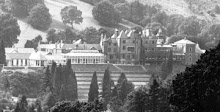
The photographs show two views of Kensington Hospital (given to the Association for use as a sanatorium by the 6th Baron Kensington) in about 1930.

Thursday, August 14, 2008

‘Reds under the Beds’- Dr Jarman

Dr Carole Reeves writes:

Byron Sambrook described Dr Jarman as an ‘out and out communist’ when he was a patient in the 1940s, and Jarman was indeed a paid up member of the Communist Party, as I discovered in his file at the National Library of Wales.

Dr Thomas Francis Jarman qualified at Durham University in 1927 and went to America on a two-year fellowship. Afterwards, he worked in several British sanatoria including Glan Ely, near Cardiff, at the same time as Dr Williams (1934). In 1938 he wanted to stand as councillor for the Bridgend Labour Party but was stopped by the Welsh National Memorial Association. He then tried to organise an exhibition of Russian photography at Neath Library, which the Town Council barred as being ‘propagandist’. He was a member of the Socialist Medical Association of Great Britain in 1941 along with a number of prominent TB experts including Philip D’Arcy Hart (who ran the Streptomycin trial in 1947).

Dr Jarman went to Craig-y-nos in 1941 to replace Dr Doherty who had joined the army. Four years later, having unsuccessfully applied for a number of jobs and been (as he saw it) passed over for promotion within the Association, he was asked by the Neath branch of the Communist Party to stand for election to Neath Borough Council. Once more, he was prevented and subsequently applied for a post in New Zealand, which he didn’t get. Eventually, in 1946, he was awarded a Fellowship to research TB in the USA, a place with zero tolerance of communism.

Jarman’s important contribution to TB was his ‘letters from America’, reporting the first uses of Streptomycin to the Medical Research Council (MRC) Streptomycin Committee. The Committee praised him for providing ‘the best and most up to date information which they have so far received on the subject.’ The MRC’s Streptomycin trials began in England and Wales in January 1947, and in February Jarman wrote to Dr Tattersall at the Association: ‘I am anxious to impress on you that we should fight for the maximum amount of Streptomycin that we can possibly get, and that we should be included in a liberal way in any Streptomycin studies that may be started at home.’ In fact the British government could only afford to buy 50 kg of the antibiotic from the USA at a cost of $320,000, a huge sum of money in the post-war era, and only 100 patients went into the trial, half of whom received Streptomycin.

Wednesday, August 13, 2008

Carole Hughes (nee Davies)-visit to exhibition


Carole, age 5, Craig-y-nos 1951-54

Carole Hughes has just sent me this email:
"On Saturday August 9th I went to Swansea museum to the exhibition I did enjoy it even though it rained so heavy outside. I met nurse Valerie Brent that was so lovely and I spoke to her.
There were a few visitors there. They were emotional seeing how we were and they all wanted to put their arms around me which was a big change from the time we had TB .

I was the first of the old patients to go back to Craig y nos in 2004 I went there twice and could not face going there again but I will be there for the launch of the book."

It was Carole who first suggested to me that I should write a book about Craig-y-nos, something I put off for over a year until a return visit finally spurred me on when I discovered that there was nothing, absolutely nothing, known about the time it was a children's TB sanatorium.

(N.B. Carole was also in Sully.)

Patti’s glass conservatory


Dr Carole Reeves writes:
This is a photograph of the glass conservatory as it was in about 1900 and used as a dining room by Adelina Patti for her numerous weekend guests including the Prince of Wales, later Edward VII.

This picture is from a very elaborate brochure which Patti had prepared for the auction of Craig-y-nos on 18 June 1901. As we all know the estate wasn’t sold, whether because she changed her mind or because there were no buyers, I haven’t yet been able to discover. In any event, when the Welsh National Memorial Association purchased it for a TB sanatorium in 1922, it’s clear that they considered it to be little more than temporary accommodation because of its unsuitability as a hospital. In 1937, the normal bed capacity was 126. The maximum capacity was 176. These additional beds could be found by crowding, which gave an additional 30 beds, and equipping other existing accommodation, which provided an extra 20 beds.

By 1939, when it was first proposed to construct a purpose-built hospital at Singleton, Swansea, the Association was not keen to spend money on Craig-y-nos. It noted that: ‘Better staff accommodation will have to be provided if the institution is to be retained, but the wisdom of spending more money on keeping and extending and improving the institution is seriously doubted.’

The hospital soldiered on for another 20 years, being patched up and painted but it appears that no serious money was thrown at it. The picture below is from an Association publicity brochure of about 1932 showing Patti’s glass conservatory as we all know it but it’s one that I don’t think we have in our vast collection.


The Glass Conservatory as a Children's Ward- circa 1932

Tuesday, August 12, 2008


The Mystery of the Missing Marmite


Dr Carole Reeves writes:
Does anyone remember having Marmite in Craig-y-nos? No? Well, perhaps that’s not surprising because I’ve uncovered a series of angry letters from The Marmite Food Extract Company in 1938 to the Welsh National Memorial Association as follows:

‘… we have been receiving a considerable number of complaints that 1 lb tins of Marmite supplied by us in your district have found their way into the homes of private individuals and we fear, therefore, that there is some source of leakage in your organisation and as a result, the purpose for which we supply you with our product in tins, ie. for the benefit of hospitals, institutions, etc. is not being adhered to.’

Was there a black (pardon the pun) market in Marmite? After a steely silence in which the Association investigated this accusation of sticky-fingered staff, it wrote back:

‘Under our regulations and contract specifications and conditions, members of the staff of the Association (whose organisation includes 18 hospitals and sanatoria, and some 100 dispensaries and visiting stations throughout Wales, with a research laboratory, educational campaign, and the central administration) have the right to be so supplied, for their personal use, at the contract price applicable to the Association.’

Surely a case for the Marmite soldiers to be guarding the stock …

Monday, August 11, 2008

National Library of Wales, Aberystwyth


National Library of Wales

Dr Carole Reeves writes:
As you’ll all know by now from the new stories emerging on the blog, I spent a week in the National Library of Wales, Aberystwyth, researching the final archives for the book. I’d like to thank Beryl Evans and her colleagues for making it possible to get through an enormous amount of boxes, volumes and files of archives in such a short time.

I’d never been to Aberyswyth before so it was a treat even though I was working. The Library is a beautiful building with great exhibition space – there were four exhibitions on during the week I was there – an ideal venue indeed for ‘The Children of Craig-y-nos’.

Sunday, August 10, 2008

Highland Moors- old boys return

Jeff Green, the new owner of Highland Moors, says:

" We have had about 25 of the boys come back and visit; we have their names and addresses.
We believe that Highland Moors was a sanatorium from 1932 to 1957."

Many thanks for this info. Jeff.

Friday, August 08, 2008

Highland Moors TB sanatorium


Highland Moors

Dr Carole Reeves writes:
A number of boys including Clive Rowlands and Haydn Beynon were sent to Highland Moors, at Llandrindod Wells, after their stay in Craig-y-nos, but couldn’t recall many of the details other than having a much better time with more activities. I managed to find some information on Highland Moors from various files in the National Library of Wales, including a publicity brochure produced by the Welsh National Memorial Association in about 1932.

Highland Moors was a private hotel in 28 acres of ground, which was sold at auction on 31 July 1931 and purchased by the Association. It housed sixty boys and staff, and was intended for the treatment of boys with TB of the lungs and bones who did not have active disease (in other words, they weren’t infectious) or who were convalescent. The institution consisted of a large central building which provided administrative and staff quarters and sleeping accommodation for the boys. A school and gym were in a separate building. The Association may have purchased additional land because the brochure mentions the grounds being sixty acres, which offered ample scope for recreation and for possible future developments.

Highland Moors is now a guesthouse which describes itself as a ‘former Victorian hydro spa hotel’
HighlandMoors – no mention of its use as a TB sanatorium. Perhaps someone would like to give a history lesson to its current owners.

Byron Sambrook- ex patient- 1943-45

Byron Sambrook has sent a further email as more memories come flooding back:

"Boys were not allowed out into the grounds on a regular basis but I do remember being on the bridge and looking back at the hospital on one occasion but that could be my imagination ."

Thursday, August 07, 2008

Byron Sambrook- more information


A further email from Byron Sambrook:


One winters night we were all woken up by a unholy row only
to be told in the morning that a fox had killed the swan, or swans,
and all that was left was a load of feathers.


On another occasion we dared a boy to go down to the bridge over
the river and when he got there he had to flash a torch to let us
know he was there. He climbed down the pillar of the balcony (there
was no stairway) and ran down all the way and a light flashed, he
came back, climbed up onto the balcony, all for a bar of Cadbury's
chocolate.

There was a large search the following morning as the
light had been seen and reported and poachers were suspected.

I don't remember being restrained for misbehaving but something
happened to me which i still remember, that was having my toenails
cut by a Nurse Davies and they were cut so short that my three middle
toes on both feet bled quite profusely and to this day I have a
double nail on each of these toes.

The boy who moved to Highland Moors with me was a David Schickle
from Maesteg. I met him about twenty years later while we both
worked at steel company of Wales.

At 77 years I am lucky inspite of a lobectomy on my left lung, TB
scaring on my right lung, TB spine, 2 hernias, high blood
pressure,angina and dupretons contractions on both hands.

My wife and I celebrated our Golden Wedding two years ago with a
cruise . We have two fine boys the eldest has been working in
Shanghai these past 5 years and is now in Muscat with his family.
My other son is also married with one daughter and has his own business."

Wednesday, August 06, 2008

Byron Sambrook- ex patient- 1943-45

I was surprised when my doctor informed me
that there was an exhibition in Swansea museum regarding Craig-y-nos.

I have been to see it and it was very interesting, but there were no photographs of my era as I was a patient there between 1943-45.

I first went into 'white ward' then out onto the balcony where I spent the rest of my stay. It was during the war years and of course there were no cameras and therefore no photographs.

I remember Nurse Davies. There was also a Sister Fischer there who was a Swiss subject and could not return home, she was a charming woman and spoilt us rotten, and when another patient and I was moved up to Highland Moors in Llandrindod Wells she accompanied us by taxi.

The Doctor was a Dr Jarman, he was based in Neath and visited
regularly, he was an out and out communist in those days but he had mellowed by the time I got home and visited the chest clinic in Neath.

There was a older boy there called Len Smalldon, from Swansea,
who had open wounds on his hands , face and leg, and he had to have
several operations while I was there and he screamed the house down
when they changed his dressing.

Other patients were on iron frames, sometimes for years...
the exhibition brought back old memories.

Sunday, August 03, 2008

National Library of Wales , Aberystwyth

Dr Carole Reeves was in Aberystwyth for the past week doing research in the National Library of Wales into the Adelina Patti hospital for the "Children of Craig--nos" project.

It has thrown up some gems of information, particularly regarding staff.

Soren Hayes-ex-patient and visitor to exhibition

Soren Hayes, who was in Craig-y-nos as a three year old, called in to see the Swansea exhibition. He told Valerie Brent that he has few memories at all of his time there.

He believes he caught TB from an aunt who came to live with them so that his mother could nurse her. She went into Craig-y-nos and later died there.

Dr Reeves says it was quite common for children to pick up TB from sick adults in the house.

Thursday, July 31, 2008

The visitor wrapped in newspapers

Here's a story told me by Pamela Hamer which encapsulates just what it must have been like for so many parents struggling to visit their children in Craig-y-nos during the winter.

"My friend had a sister in Craig- y- nos. Her Name was Phyillis Anne Smith. She went in as a 2 year old and came out when she was 8 it was in the late 1930s.

One cold winters day her mother was on the bus and she could hear rustling.
After a while she was wondering where the rustling was coming from, and a man on the bus saw her looking around and he said:

"I'm sorry the sound is coming from me, I have had to line my body with news papers to keep me warm as I am going to visit someone in Craig-y-nos."

Pamela Hamer( nee Osmond) -exhibition


Pamela Hamer with her husband at the Swansea museum exhibition:"Children of Craig-y-nos"

Pamela tells me that she is going to invigilate the exhibition today.


"I will make sure everyone signs the Visitors Book."

Wednesday, July 30, 2008

Shingles! and Children of Craig-y-nos project

Thank- you to all who have enquired about my welfare after hearing I had shingles. Well, six weeks later I am hopefully cured though a bit of pain still lingers on.

It came as something of a surprise because I consider myself to be very healthy. However, it was also something of a wake-up call when I discovered that there is a stress element to shingles and I realise that the time has come to begin closure for the" Children of Craig-y-nos" project. During the past two years I reckon I have either interviewed, spoken to, emailed 150 people mainly ex-patients.

Their stories have often been harrowing, far worse than anything that I had anticipated from even my own experiences though I was in Craig-y-nos for four years.

Digging up the past is bound to be painful. Perhaps I was naive in not anticipating this. But I am not alone.
Journalist John Sutherland who wrote his own childhood memoir, The Boy Who Loved Books, described the experience :
" I had, it seemed, stirred up a lot of mud writing the book - woken a whole pack of sleeping dogs."

For me it has been as if I had opened a door into a ward full of screaming children:"take me home!" Fifty, sixty even seventy years after leaving Craig-y-nos those early traumatic memories for some people still remain fresh, as if it happened yesterday, in their minds.

That was a shock.

On the positive side though it has put me in touch again with my Welsh roots and I have met some lovely people.