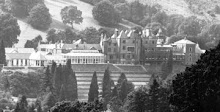
Graham Canning, age 67, tells his story of the years he spent as a child in Craig-y-nos:
"I
recently saw the BBC "One Show" about Craig-y-Nos . I too am a past patient spending nearly
five years there.
(3rd
June 1948 to about 8th March 1953.
I
contracted TB in the left knee, which then spread, to my right hip. “
 Photos show Graham not only in
a plaster cast but with his hands tied to the bed too because he had worked out
how to undo some of the shoulder straps tying him down.
Photos show Graham not only in
a plaster cast but with his hands tied to the bed too because he had worked out
how to undo some of the shoulder straps tying him down.
However,
after sorting out my left knee my Mother brought clothes to bring me home and
was told that I had collapsed when walking and investigations discovered that
the TB had spread to my right hip. After 2 years of my parents were
devastated. The right hip was now a different matter to the left knee
however. By the time it was detected the TB had all but destroyed the hip
and the doctors had to fuse/lock it. This meant that I have very limited
movement of the hip.
Also
I was also left with a shorter right leg.
Many
of the comments on the One Show I recognized. My parents also could only
visit once a month. There were quite a few visitors from the Cardiff area
and I recall my Father telling me that the Cardiff bus used to miss the Swansea
connection to Craig-y-Nos by 5 minutes. So my Father spoke to the Swansea
bus company and they agreed to change their timetable to meet the connection.
It
is perhaps worth recording the tremendous power that the doctors held then.
My parents were told that when I eventually came home I would need a lot
of care and attention. In fact so much that they should not have any
more children so that they could devote all their time on me! So I
became an only child. I don't know the name of the doctor, my Father
thought her to be foreign. (This would be Dr Hubbard the Austrian-Jewish
refugee).
 I
was tied with straps to the side of the bed but because I used to strain to
reach and then undo the knots they moved the straps to the rear of the bed over
my shoulders and through the springs of the bed well out of my reach - and that
was that! I remember the straps coming from a corset type jacket around my
body.
I
was tied with straps to the side of the bed but because I used to strain to
reach and then undo the knots they moved the straps to the rear of the bed over
my shoulders and through the springs of the bed well out of my reach - and that
was that! I remember the straps coming from a corset type jacket around my
body.
I
remember during the early stages of learning to walk clambering to the end of
my bed in anticipation when I smelled the polish on the leather of the boots
forming part of the calipers and hoping they were coming to me.
My Parents
My
Mother never really got over my illness and the length of time I was away.
Her everlasting memory of when I first went to Craig-y-Nos was of me
being carried away in a nurse's arms with me looking back over her shoulders
crying with arms outstretched reaching for her. All her life she informed
others that I was in hospital for 5 years. It left a mental scar, which
remained with her all her life.
Me
With
regard to contracting TB I have always considered myself lucky. TB at
that time was a killer and many died because of it. Those that died in
the main had the disease in their breathing system, in particular their lungs.
Even if they survived it was likely that breathing problems could occur
later in life. My problem was physical and was simply a case of adapting
and getting on with it with little risk of problems in later life. To date that
has been the case. I've led a very active life, playing sport at a high
level, in particular badminton and can do all the things, like swimming, riding
a bike etc. that doctors thought not possible. Although I was playing
badminton at a high level my hip frustrated me and I sought advice from a top
consultant to ask if there was any way I could change my situation eg. lengthen
my right leg and replace my hip with a new one.
But
he said there were no realistic options and it was a miracle that I could play
sport at the level I was playing without any discomfort that I should send the
surgeon who did the operation on me as a teenager a magnum of champagne.
.
When
I first came out of hospital my parents/family suggested I should have a wheel
chair but I was having none of that. They say we are all products of our
environment and upbringing and that was certainly the case for me.
All
my friends were keen on sport, one a good footballer, another a good runner,
another a good wrestler, etc. and children being what they are you either
compete with them or you are left behind. It was great character building
and with my positive outlook on life and total disregard to my disability (eg.
on school sports days I was always on the starting line for races knowing I was
going to finish last!) has stood me in good stead all my life.
At
14 years of age I had a further operation in a Cardiff hospital to take a bone
from my shin which was placed in my hip thus increasing the length of my leg.
But for that operation my right leg would now be two and a half inches
shorter instead of the one and half it became and still is. So what has been
the effect on the family? Nevertheless I played all sports, as I grew
older, playing badminton at a high league level, coaching and managing the
Welsh U14, U16 & U18 Welsh national junior squads.
Finally,
my coming home was a strange event. My parents rang up one day and asked
if they could look after me at home.
The
Sister said she would speak to the doctor and for Mum to ring back later.
So Mum did and the hospital agreed and told Mum to come and get me, just
like that!!!
Graham
remembers the huge party at his house to welcome him home and people coming in
and throwing money on to the bed for good luck. “The whole street was there. In
those days there was a strong community spirit.”
Coming
home had its problems. He wasn’t used to doors and he used to run in and out of
peoples houses.” If my mother smacked me for being naughty I would say:” I am
going to tell sister in you.”
The
family lived in Grangemouth, Cardiff where his father worked on the docks as a tugboat
skipper
He
says his father used to buy cheap unpasteurized milk from the docks.
(Graham is unaware until I tell him that unpasteurized
milk is the main source of TB of the bone).
As
a ten-month-old baby he had Pinks disease (caused by mercury poisoning) and he
is lucky to have survived it only to go down with TB of the bone 18months
later.
At
9 years of age he was hospitalized again after falling off his bike where the handlebars
ruptured his stomach and led to the removal of his spleen.
But
despite all these early setbacks Graham was determined to make something of his
life.
“
I was lucky. I was born with the right attitude to life,” and so it has proved.
Today
67 year old Graham is a retired Civil
Servant and he continues to lead a very active life: he plays badminton twice a
week and goes dancing (rock ‘n roll and jiving) with his wife every week in
Cardiff. They have two daughters.
"The Children of Craig-y-nos" by Ann Shaw and Carole Reeves, published by the Wellcome Trust for the History of Medicine, price £9.99 is available from Amazon online.


 So far they have raised £780 of their £1,000 target


 Photos show Graham not only in
a plaster cast but with his hands tied to the bed too because he had worked out
how to undo some of the shoulder straps tying him down.
Photos show Graham not only in
a plaster cast but with his hands tied to the bed too because he had worked out
how to undo some of the shoulder straps tying him down. I
was tied with straps to the side of the bed but because I used to strain to
reach and then undo the knots they moved the straps to the rear of the bed over
my shoulders and through the springs of the bed well out of my reach - and that
was that! I remember the straps coming from a corset type jacket around my
body.
I
was tied with straps to the side of the bed but because I used to strain to
reach and then undo the knots they moved the straps to the rear of the bed over
my shoulders and through the springs of the bed well out of my reach - and that
was that! I remember the straps coming from a corset type jacket around my
body.